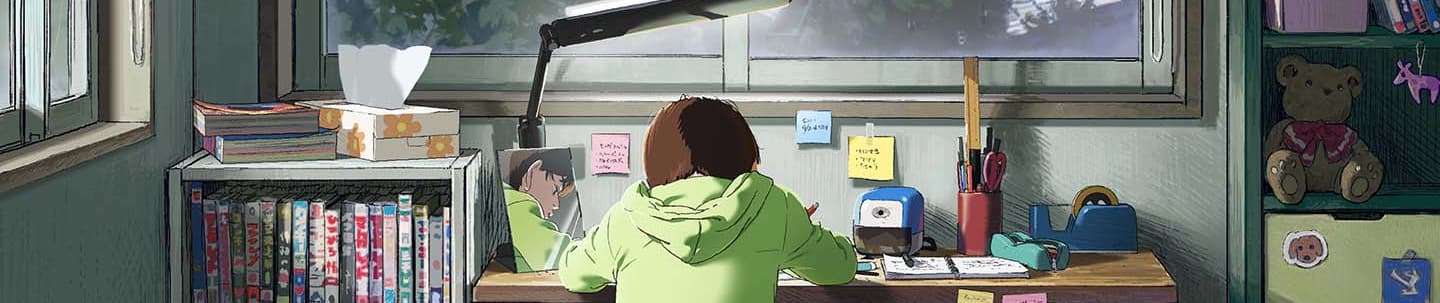
When artists write an internal analysis of their own field, through the same art form, we expect it to be good. When writers write about what it takes to write, or manga artists make a manga about what it takes to make manga, it better be the great. Otherwise, what right do they have to tell this story? Look Back doesn't disappoint.
Look Back is about building a skill over years, with a mountain of effort. It's about the motivations and discouragements along the way. It's about ego and jealousy, but also cooperation and deep friendships. What starts out as a fun grade-school project becomes a foray into studying and practicing drawing to measure up to this mystery student's superior art. After five books on drawing, two years, and ten notebooks, she feels like she is ready to quit; having achieved a satisfactory result and an end to the grade-school manga submissions. What she finds at this mystery student's house is not ten, but hundreds of notebooks knee-deep with a narrow path to her bedroom door. A manga master, who turns out to actually be her fan!
The rest of the movie touches on but does not expand on various themes: genius vs hard work, cooperation, and how long it takes to do something great.
This accurately depicts the gritty relationship anyone aspiring to learn a difficult skill will have with his work, with others, and with himself. Whether it is art, music, programming, learning Japanese, or something else, this film nails it.
There is a cottage industry of these "main character learns X" type stories, but I wouldn't consider this a part of that genre. It's about getting really good at something, and what that lifestyle looks like. But it is also about the real work that is requied to make something out of that skill afterwards -- networking, convincing you help to stay along for the long-haul, interacting with publishers, fitting in with the marketplace. It's not just about learning to draw, it is about learning to work and become independent in society. The side-character is the quintessential non-productive genius, who cares deeply about being good at the drawing, but can barely string a sentence together and has no hope of gaining economic independence. The main character -- she is never as good at drawing, but runs a business and takes all the credit for the work, knowing that it simply isn't the case. She is bound by all these internal and external factors, while the side-kick is much better at drawing and doesn't even consider them for a second. Seeing how these two interact is a very informative experience.
Is it better to care entirely about being a master, or is it better to aim for "good enough" and instead employ the help of others to make things happen? Is it better to stop at 10 notebooks of practice or hundreds? I wish that I knew how to apply these lessons in my own life.
37 out of 38 users liked this review
