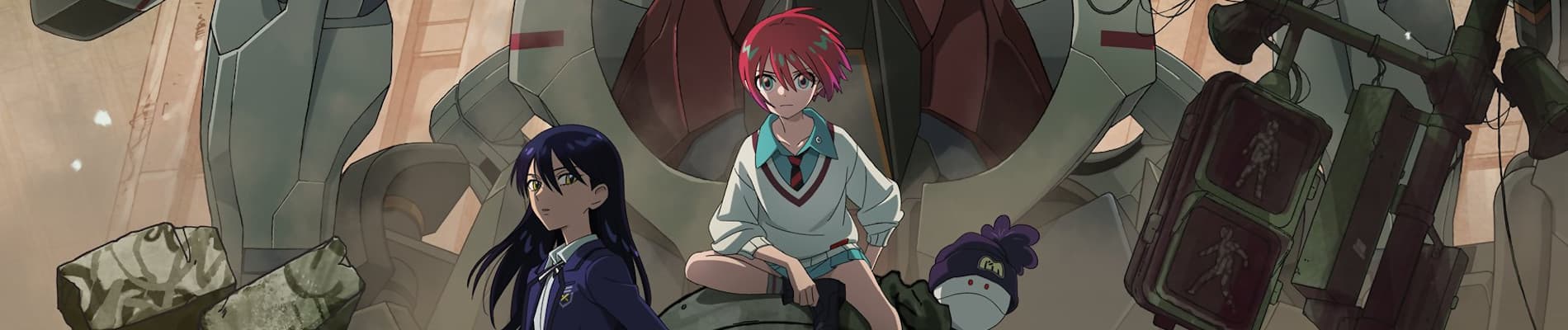
Gundam GQuuuuuX is an ambitious alternate timeline narrative that expands upon the ideas and themes of the original Mobile Suit Gundam. While it has plenty of interesting things to say, combining more developed ideas from later works like Zeta Gundam with insight from almost half a century of re-examining the source material, it is also attempting to fit an immense number of ideas into a mere twelve episodes. Just covering the political complexities of Zeon winning the One Year War, with the unravelling hypocrisy around their ostensible ideology and the dysfunctional government of the Zabi family, could be an entire series unto itself. But in addition to that, GQuX also wants to explore ideas surrounding the Newtype condition, both in how it shapes individuals and their relationship as a group to the rest of society. Unfortunately, this overload has resulted in significantly rushed characterisation, with the more personal and emotional beats between the new cast feeling like they only have the outlines of their relationships and arcs present. All while the mechanical plot also feels like it lacks the time to full explore the intricacies of its moving parts and build up more tension before its climax. Nevertheless, GQuX still manages to squeeze out a surprising amount of depth in its run time by loading many of its scenes and dialogue with significant implications that can be inferred by those with knowledge of other Gundam shows. While intertextuality is necessary and arguably the entire point of its premise, it would understandably be alienating for first time viewers since the synopsis does not warn them nearly enough about this, all while the emotional arc of the new characters cannot fully compensate for it. This all leads to GQuX being more compelling for its developments on the ideas of the Gundam franchise rather than the new characters successfully asserting that this is their story. While what is presented right now is certainly polished with an immense potential, it is abundantly clear the story cannot be fully realised in only twelve episodes because of the sheer magnitude of its aims.
The concept of exploring the hypothetical scenario of Zeon winning the One Year War and its consequences is as old as the Gundam franchise itself. Some of these ideas have ranged from frivolous to unsavoury given what Zeon represents, but the premise itself does have its usefulness. Put succinctly, an outcome can only be as important or meaningful as the possible alternatives to it. The extent of insights gleaned from counterfactual thinking does have its limits in real academic fields, but in the case of fiction, these what-if scenarios can be written to essentially be just as “real” as the canonical timeline. This allows GQuX to make larger points without necessarily dedicating a significant amount of screen time to them, such as showing how Side 6 is effectively under Zeon’s boot. Refugees from other space colonies are treated as undesirables despite being fellow spacenoids, and the government of Side 6 is subject to Zeon’s intrusions due to the power imbalance rendering them little more than a satellite state. This alone makes a strong impression on the viewer beyond simply confirming the authoritarian nature of Zeon under the control of the Zabi Family. It also demonstrates the merely hypothetical point made in other media like Zeta Gundam, that spacenoids would be oppressed by either side of the conflict, be from a victorious Zeon or the Federation’s Titans. This then raises the question of what possibility there ever was for change, who or what is to blame for impeding it, and whether this is simply inherent to the political situation of humanity evolving into a spacefaring society. All of this does rely heavily on knowledge of the source material for it not to feel like mere set dressing, but it is hard to claim that these pieces of information were not added for a specific purpose. Either meant for some implicit comparison or to leverage the source material to create depth, like with how Nyaan is mentioned to be from Side 2 of all places. Yet the complexity of the setting is certainly not utilized to its full potential. The is never much time dedicate to exploring the politics of Side 6 or the experience of the refugee population despite both having direct connections that could reinforce the characterisation of the main cast.
This sheer lack of screen time also extends to examining the instability of the Zabi family and the power structures within Zeon. The idea of the Zabis falling into infighting once they lacked an external foe is compelling for anyone familiar with the One Year War since it was one of the obvious dangers of them winning. While the gist of the power struggle between Kycilia and Gihren is understandable, even to a viewer with only a rough memory of the source material, it is still incredibly ill defined beyond a mutual personal hatred and wanting power for the sake of it. That is certainly enough to spark a conflict, and speaks to the dangers of authoritarianism vesting power into only a few people with no other checks, but it does not give a good sense of what elements of the Zeon military or government are loyal to which faction and for what reasons. Eventually there is some semblance of clear battle lines being drawn with how Kycilia’s forces extensively use Newtypes like some kind of elite wunderwaffe while Gihren’s conventional forces still dismisses their existence. But there is simply not enough built up surrounding this conflict to have a good sense of tension or escalation before the climax of the plot. In fact, it takes a remarkably long time for the show to outright state something as important as Degwin having died prior to the start of the main narrative. Part of this is due to Chalia Bull being the main Zeon perspective the show follows, who is loyal to Char’s ideals and a sort of third pole in the intra-Zeon conflict. While this gives the viewer extensive insight to Chalia as a character, at least relative to others in the series, it leaves the wider tension within Zeon feeling formless. There is some tension or dread derived from the wider conflict being partially unknown, but it cannot compare misses the opportunity to buttress the show’s other political themes by exploring more of Gihren and Kycilia, or at least Chalia and the average Zeon soldier’s perception of them. It might have been better to take some time to better spell out who the two of them are and what the political status quo is, even if it did have to retread some information from the source material like how the Zabis hijacked the Zeon independence movement for their own gains.
Instead, a significant amount of narrative time was spent covering this timeline’s point of divergence during the One Year War. Granted, all of this is tremendously entertaining for an established fan with all the mech combat and visuals of the entire series being highly polished. But it does start to feel overindulgent considering how the entire second episode was dedicated solely to this objective. It raises the question of whether this time could have been better used considering the rest of the show relies so heavily on knowledge of the source material that it is not particularly effective means to catch up first time viewers. Some of the details in how the story diverges from 0079 and its immense focus on Char’s role in the war are load bearing considering how much his legacy weighs upon the rest of the story in more ways than one, yet there is limited utility beyond that. GQuX does delve somewhat into the idea of MAV tactics, but it is apparent that this is mostly a narrative device to help better frame the mobile suit combat since it is essentially an analogue for tactics and cooperation with a wingman. This has always been present in Gundam, and has always been somewhat necessary as part of choreographing a fight with multiple mobile suits, but it is simply the firs time that so much attention has been drawn to it. While more effort could have been made to sustain the focus on this concept as the series stretches on, the fixation of some fans on this being a lynchpin narrative idea perhaps speaks more about their preoccupation with the military minutia and technicalities. All this does at least aid in characterising Chalia Bull, and when combined with scenes later in the show gives him an extensive amount of depth in showing his ideals, contradictions, and change of heart when it comes to the Zeon cause. This reaches a point where he could be considered the most fully realised character in the series, even when compared to Machuu.
This presents something of a problem since the show is ostensibly meant to be primarily Machuu’s story, with her, Nyaan and Shuji forming the core trio that emotionally anchors the narrative. The framework for their arcs and relationships are apparent enough if a viewer goes deliberately searching for it, with how Nyaan’s status as a desperate refugee and Machuu’s listless rebelliousness are major elements to their characters. Yet this is never explored and only demonstrated indirectly, which while praiseworthy as effective writing, can only go so far before there simply needs to be a more overt examination to achieve depth or emotional resonance. The scenes between Machuu and Nyaan have their charms thanks to a strong performance by their voice actors and the animation team, but they are rarely used to bring out more of their characters. In particular, it is disappointing that Nyaan being a refugee is used almost exclusively to further the plot instead of it creating an emotional conflict, either within herself or with others. Conversely, Machuu’s sheltered upbringing is never made into a point of envy or even distance between her and Nyaan despite it being some obvious grounds for exploring what is essentially class differences between spacenoids and the consequences of war. There is some effective characterisation that highlights Machuu’s desire for freedom and to chart her own path, but it reaches a point of appearing almost petulant with how the show can only afford to have brief scenes of it that preclude any detailed exploration of her feelings. It is still a decent set up for Machuu being in over her head, but it does not effectively bridge the wider political narrative with the more personal story between the teenaged characters, perhaps through something like Machuu’s mother insisting that life is difficult outside of Side 6 which could then give us some insight into Machuu’s naivety or rebelliousness. All this ends up leaving the character’s traits and arcs to be more implicit with little being done to highlight them to the viewer. While this could be argued as subtle storytelling, the issue is that indirect means of characterisation simply require more time to build up then something overt. Which then presents a major problem when these underemphasised character elements are used as the basis for actions that propel the plot forward, like with Machuu’s rebelliousness or Nyaan’s isolation and desperation. The lack of emphasis on their characters and how it affects their agency leave events just seeming to overtake the cast with little emotional payoff.
What we are left with is the core of the connection and conflict between Machuu and Nyaan being founded upon their responses to the Newtype experience, and Shuji effectively being used more as a symbol or plot device for this than being his own character. While it does serve to provide compelling insight into existing as a Newtype, with this heightened connection also potentially being a curse in how overwhelming and dependent it can make an individual feel, it is hard to say it is compelling on a character level with how much it focuses on the external stimulus of “Kira-Kira”. The idea of “Kira-Kira” itself, being a sort of representation of how Newtypes perceive the universe like some higher reality that can connect them across time and space, is generally compelling and effective. But the issue is that this becomes the overriding focus of Machuu and Nyaan’s character actions which leaves everything else by the wayside, likely as a result of simply lacking time to dedicate to other character elements. This does appropriately coincide with the show’s pivot in the latter half of its season that effectively escalates its stakes, executing a mid-season climax that irreversible shatters the status quo of playing around at Clan Battles and being delinquent teenagers. While it does not suffer the issue some other Gundam shows have of still trying to return from paradigm shifting moments for more lighthearted episodes, it cannot help but feel like GQuX simply needed more time to build up towards this. The pacing and position of this pivot within the structure of a twelve episode series is by all measures effectively placed. However, the sheer magnitude of ideas being crammed into it leaves it feeling rushed since there has been an inadequate amount of foreshadowing to build up tension for so many moving parts. In particular, with how pivotal the ideas around the “Kira-Kira” becomes, it would have been better if there were more hints to it not merely being a symbol. Perhaps through some concrete discussion between the characters on its possible nature, or even them being granted some premonition or insight that would demonstrate it is clearly beyond the classic Newtype intuition viewers are familiar with.
Beyond that, discussing much of the second half of the season or the climax without giving anything away is relatively difficult. To use more vague terms, the pay off for all these ideas coming together is spectacular when viewed as a sci-fi fan who is interested primarily in seeing high concepts being executed. Though less so from the standpoint of it being an emotionally compelling culmination the various character arcs. There are interpersonal conflicts that underpin the wider climax, but relative to the magnitude of events transpiring in the plot, they simply lack an adequate emotional build up or investment to be particularly compelling, at least for the new characters introduced. Legacy characters that return to the narrative do have an tremendous emotional punch to them, but that is due to GQuX essentially leveraging their extensive preexisting characterisation and story, which alleviates a lot of the set-up work required within the show itself. While the eventual trajectory of the show does spark tremendous interest on the conceptual level and effectively serves the larger themes at play, it does also leave the political angle of the story underserved since it essentially turns to focus on its Newtype ideas. But perhaps that is par for the course with the climax of a lot of Gundam shows. To be certain, there are interesting metatextual questions about how the Newtypes fit into the Gundam narrative, raising the idea of if they are simply a chosen few that can influence the story while everyone else has their agency negated or significantly diminished and what that means for a world with them. Yet, as emblematic of the show’s pacing thus far, these are more interesting as abstract concepts rather than being seamlessly tied to a particular characters' personal arcs. There is still a strong emotional punch to GQuX in its finale, but it relies heavily on its connection to the source material and viewers being both familiar and invested in the legacy characters. Although there is nothing necessarily wrong about this, and it proves effective regardless, it cannot help but feel somewhat incomplete because of how much of it ends up not really being Machuu or Nyaan’s personal story.
Overall, Gundam GQuuuuuuX attempts to be not only a development on the core Gundam narratives and themes but also something of a synthesis of the many ideas and iterations that have been put forward over the years. It has plenty to offer Gundam and wider sci-fi fans, particularly on a conceptual level with the ideas it invokes and explores. In fact, the moment the wider plot elements clicked into place to reveal how far GQuX wants to take its concepts was even somewhat comparable to the moments of revelation in far loftier sci-fi novels like Anathem, if much less cerebrally presented. However, despite already demonstrating an excellent amount of narrative efficiency with its limited screen time, there is just too much to squeeze into twelve episodes and no amount of deft directing or writing can likely remedy that. Emblematic of this is how all the character arcs and the themes around them are clearly set up, with the framework being incredibly apparent, but there were likely no narrative resources left to allocate for furthering them. Not to mention there simply not being enough time to let some weighty plot points or character moments linger and be developed over multiple episodes to lend them a proper amount of emotional impact. A twenty-four episode run would likely be enough to cover the ambitions of this premise with how much efficiency has been displayed in GQuX’s storytelling, but it is unfortunate that this choice was not made for whatever reason. But at least the setting seems open ended enough for some kind of sequel that could explore more of the political themes to do with Zeon and Newtypes.
As someone who is more interested in the idea side of a show, GQuX is a solid 8 out of 10 with how it clearly knows what it wants to say and how it wants to expand on Gundam’s themes and concepts. But it is also understandable if the characters being underserved by the narrative leaves some viewers feeling like it is difficult for it to be more than a seven. There might even be those who feel like they entirely lost the narrative because of how referential it is, but perhaps that is on how the series was pitched, not making it clear how reliant on the source material GQuX is.
30 out of 36 users liked this review