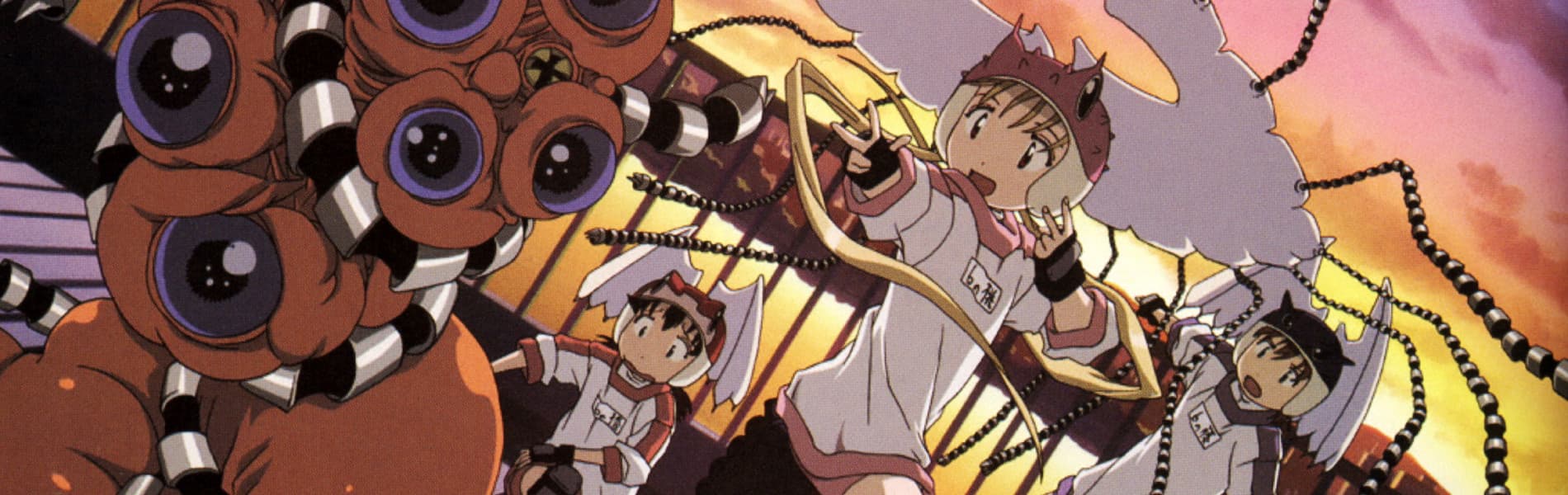
Alien Nine
a review by PollyannaQuixote
a review by PollyannaQuixote
Spoilers for Alien 9
An acquaintance of mine suggested that check out Alien 9 after reading my thoughts about FLCL, stating that the former had a resemblance to to the latter. I can see where he's coming from; both OVA series are early 2000's science fiction stories centered around children and aliens and both use said extraterrestrials as abstract metaphors for coming of age.
The similarities kind of end there, however. While FLCL is a much beloved series with unique animation and multiple follow ups, Alien 9 is a more obscure title, has a moe-art style emblematic of the time period, and is relegated to to this single OVA series, which even on its own feels unfinished. FLCL has a strange, punkish, but ultimately positive view towards adolescence and growing up, while Alien 9 seemingly posits that maturing into adulthood is the result of losing one's childhood innocence to the horrors of the world and learning to internalize that trauma.
To begin with, I would say the biggest problem with Alien 9 is that it is incomplete. The act of making an anime out of an unfinished story or only using part of a story is not inherently a bad thing; my last review was on Berserk, and despite that also being an unfinished story with an abrupt ending, it is still a very good show. Moreover, I don't want to imply that the presentation feels especially ugly or cheap or that they rushed the project out (though there isn't much to write home about, either). It's simply that the OVA series is only four episodes and those episodes only cover the beginning of the story.
Here's an admission; when I finish watching an anime or anime movie, I tend to take a brief look a the Wikipedia page for the property to get a quick recap of what I've seen, learn peripheral information about the work that might aid my understanding of the text, and check out thematic analyses to see if they align with my own (I try not to let these influence my writing too much). It was while looking further into Alien 9 that I discovered that the OVA series isn't a comprehensive retelling of the manga, just the first part of it. The final episode is even titled "The End of the Beginning". This is reflected in the anime most starkly by the abrupt heel turn of Kasumi and subsequent death of Kumi at the end of the show; what feels like an morbid ending for the OVA series is in the manga the beginning of the rest of the story as it begins to delve into more convoluted sci-fi stuff in the manga. I only read a plot summary on Wikipedia, so I can't pretend to be an expert on the manga's plot, but from what I read it seems as though many of the mysteries left hanging at the end of the OVA series are addressed in the manga. Notably, the OVA series doesn't give the viewer a lot of world building and sort of expects the audience to take what they're being shown as the norm within this universe. While I appreciate a narrative that forces the reader to come to their own conclusions by being cryptic and vague, and some of these answers can be inferred by the text, it feels in _Alien 9 _that this was not an intentional choice and more a result of the anime cutting those parts out for time or never reaching the point in the story where it is revealed in the first place. For instance, from my understanding the purpose of the Alien Party is to develop human-alien hybrids like the Principal and Megumi, and that can certainly be seen through their drill hairs, but it's never stated explicitly.
Thus I find myself in a pickle. I'd like to try to make sense of this work, give a guess about what it's trying to tell me, but I am always unsure if my interpretation is going to be limited by the isolated portion of the story I saw; I don't know if what I got from it is a proper reading of the text because I only saw part of it. However, I suppose I could say the same for my viewing of Berserk...a partial text is still a text, so here's kind of what I got from the four episode OVA series.
As mentioned at the start, Alien 9 appears to be an abstract metaphor for the pain and difficulty of maturing. It's kind of difficult to not at least touch on coming of age ideas in stories involving kids and teenagers, but Alien 9 takes a grim, violent approach to the idea, implying that adulthood is when the child inside of you dies from being assimilated with your hardships. The main characters of the series use a symbiotic alien species known as the Borg to protect themselves from Alien threats. The end goal of the Alien Party is to train and develop hybrid human and alien adults to create a more powerful race of people, though again, this is never explicitly stated. Therefore the Borg end up being an abstract representation of growing up, puberty, and the stress with comes with it.
In a rather uncomfortable pre-pubescent measurement taking scene, Yuri finds that she has grown a few centimeters since joining the Alien Party. Further she has attracted the attention of some of the boys in her class who had previously been latched onto by aliens. The boys, finding that nothing satisfies their interest as much as when they were connected to the aliens, gang up on Yuri and uh..."penetrate" her Borg with their aliens drills. The implications of this scene are harrowing. The point is however, in these scenes the Borg represents pubescence, causing those who it shares a symbiotic relation with to grow and experience hormonal attractions. In another sequence, Yuri has a nightmare about all of her classmates turning into Borg, chanting that everyone will graduate, and everyone will become aliens. While not literally the case that everyone will put winged salamanders on their heads, it is true that everyone will grow up and change, perhaps in a way that makes them unrecognizable, alien, to who they were as children.
The Borg also serve as protectors, nay, even guiding figures to the Alien Party, protecting them from danger and aiding them in their tasks. When the attached human becomes frightened, the Borg begins to lash out violently in order to protect it's host. This is a particular problem for Yuri, who spends 80% of the show hysterically weeping. Of course, biologically the symbiote would want to protect the host creature, but I do not think it is unfair to assume that in these scenarios the Borg represent adults who attempt to help and protect (often with great ferocity) the young in the hopes that they will eventually become self reliant adults themselves, here represented by the hybrid-Borg humans who can use the same attack drills the Borg do. It's also possible that these actions are reflective of the turbulent emotions children feel growing up; when they face hard realities of the world and experience unfamiliar feelings of dread and anxiousness, it can cause them to break down and fight back. Another interesting aspect of the Borgs is that assimilating with them gives everyone in the Alien Party telepathic responses to one another; when one of them feels fear they all feel fear. It seems to imply that the process of growing up is a shared experience, or even a collective trauma of sorts.
The last episode surrounds the Yellow Knife, this big alligator looking Alien that has consumed the most promising Alien Party member Kasumi. Sensing Kasumi's loneliness after the departure of her brother, Yellow Knife assimilates that fear into his defenses and attempts to use it against the other Alien Party members. Kumi managed to resist Yellow Knife's influence after her Borg assured her that he would always be with her. It's unclear whether this is meant to say that her relationships with others and their impact will be carried with her regardless of who she is with, or if she is stuck with her feelings forever. Yellow Knife's plan ultimately fails, but Kasumi and Yellow Knife fully merge together (again, implied in the show, explicit in the manga) producing a slimy and violent new Kasumi who strangles Kumi in retaliation for killing Yellow Knife. Kasumi will eventually kill her at the end of the show. If we look at Yellow Knife as a similar way to the Borgs, we can see Kasumi's actions towards her friends as the result of her rocked emotional state from her loneliness manifesting itself, her internal pain coming out in physical violence, to how similar problematic behaviors come out in adults who have unresolved issues from previous experiences.
I suppose that's my best crack at finding some meaning in Alien 9, but I must admit I don't feel super confident in my reading. It's a bit of an odd show; it's quite violent but doesn't really feel that way since almost all of it is against aliens and green blood doesn't make me feel as bad. The show is uncomfortable at times, but that's less to do with the tone or atmosphere and more due to the occasional "naked prepubescent" scenes and seeing Yuri balling her eyes out all the time. The third episode is almost entirely skippable; it's just sort of a summer vacation beach/episode in a series already strapped for time. And of course, the anime being an incomplete telling leaves the ending feeling dour and inconclusive and makes me question what the perplexing intent of the show was. I'm a pretty light reviewer and I did have a little fun with it so I'm not going to say to not watch the OVA series, but just that if you're interested in Alien 9 you might want to read the manga instead. I can't say I've read it, but it seems as though it would be at the very least more cohesive than the anime.
5 out of 7 users liked this review
