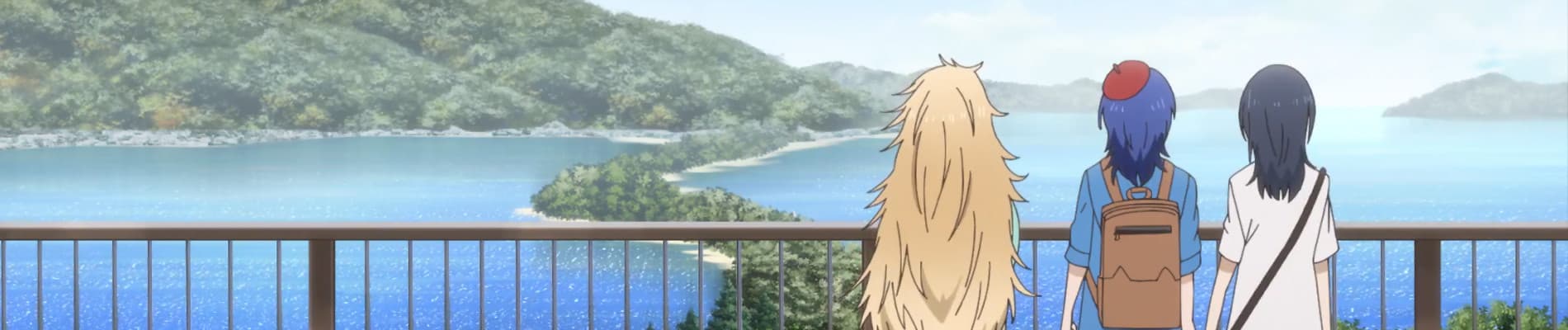
After watching the first episode of ZatsuTabi – That’s Journey, I initially thought, this would be a Laid-Back Camp clone. The wintery atmosphere, the blue-haired protagonist, sightseeing, mouthwatering meals, onsen and a calm narrator explaining random facts. It all screamed Laid-Back Camp. But what started as a familiar comfort anime ended up becoming so much more than I ever expected.
At the heart of this series is Chika Suzugamori, a young student just at the start of her career as a mangaka and already stuck. Her numerous story pitches keep getting rejected. But rather than wallow in frustration, she makes a spontaneous decision: she sets off on a journey. With no clear destination and only a Twitter poll to guide her direction, Chika heads into unknown terrain. It’s striking how she never lets setbacks defeat her. She’s scared, uncertain, sometimes regretful but she keeps moving forward. The 1000 steps she climbs in episode one become a powerful symbol of her path. She struggles, but pushes through. And when she reaches the top, no breathtaking view waiting, she laughs. Because she realizes: the goal isn’t the reward. It’s the journey itself, the one she walked despite everything. It may sound like kitschy, but ZatsuTabi sells that message with such sincerity and warmth that it feels completely earned.
A perfect example is episode 8, where Chika desperately searches for inspiration during her next trip, only to find it not in the landmarks but in the emotions she experiences along the way. The bliss of an onsen, the frustration of a canceled train, the joy of local cuisine, the anxiety of finding no room for the night, the excitement of endless stairs. Chika learns to feel these moments and that gives her the strength to move forward.
And that’s a central strength of ZatsuTabi: the show embraces spontaneity as a vital part of life, its chaos, its beauty. Chika’s choice to travel was a spur-of-the-moment decision and so were the destinations. And from that randomness comes everything: the joy of discovering unknown places, the disappointment of missed connections, closed shops, the wrong bus. Towards the end, Chika craves these moments like a masochist who fell in love with the mess. But that’s the charm: daring to take that first step into uncertainty, just like Chika did. We learn she’s always been a determined person, someone who doesn’t want to live with regrets and that trait pushes her onward. She overcomes setbacks and stands tall, smiling one of the most genuine smiles I’ve ever seen. And what makes her so lovable isn’t just her resolve, but that she never loses her inner child. She jokes around with her friends, devours food with joy, and soaks in more hot springs than anyone would. Even as she grows up, her playful side brings warmth and levity to the series.
Another reason Chika works so well as a protagonist is her realization of how different it is to travel alone versus with friends. When she’s by herself, she reflects deeply on her thoughts and emotions, evaluating her journey. With friends, she expands her horizons, developing new interests, like history and takes joy in sharing beautiful moments with the people she cares about. Both types of trips help her grow and find herself. And that hits especially close for me, because my favorite character of all time from a different anime reached the same realization and that gave me strength.
But what would Laurel be without Hardy? Batman without Robin? Chika without her friends? It’s not just our blue-haired protagonist who shines in ZatsuTabi, the whole cast brings healthy and heartwarming variety to every episode.
First there’s Koyomi, Chika’s best friend. Every trip with her promised joy, excitement and fun. Watching them goof around together is not only adorable, it shows how precious friendship can be. Yui, Chika’s Kohai, adds a mentor–student dynamic that brings Chika into a more responsible role as she cares for her junior. With Fuyune and Riri, the roles flip entirely. Chika becomes the student, learning from her senpai how to be a better mangaka.
What’s even better: the side characters grow as well. They’re not just there to support Chika, they have their own fears and dreams. We see that especially as their dynamics shift. In episode 10, for the first time, we see a vulnerable Koyomi, scared of being left behind as her friends start moving forward. That gives rise to a beautiful moment where Chika simply is there for her and together they let the magic of the journey inspire them. Yui, who worries she’ll never be able to stand on equal foot with Chika, learns to accept her role and is rewarded with a heartfelt invitation for another trip at the end of episode 3. Fuyune, who initially supported Chika alongside Yui in episode 8, is later supported by Chika in episodes 11 and 12 as she sorts her emotions and shows her caring side.
Then there’s Riri, someone Chika (understandably) first resented for her over-the-top drinking habits. But that resentment turns into respect when Riri proves she can be serious when it counts. Whether it’s abstaining from alcohol while traveling with the underage Chika in episode 7, jumping in front of a child who suddenly runs into the street or simply discussing manga ideas with professionalism, Riri earns her place. She even shows a romantic side in episode 12, taking a seven-hour train ride just to reconcile with Fuyune. Watching the cast evolve beyond their “supporting” roles was a welcome surprise. Some characters get more depth than others, sure, but in the end, every one of them brings something meaningful to both Chika and ZatsuTabi.
That said, I do have one criticism. The show often doesn’t give enough breathing room between trips. It frequently jumps from one to the next without pause. That makes it harder to let the previous journey sink in. This is especially noticeable in episode 5, when a beautiful solo trip ends, only to immediately cut to Chika’s next journey with Koyomi. As much as I love Koyomi, going from such a quiet, introspective moment to a lively duo doesn’t give the solitude time to resonate. I would’ve appreciated more moments of everyday life between trips, to really feel the impact of each journey. Still, I forgive it because in exchange, we got an incredibly emotional finale that tied ZatsuTabi together perfectly.
ZatsuTabi thrives not only through its characters but also through the immersion of its settings. The backgrounds are stunning, drawing you into every location as if you were really there. I especially loved how the environments were used to symbolize the characters. The 1000 steps in episode 1 represent Chika’s first leap. Steps appear again in episode 10, when Koyomi catches a falling child as she and Chika climb, a hint at her dream of becoming a teacher. In episode 9, there are no steps but instead, the rising and setting sun at New Year’s, marking the end of one chapter in Chika’s life and the beginning of another.
And then there’s the gentle soundtrack and art style, which together create a calm, thoughtful atmosphere without ever overdramatizing anything. Take Chika’s moment of realization in episode 8 when she climbs the stairs with her friends. There’s no big fanfare, no dramatic speech. Just a quiet “Wow.” Or Koyomi’s fears in episode 10, portrayed not as a life-or-death crisis, but as the quiet anxiety of a young adult still figuring herself out. ZatsuTabi is quiet and unhurried. It shows us how to cherish life’s small moments whether it’s secretly planning a trip to surprise your friends or taking a silly argument way too seriously because the bond means that much. Above all, Chika reminds us again and again that something as simple as a bath or a good meal can be incredibly special.
ZatsuTabi – That’s Journey is not just a Yuru Camp clone. Its older cast and more mature themes give it a different, more grounded tone. But what it excels at most is showing how Chika and her friends find their respective paths, step by step, quietly and earnestly. And if you ask me, this anime was a beautiful source of inspiration that proudly proclaims:
That’s Journey.
14 out of 15 users liked this review