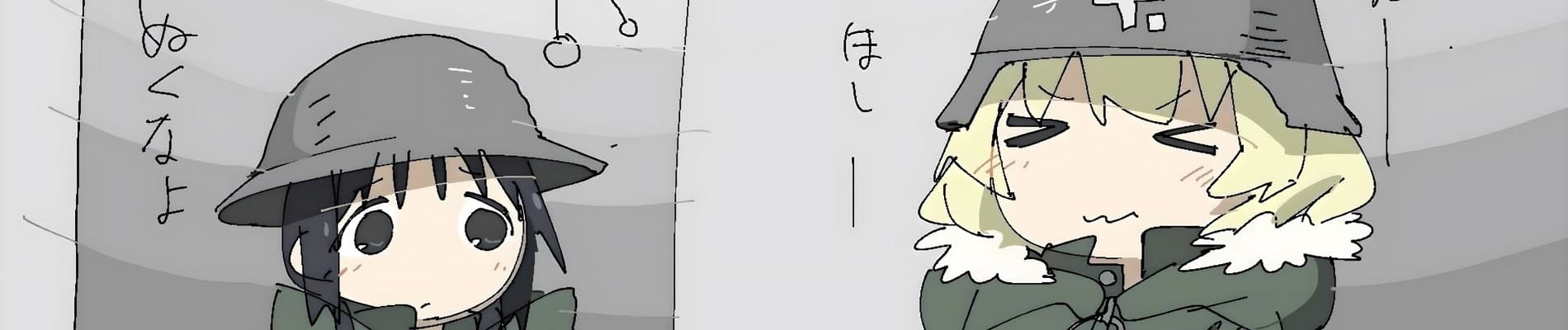

Girls' Last Tour is an exceptional manga. A manga extremely special to me. As the brilliant main theme of the series starts playing, the world awakens to brace our two protagonists Chito and Yuuri for a journey of the end. Writing about a work that I so deeply cherish is going to be difficult but I'll try my best to dedicate a love letter to it.
つくみず's work is an iyashikei manga that—contrary to the expectations one might have of a story with the purpose of healing the reader—takes place in a post-apocalyptic world characterized by monumental architecture and difficult living conditions. Similar to other slice of life stories, the cast is the central focus, despite there not being a variety of characters to love and get to know. Its positive nature, coupled with the elements of a lonely surrounding filled with hopelessness, makes for a slight contradiction in emotions. Whether it's moments of joy or grief, a deep melancholy usually emerges from the two. To explain the premise in simple terms: Chito and Yuuri travel through the abandoned, snowy city and talk about all kinds of philosophical questions that the road throws their way.
This Wonderful End of the World
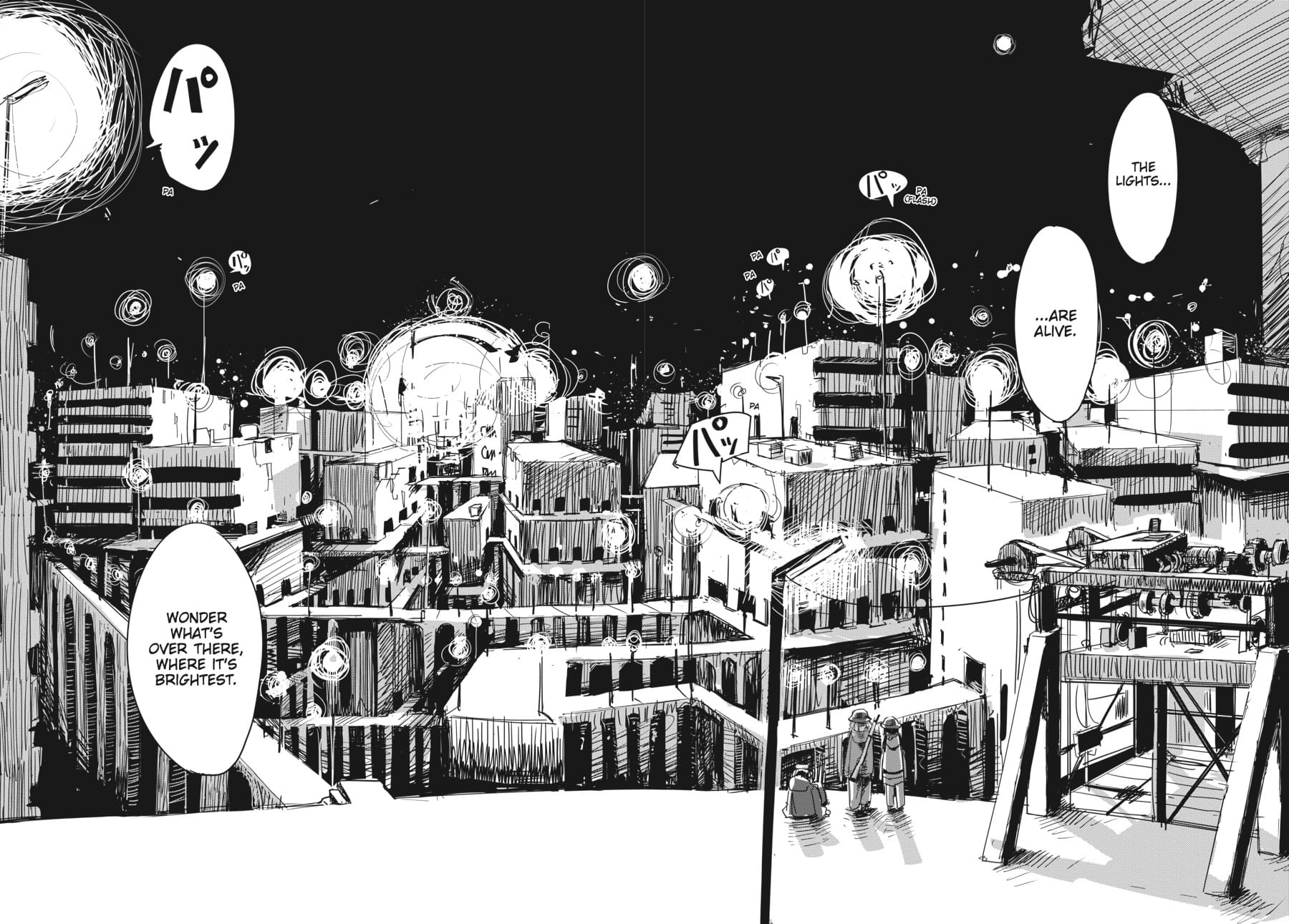
The author has stated that they "want this work to touch something universal within humanity." [↗] What's really interesting about Girls' Last Tour for me is that it doesn't promise an everlasting comfort. Instead, it sheds light upon a perspective shaped by darkness with no end in sight and shares the moments of the two protagonists as pure: being alive. Chito is someone intellectual who likes to write new information in her journal; while Yuu on the other hand is much more impulsive. The two make for the perfect duo to overcome their challenges and have chats together. What are memories? What is "life"? What makes this food so delish? What is culture? How did the people of old dress? What is hopelessness? These questions are integrated so very well that each chapter makes one reflect about things that are most likely impossible to ever fully comprehend. And in the end, one is left with a heart that is beating! Through the dialogue of the characters, つくみず allows themselves to attempt to understand a very fundamental aspect of life itself. Just as the early surrealists in art history were trying to get to something essential about humanity, the work isn’t supposed to be divorced from reality, but rather be a very reflection of it.
The moments of wonder alongside the girls' journey are magical. A unique art style radiates the beauty of each interaction between our two protagonists, no matter how small. The linework in particular is quite light and shaky; the panels have just enough detail to give life to the environments Chito and Yuuri find themselves in. It's known from interviews that つくみず was inspired by past works of art creating their story, for instance Paul Klee's paintings and specific sculpture work of Richard Serra. "Restrictions in representation and freedom are two sides of the same coin. The question of what one cannot draw influences the creation of a work just as much as the question of what one can draw. Therefore, while I like to let my imagination run wild, imagination alone doesn't create a work." [↗] I still think about these words as it always seemed to me that a lot of thought had gone into the composition and presentation of the pages and panels. After all, one should be able to follow along with the manga's imaginative world.
Girls' Last Tour is a rather quiet story as well. One is encouraged to come up with ideas and draw conclusions, no matter how temporary they may be. It's definitely really fun nonetheless because our protagonists strive to make the most of the situations they find themselves in and always remain curious. The opening and ending songs of the anime sound exactly the way they do for a reason! It's ultimately part of what defines the tour and what envelops the series in a hug.
The side-characters also complement Chito and Yuuri wonderfully—though to leave this review free of spoilers, I'll refrain from analysing them. Undoubtedly they don't stumble upon many companions, but this is to be regarded positively. I find the members of the side-cast to be clear depictions of very human things, opposed to the impression one gets from more "abstract" moe characters. The destination of the two girls is formed by encouncters with the other characters more than they might realise. A destination is a vague term to speak of in this case; the tour is generally aimless. It's precisely the desire of wanting to know more about the world that leads the characters through what seems like a never-ending culmination of buildings and places.
Although it doesn't clearly mean anything, you might cry reading occasionally. It's not depressing, nor filled to the brim with happiness; it is a journey. A vague feeling of optimism in a broken world, the quiet, expansive, sometimes unsettling atmosphere, the unique exploration of nihilism and existentialism—there's a lot in this little 6-volume manga. But it's all of those themes that create this very special feeling. It's a challenge to describe the travel concisely when viewed as a singularity. Girls' Last Tour has a motif of end and farewell all the way through, popping up here and there in corners of a dialogue. It's not a series to read quickly and jump to an other afterwards. And while I'm writing this text, I realise that this manga is probably not a work that was created to be liked by the masses. What could the end of the world look like? I'll never have enough words to write everything I adore about this manga from the bottom of my heart. It's special, it's beautiful and what feels everlasting as a memory.
Instead of assigning life a meaning, this work might express that perhaps there is truly nothing to live for. After all, the concept of a 'meaning' is so fundamentally tied to thinking living existences that there needs to be life for existence(s) to be perceived as special, or for it to have a "worth". I hope that you enjoyed and whether this review made you interested or not, both are fine with me. And with that, rest in peace, eternity.