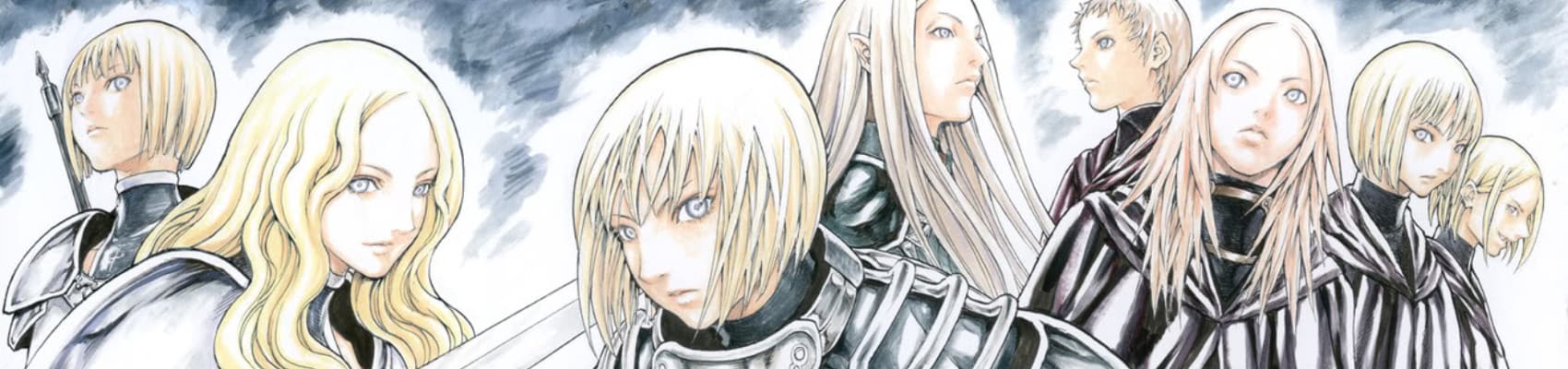
Claymore
a review by MagicalGalsGal
a review by MagicalGalsGal
Claymore is magical girl. Thanks for coming to my Ted Talk cuties.
Spoilers: Claymore, Madoka Magica, Revolutionary Girl Utena, Princess Tutu
After finishing, I did some quick searching to see is anyone had talked about Claymore being magical girl or not.
I didn't see much about it, so here goes!
I'd argue that Claymore (manga) is extremely in line with many common magical girl themes and tropes. Beyond having the genre defining girls with magical powers it shares key narrative beats with classics like Revolutionary Girl Utena, Princess Tutu, and Madoka Magica. Wonder Egg Priority as well, although because of the real life production issues late in development we never really got to see if it would stick the landing for real.

A lot of the best (read as personal favorites) magical girl narratives focus on patriarchal forces exploiting the suffering and labor of women and girls that is largely dismissed/ignored. Magical girls are constantly being put in life or death situations that are (in their worlds) necessary to the survival of an (often) unaware populace.
Claymore has the patriarchal figures grant magic power to girls (Dios in Utena, Kyube in Madoka, Drosselmeyer in Tutu) and charge them with duties to further goals they fail to disclose. Only for the heroines and reader to realize they are fighting a manufactured enemy, one manufactured by their manipulators. Akio exploiting the duelists in Utena. Drosselmeyer's approach to the (his) narrative in Tutu. The incubators establishing, enabling, and exploiting the results of magical girls succumbing to their wish’s curse.
As we learn, the Organization created their soldiers and many yoma specifically to pit against each other. The manga and other anime mentioned lead magical girls (Claymores) realizing they exist explicitly to be tortured and killed for their would be fathers. They don’t particularly like that… wonder why? The power is in their hands, and dismantling the system that was created to oppress them. In Claymore this is of course the physical destruction of the Organization. Is Claymore really just about labor organizing and class solidarity??? It does take community and collective action to truly destroy master's house after all.

Lest I forget, magical girl narratives are inherently ones of change and transition. Not just the transformation needed in creation of Claymores from human girls. The main Claymore septet of the second half also learning that their ability to blur the lines of awakening and not to find their greatest strength. There is great strength in rejecting who you were made to be and embracing who you are. The Organization (which is almost exclusively masculine presenting characters) trying to deny them the range of self-expression they actually have. Until the Claymores come together, share knowledge, and collectively tell management that power belongs to the people doing the actual work.

I haven’t seen the anime, and I don't know if I will, but the transformative parts of Claymore's narrative occur after The Northern Campaign, which is kind of vital to the full narrative. Honestly, the show stops right where the manga really comes into its own.
The manga probably wont enter my list of favorite magical girl, but I'm tagging it in my collection ~~~~~~
13 out of 14 users liked this review
