Blue Giant
a review by Lesvaries
a review by Lesvaries
I know I'm very late, but better late than never. So here's my review of Blue Giant. It will focus solely on the first series, without touching on Blue Giant Supreme, Explorer or Momentum, which I haven't yet read.
Overall, Blue Giant is an incredible work, which I personally consider a true masterpiece. And here's why.
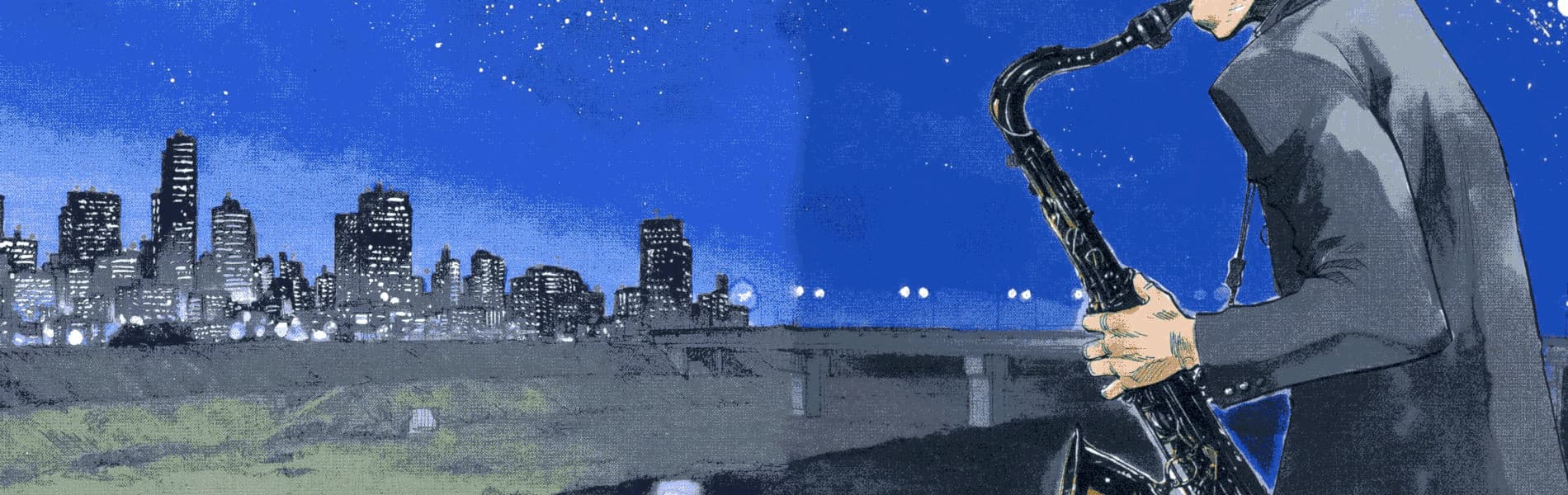
Blue Giant tells the story of Dai Miyamoto, a passionate high-school student who dreams of becoming the best jazz tenor saxophonist in the world. Unlike most musicians, he didn't start as a child, but much later, at the end of high school. This delay didn't stop him: he made up for his lack of experience by working hard. Every day, he goes to the riverside to play the saxophone, an instrument given to him by his brother. After graduating, Dai decides to move to Tokyo to pursue his dream, climb the ladder and start a band.
It's hard to talk in depth about the narrative without spoiling, but don't worry: I won't mention any major elements here. What I can say is that Blue Giant is an extremely rich work, both in its narrative and in its drawing. The graphic style manages to suggest sound through movement, which is a feat in itself. Narratively, the work follows a linear structure, from A to B, telling the story of Dai's evolution, his encounters, the formation of his group, and their progression. This already makes for an excellent story... but not yet a masterpiece.
What, in my opinion, elevates Blue Giant to the rank of masterpiece is the treatment of the characters. All are touching in their own way, at some point in the story. Whether they're main characters, secondary characters, or even brief extras, they all seem real, human. They are inhabited by their dreams, their doubts, their failures, their remorse.
But above all, the main characters aptly embody different facets of the human relationship to passion - whether musical or otherwise. Here's a brief analysis of the three main figures:
- Dai Miyamoto is the embodiment of raw passion. He's not a genius, he has no innate talent: he relies solely on determination and hard work. He represents those who arrive “late”, but catch up with rage and sincerity. Benevolent, he has his heart in the right place, but can be stubborn, even a little closed-minded. His vision of music is personal, almost absolute, and he defends it at all costs.
- Yukinori Sawabe, on the other hand, is the opposite: a precocious genius. He started early, he masters his instrument, and he knows it. This gives rise to a certain arrogance on the surface, but which in reality conceals a much deeper fear: that of no longer progressing, of no longer feeling anything. He is criticized for playing without putting his soul into it, and this criticism haunts him. It's a universal question among gifted artists: how can one continue to evolve after so many years?
- Shunji Tamada is the “newcomer”, the one who arrived “too late”, who never imagined himself in music. He represents those who have no (or no longer any) passion, or who think they've missed their chance. With no experience, he joins the band by chance, but invests himself with admirable intensity. He's not trying to become the best, just to stop being “rubbish”. And that's already a huge victory. Through him, Blue Giant sends out a powerful message: it's never too late to take the plunge.
All in all, Blue Giant is a profound, mature and moving work, as much in its narrative as in its drawing and characters. If you've never read it, I sincerely recommend it and its sequels. And if you've already discovered it, don't hesitate to share your impressions: I'd love to discuss them. For my part, Blue Giant is unquestionably one of my favorite works to date.
9 out of 9 users liked this review
