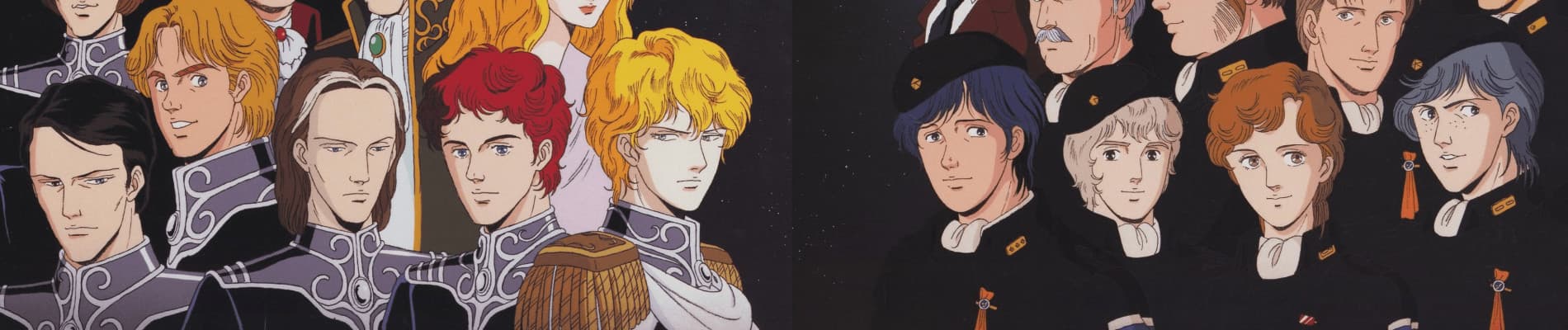
Legend of the Galactic Heroes is not just a space opera; it’s an immersive experience. With over 100 episodes, LoGH stands out as a rare breed of anime that delves into philosophical discussions, political strategy, and character development rather than relying solely on action set pieces or emotional catharsis. This deliberate pace and focus on character growth make it one of the most intellectually ambitious and rewarding anime of all time. Despite its imperfections, it has garnered an impressive rating of 87, solidifying its status as a resounding success with its exceptional qualities outweighing its flaws.
The central storyline revolves around the conflict between two galactic superpowers: the autocratic Galactic Empire and the democratic Free Planets Alliance. What sets LoGH apart is its ability to avoid simplistic portrayals of good and evil. Instead, it explores the nuanced complexities of power, corruption, leadership, and ideology. The show presents a critical examination of imperialism and democracy from two distinct perspectives: Reinhard von Lohengramm and Yang Wen-li. These conflicting ideals are not presented as abstract concepts but are vividly portrayed in concrete and often tragic ways.
While the pacing may be slow, even glacial at times, this deliberate approach is intentional. LoGH is not meant to be consumed in a single viewing session. Instead, each arc, from the Iserlohn Fortress standoffs to the internal political collapse of the Alliance, builds towards a satisfying and inevitable conclusion. Set in a futuristic world, the show presents a chillingly realistic depiction of how various ideals clash, leading to the downfall of empires and the decay of democracies. The timeless nature of these conflicts creates a profound sense of resonance, making LoGH a truly captivating and thought-provoking experience.
Reinhard and Yang are undoubtedly two of the most formidable characters in anime. At the precipice of personal grief and fueled by a relentless desire for revenge against his sister’s suffering, Reinhard emerges as the revolutionary rising star. Unlike ordinary anime geniuses, his ascent is marked by bloodshed and genuine loss. On the other hand, Yang embodies the dour hero archetype. As a historian and idealistic conscience, he is a realist in his actions, while his disdain for political power serves as the perfect foil to Reinhard’s ambitions.
What elevates LoGH to a superior status is its meticulous attention to its side characters. Oberstein, Kircheis, Julian, Poplan, Mittermeyer, and countless others are not mere background figures. These characters undergo growth and development, engaging in conflicts that inevitably contribute to the profound reflections on power, responsibility, and the finite nature of existence that the series presents. Unlike the cheap shock value deaths seen in other anime, Donnie and Scrubs are genuinely emotionally connected because they are not just any ordinary characters.
LoGH stands out as the only anime that delves deeply into the realm of political theory and rule. Its exploration of democracy versus autocracy, the burden of leadership, media manipulation, and the cyclical nature of power is profound. Even real-world political thinkers like Machiavelli and Clausewitz are referenced, adding intellectual depth to what would otherwise be an action-packed narrative. This approach does not offend the intelligence of the viewer; instead, it demands attention and deep contemplation. This is adult anime, not in the sense of explicit content or gore, but in its ability to pose thought-provoking questions without providing simplistic answers.
Furthermore, LoGH courageously addresses complex issues such as religion, propaganda, military ethics, and civil-military relations. While war is a central theme, the show goes beyond depicting conflict itself. It focuses on the machinery of war, the institutions that perpetuate it, the ideologies that fuel it, and the people who are subjected to its devastating impact.
Legend of the Galactic Heroes, a classic anime series, offers a unique viewing experience that goes beyond the typical anime fare. While the animation may be dated and somewhat wooden, the show’s strength lies in its writing, which prioritizes character development and storytelling over spectacle.
The series features a heavenly classical background score that draws inspiration from composers like Mahler, Bach, and Beethoven, creating a pompous and serious atmosphere. Although the adventure theme may not be groundbreaking, the background score enhances the storytelling process. The voice acting is exceptional throughout, with characters like Oberstein and Yang delivering nuanced performances that carry the emotional and intellectual weight of the series.
Unlike other anime, Legend of the Galactic Heroes is slow-paced and speech-driven, requiring complete attention from the viewer. However, it offers a rewarding experience that engages the audience on multiple levels—morally, intellectually, and emotionally. Each episode feels like reading a chapter of a heavy but unforgettable novel.
While not everyone will enjoy Legend of the Galactic Heroes, those who dedicate their time and attention to it will find it to be one of the most ambitious and thought-provoking anime experiences in general. Although the show may not have the most stylish animation and can be somewhat expository at times, it surpasses other anime in terms of writing, character development, and themes. Legend of the Galactic Heroes is truly an epic—in scope as well as size.
39 out of 41 users liked this review