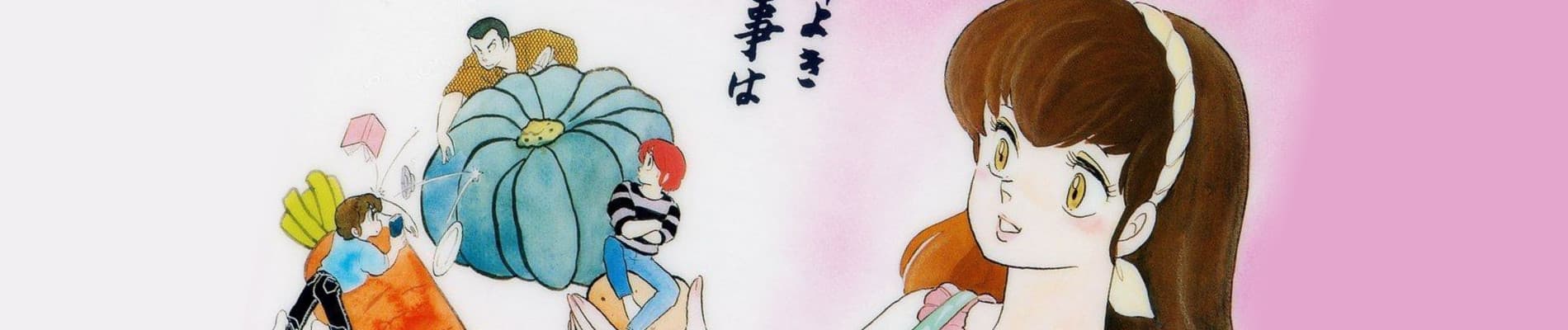
Maison Ikkoku
a review by DNSS
a review by DNSS
Two years later, she begins serializing Maison Ikkoku, a mature, intimate romance that couldn’t be more different from her debut work. Just look at this woman’s mangagraphy, her résumé — the sheer talent and impact she’s had, all while refusing to slow down even now, at 67 years old!
Any attempt to analyze her work must, of course, begin with the utmost respect and reverence for this legendary writer, a true cornerstone of Japanese artistic canon. But honestly, even a mediocre AI could compile a dry list of facts about Takahashi’s influence on manga history. So, I’ll leave that part to the machines and stick to the human art of writing. If you’re curious — or if you’ve been living under a rock and don’t know who Rumiko Takahashi is — go google her, crack open an encyclopedia, read her bio. Because her name disappears from here on out.
My goal is to honor her work. And to do that properly, we must discuss her art through her art — not through external accolades. There’s no need to lean on her authority, her importance, or her unshakable integrity as an artist. Those are essential for understanding her as a cultural figure, but not for grasping her stories. Her works stand on their own. Their quality speaks for itself, transcending time and culture.
From this point on, we talk about Maison Ikkoku and Maison Ikkoku only.
Now, let’s talk about love.

Can I tell you what Maison Ikkoku is about? Damn it, you haven’t read it yet? Well, you should. Maison Ikkoku is about love, about falling in love, letting yourself be loved, and, above all, fearing love.
We follow Yusaku Godai, a clumsy, down-on-his-luck ronin with bleak prospects, living in a tiny boarding house surrounded by a ragtag group of troublemakers hell-bent on making his life miserable. There’s Yotsuya, a creepy voyeur; Akemi, an uninhibited waitress; and Hanae, a middle-aged woman who loves to drink — key players in this claustrophobic, oppressive, and enraging household.
Fed up with this daily hellscape that only hinders his studies, Godai decides to move out, desperate to escape his chaotic neighbors. But not so fast — a small surprise throws his plans into disarray. A new manager takes over Maison Ikkoku: our heroine, Kyoko Otonashi. Beautiful, young, and deeply melancholic, Kyoko immediately catches the eye of the ever-fickle Godai.
You know, it’s funny — and not at all surprising — but 45 years later, men haven’t changed one bit. Godai perfectly embodies the timeless stereotype of the shallow guy who falls for the first pretty woman who shows up. I feel you, Godai. I really do. If she’s kind? Even worse. How do you not fall in love? Love isn’t that complicated, it's just so easy.
And so begins our story: a young man with no present, surviving only on hope for the future, meeting a young woman also without a present — but one trapped in her past. Can love bloom between them?

Can we live without love? If you don’t love, you want to. If you already love, you want to keep loving. And when you lose love — how do you love again? Kyoko Otonashi carries an immeasurable pain: the endless grief of her first love, her late husband. A widow at just 22, Kyoko resigns herself to solitude. She’s kind, warm, and nurturing — yet romantically untouchable. The locks on her heart are unbreakable.
Kyoko doesn’t see — or want — a future. With her love ripped away so violently, the idea of new stories feels impossible for a heart still clinging to cherished memories.
So what Godai faces isn’t just the challenge of building new love — but dismantling an old one. Opening her heart to him would feel like a betrayal of her past. For someone devoted to a lost love, what does it mean to love again? If we love, can we ever stop? Can we replace a true love? Can we forgive ourselves for moving on?

The answers aren’t clear. Solutions are tangled. And with Godai being so clumsy and untrustworthy, any hope of a simple resolution is doomed. How do you compete with the idealized memory of a flawless love when you’re a walking disaster?
This is where Maison Ikkoku’s brilliance shines — its uproarious comedy perfectly balancing its romantic drama. Disastrous misunderstandings and dragged-out conflicts aren’t just cheap plot devices to prolong the story. No. These inconveniences shape Godai’s growth and his evolving feelings.

Godai is indecisive, impulsive, unreliable, desperately needy, and riddled with low self-esteem. His life revolves around an uncertain future — getting into a mediocre college for a major he’s too ashamed to admit. This slow, shaky journey actually mirrors his own insecurities. Because while he awaits the solutions to his life in the hope of a better future, he fears them just as much, for the simple possibility that he won't find the solution to his problems in them.
It’s tragic. But that’s love. Godai doesn’t live in the present and dreads the future. Kyoko doesn’t live in the present and dreads the past.
Love, save us.

This melancholic romance, disguised as a side-splitting comedy, walks a delicate tightrope.
The pain of losing a loved one can’t be measured. Grief hits everyone differently. Losing a true love? Even worse. But Kyoko must eventually realize that life doesn’t end when a loved one is gone. Choosing eternal mourning isn’t proof of love or loyalty — it’s self-sabotage. Life goes on, and building that future is these characters’ duty. Our duty aswell.
We don’t need to go as far as grief — even breakups make the point. Let’s be honest for a moment. Think back, dear reader, to your old loves. How many survived? How many remain, and how many faded? For me, a modern-day Godai, the examples are painfully vast.

For Kyoko, a new romance isn’t betraying her past love—it’s a chance to love again. This isn’t a polyamorous manifesto; let’s not get tangled here. Don’t cheat, don’t abandon your passions—but never stop moving forward. We don’t have to erase the past to embrace the present. Old memories can coexist with new realities.
Maison Ikkoku masterfully illustrates human uncertainty with impeccable subtlety and sharp humor. Through brilliant, immersive writing, we witness a story that’s cruel, hilarious, and heartwarming. Love serves to mend all this, curing insecurities and complementing each other's flaws; to love is to put together a puzzle, after all. The fragility of the future, the nostalgia for a perfect past, the disposable present—a purgatory separating past fears from future hopes. In the end, as my favorite saying goes: Jacaré parado, vira bolsa.
As a historian by background, my answer is always the same: Time. Never stop loving.

18 out of 18 users liked this review
