WARNING, THIS REVIEW CONTAINS SPOILERS
Preamble
Frankly speaking, I would never have expected in a million years for this show to hit me as hard as it did.
I'd like everyone wanting to watch this masterpiece to know that it is not just a silly comedy anime, as I thought it would be when I began it. I can easily say that this show has completely changed my perspective on manga and anime, and I’m certainly not ashamed to admit that Girls' Last Tour is the only manga that has made me cry several times in such a long period of time—and it still hurts me today to think about it.
Summary, Spoilers
Girls' Last Tour is a post-apocalyptic manga and anime series written by Tsukumizu, a thoughtful and introspective author whose works tend to revolve around existential and philosophical themes. Tsukumizu's art has often been described as heartwarming, surreal, and poetic. Despite its apocalyptic setting, Girls' Last Tour is not an action-oriented anime, nor does it try to overly hype you with exciting scenes.
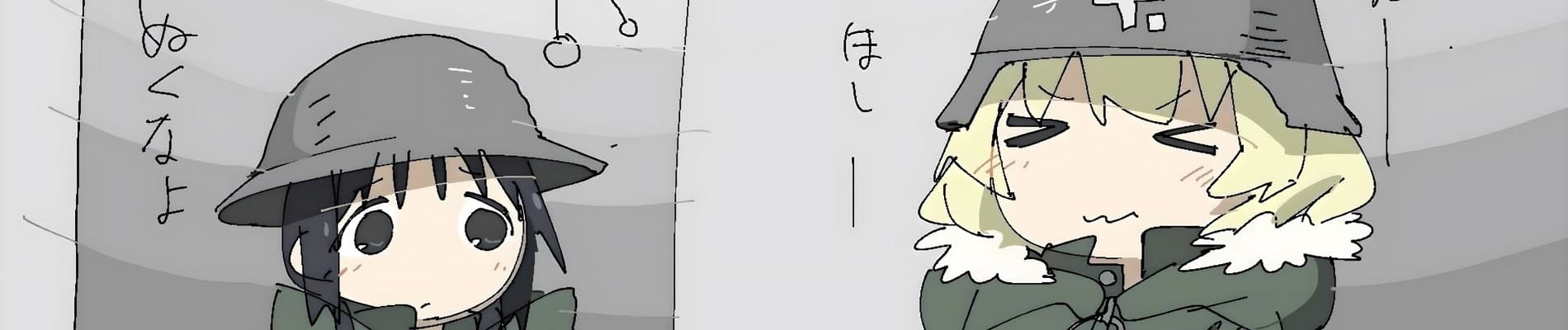
The show follows Chito and Yuuri, our main characters, as they make their way toward the top level of a ruined city using their gifted motorized vehicle called Kettenkrad. Along their journey, they reflect on and question themes such as war, culture, life, empathy, existence, and more. They also encounter and experience remnants of the lost human civilization, such as flavored rations, canned food, alcohol, cigarettes, and literature. It’s fun and silly, yet also deeply melancholic and depressing.
When they reach the top level of the city, they're disappointed to find nothing but a flat surface covering the entire top layer. Knowing that they could be the last living people on Earth, and that human history could end with them, Chito begins to break down—questioning their choices and everything that led to this outcome. Yuuri interrupts her, starting a snowball fight and giving a speech about how, even in such an uncertain world, regardless of whether their decisions were right, the lives they lived were still worth living.
Even at the end of their journey, having lost everything they had, staring death in the face, they spend their final moments having fun. Perhaps what they hadn’t lost was the life they had lived—the joy they found in exploring and living together.
And finally, they eat their last bit of rations and fall into a deep sleep, until the end of time.
My Own Opinion
There’s something deeply comforting about the show. Maybe it’s the way Chito and Yuuri interact—different, yet so deeply connected that they complete each other. Wandering through the ruins of a dead human society, through everything they experience—despite being all alone together, despite living in such a cruel, uncertain world and under such harsh conditions—they never lose hope in each other or in the life they’re living. Knowing that it’s all meaningless—or hopeless, as Yuuri puts it—knowing that everything familiar will one day vanish as if it never existed, Chito and Yuuri kept moving forward. And as the author stated, they held onto the belief that the joy of living would never fade.
In line with that sentiment, I’d like to believe that too. The obscurity of life and death, of existence and nonexistence, of consciousness and oblivion—it scares me. And I also believe that, regardless of what one may believe in or how certain they claim to be regarding it, that fear lives quietly within them too.
Girls' Last Tour was a unique experience for me. The way this manga is presented to the reader makes it incredibly satisfying to read. It’s both wholesome and terrifying, sad and funny, silly and serious—in a way that truly makes you think. If I could, I’d like to thank Tsukumizu for creating such an incredible work.
59.5 out of 61 users liked this review