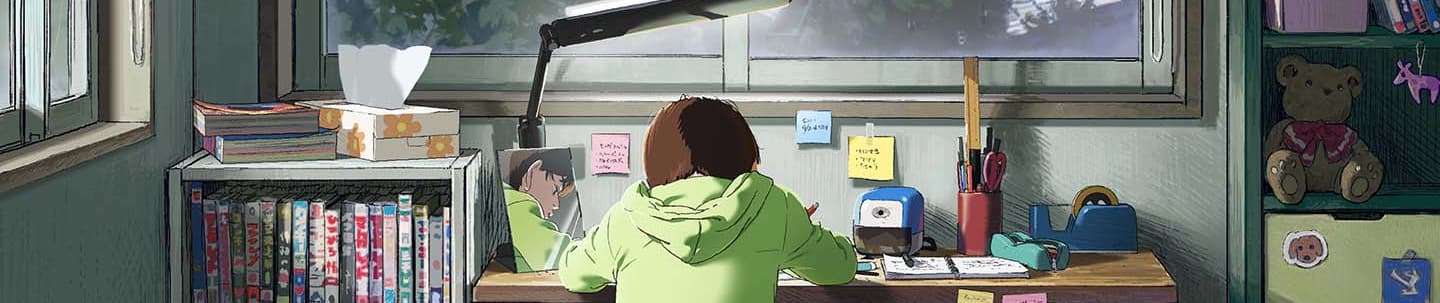
LOOK BACK
a review by patkarunungan
a review by patkarunungan
I somewhat enjoyed the manga and it seems that watching the movie is a logical choice as everybody is saying that it enhances the source material. But I can't help but feel mixed feelings towards it.
§ Overview
Fujino Ayumi is a girl with many talents. She can draw manga, she excels in her studies, and she is athletic. After an impressive establishing shot, we see her drawing and we get to see an impressive sequence of her work — First Kiss — come alive. But then, she was bragging to her classmates that she rushed the work yet ended up so good.
One day, her teacher asks her to give a page to a reclusive student named Kyoumoto. At first, she doesn't feel like this is a big deal. But it turns out that she can draw better than Fujino. This incident is the start of her obsession to defeat Kyoumoto. And the rest is for you to find out.
§ Remarks
I've since had mixed feelings about the story. It's not bad, but it wasn't what I was expecting.
Firstly, I read on social media that it's about the passion for creating a work of art. But considering how unlikable Fujino is, it doesn't seem to be one that romanticises creativity. (If you want to see a film that does this better, I recommend 'Pompo: The Cinéphile'.) Rather, it shows that the motivation for creating a piece of art can come from unflattering character traits or situations. This also applies to Kyoumoto.
The how-to aspect of creativity can be extracted, but the reason why is something personal. The motivation for Fujino's and Kyoumoto's creativity is not flattering.
A number of readers have remarked that the two characters, Fujino and Kyoumoto, are different aspects of the mangaka, Fujimoto Tatsuki. (Take the FUJI from Fujino and the MOTO from Kyoumoto, and you have his surname Fujimoto.) Fujino represents that part of him who uses his artistic skills to create commercially viable media, and Kyoumoto represents his more artistic side, that part of him that he seemed to have killed. Thus, it seems to me that, rather than being a manifesto or celebration of creativity, 'Look Back' feels more like Fujimoto Tatsuki's confession.
Whilst I do not subscribe to Sainte-Beuve's biographical criticism, i.e. in order to fully understand a piece of work, one must understand the artist's biography, I take exception to 'Look Back' because Fujimoto Tatsuki himself says that it is a product of his experiences. In this article — "Drawing Felt Meaningless": Chainsaw Man's Creator Already Explained The Real Reason For Making Look Back, & It's Heartbreaking — we learn that Fujimoto experienced difficulties when he volunteered to help with cleaning efforts in the great 2011 earthquake.
He channeled his frustrations to this work. Also, it's apparently a tribute to the KyoAni arson. Some have reported that a friend of Fujimoto died there, but I can't find a credible source.
It's a sad film. I don't know if Fujimoto had Class S / subtextual yuri in mind when he created this, but it feels like it. It really reminds me of early yuri material.
What specifically gives me mixed feelings is how unlikable Fujino is. (I don't know if Fujimoto himself is unlikable as a person, going by the direction that 'Look Back' appears to be a confession.) Firstly, she was obsessed with how to defeat Kyoumoto.
When she finally meets Kyoumoto, this begins their strong friendship.
That said, she is such a control freak. She had used Kyoumoto's abilities, disregarding her feelings. Kyoumoto wanted to go to art school in the hopes of improving her drawing skills, but this meant stopping drawing along with Fujino.
Fujino in turn
Newsflash: Shit happens.
The movie has the same defect as the manga with regard to not having a smooth transition between reality and fantasy. When Fujino went into Kyoumoto's room, she found a comic strip titled 'Look Back.'
But I'll forgive them as this is a dramatic moment of the story. Fujino was looking back in regret.
When Kyoumoto
At this point, we can only speculate what happened next. She is clearly
Also, the montage of their activities as friends is impressive. I like the animation when Fujino was leading Kyoumoto as they ran.
The musick is great, but there was great use of silence at that fateful moment.
§ Conclusion
The story gave me mixed feelings because of how it was sold to me, but it's a very good story. Just manage your expectations.
It's impressive when we talk about technical aspects. Ultimately, it is Fujimoto Tatsuki's confession of his life as an artist veiled in what appears to be Class S. He seems to be looking back with regret.
It's not a treatise on creativity, but touches on creativity partly. Creativity is a personal thing, and it's up to the creative to find a different source of creativity, something different to what Fujino had, so that he or she would not look back in regret.
17.5 out of 19 users liked this review
