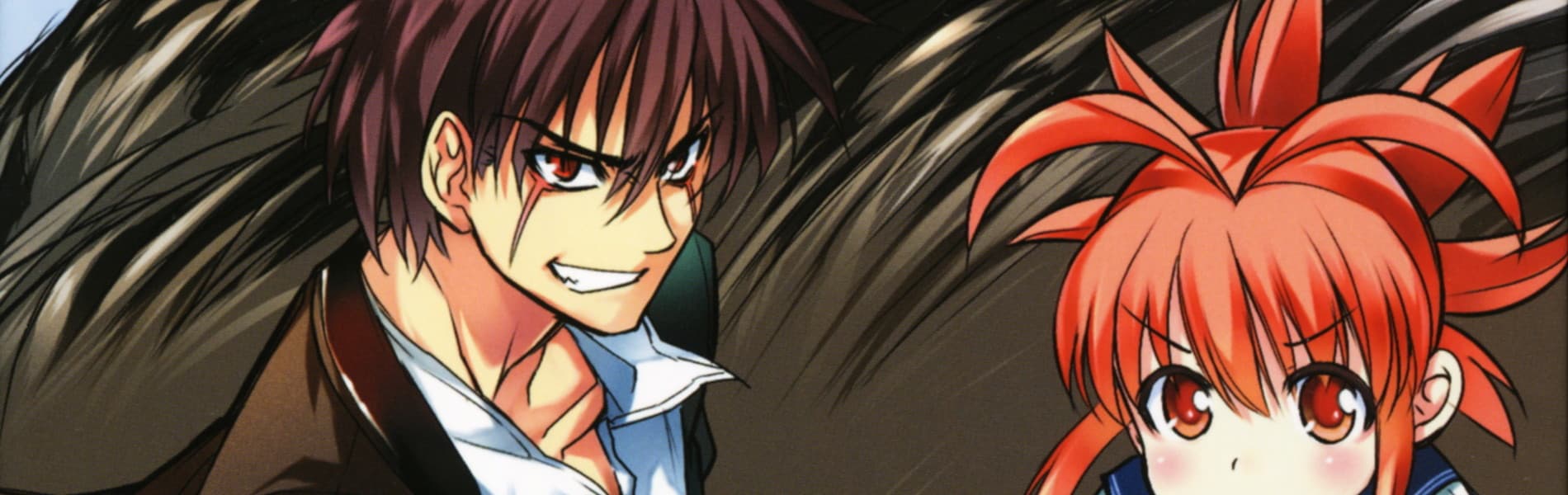
Sometimes, a show comes into your life not because you planned for it, or even remembered it existed, but because the universe nudged you in just the right (or wrong?) direction. That’s how I ended up watching Demon King Daimao. I didn’t seek it out. I didn’t even remember putting it on my backlog. It had been sitting there for so long, buried under a digital mountain of forgotten titles, it may as well have been placed there by a past version of me who wanted to prank my future self.
The catalyst? A “certain” emotionally scarring episode of Mobile Suit Gundam: Iron-Blooded Orphans. If you’ve seen the show, you know the one. I needed a palate cleanser—something light, dumb, and hopefully with fewer child soldiers. I scrolled, saw the title Demon King Daimao, and thought, “Sure. Sounds like a harmless little fantasy distraction. Probably something with swords, maybe a dark lord, maybe some budget magic.” So I hit play.
And you know what? The opening kind of delivered. To its credit, the show doesn’t wait around. Within the first five minutes, we’re tossed into a near-future world where magic and sci-fi have fused into some sort of technomagical high school setting. The aesthetic screamed “early 2010s,” and I found myself lulled into a weird nostalgia haze, like finding an old PSP and realizing it still works. It wasn’t original, but it was a vibe.
Then came the cracks. Oh, the beautiful, shimmering cracks.
Our main guy, Akuto Sai, meets his destined-to-be-first-harem-member Junko, and right away the two start talking about their tragic pasts, noble dreams, and what feels like a solemn blood pact of friendship. It’s heavy. Dramatic. Almost melodramatic. And then—without warning—the camera angles start to drift. They dip lower. They linger. And suddenly, I'm not focused on the character arcs or the heartfelt dialogue anymore. I’m flashing back to conversations with Miranda on the Normandy, where every “emotional” exchange somehow involved the cameraman falling directly into a cleavage dimension.
And just as I'm trying to reconcile this tonal tension, the show commits. We go full vertical pan up Junko’s skirt in the middle of her emotionally charged monologue. No context. No warning. No shame.
It was like watching a Shakespearean monologue filmed by someone who just discovered what legs are.
That was the moment I realized Demon King Daimao wasn’t going to be the show I thought it was. Or maybe it was — and I was the one who misunderstood. Either way, I wasn’t bored. Whiplashed? Absolutely. Confused? Constantly. But bored? Not once.
And that, oddly enough, is how the show got its hooks in me.
Now, as much as Demon King Daimao lured me in with its oddball premise and early 2010s aesthetic, it wasn’t long before the cracks started widening into full-blown, bosom-sized chasms. The biggest offender? Tonal whiplash so severe it should come with a chiropractor’s warning.
This show doesn’t just shift tone — it detonates it. One minute, our main character is having a solemn moment of introspection about destiny and the burdens of power, and the next, the camera is nose-diving into the nearest pair of thighs like it's trying to solve a mystery only underwear can answer. It’s not that the fan service is present — I expected that — it’s the sheer audacity of it. It doesn’t interrupt the story so much as run up behind it with a steel chair.
And look, I’m no stranger to etchi. I’ve watched my fair share of “accidental harem shenanigans” and “hot springs diplomacy” over the years. I know the playbook. But Demon King Daimao isn’t just playing the game — it’s writing in new plays mid-match. The fan service here isn’t an occasional indulgence. It’s a persistent cinematic philosophy. A worldview, even. The camera moves like it’s being operated by someone deeply committed to making every plot beat share screen time with someone’s panties.
And the strange part? The rest of the show acts like it’s trying to be serious. The characters — especially Akuto and Junko — treat their situation with near-religious gravitas. They’re fighting ancient conspiracies, navigating political upheaval, and grappling with fate itself. But every time the tension builds, every time you think the story might just settle into something cohesive... bam. Cleavage. Or a lovingly framed panty shot. Or a rogue android tripping into someone’s chest while her rear-mounted power button activates with a moan.
It genuinely feels like the writers and the cinematographer were working from two completely different scripts — one a sweeping fantasy drama about the rise of a misunderstood demon lord, and the other a feverish doujinshi that gained sentience. Every character gets their moment in the fan service spotlight, often in increasingly absurd ways. I lost count of how many times I asked, “Wait, why are we zooming in there?” only to realize the show had long since stopped asking permission.
What makes this more baffling is how the show isn’t censored. At all. You keep expecting the standard beams of light or convenient clouds of steam to swoop in and save face, but they never arrive. It’s raw. Shameless. And completely uninterested in subtlety. There’s no teasing here — everything is proudly on display, often at the worst possible narrative moment.
And yet, somehow, this chaotic blend of high-stakes prophecy and low-angle fan cam keeps dragging you along. You’re constantly whiplashed between dramatic exposition and sudden “oops I fell into your cleavage” energy, like the show is being re-edited on the fly by two interns in a slap fight. It’s confusing. It’s jarring. It’s tonally catastrophic.
And somehow... I still couldn’t look away.
If the tonal inconsistency of Demon King Daimao didn’t already raise some red flags, the pacing grabs you by the collar, throws you through a stained glass window, and doesn’t stop running. This show doesn’t “move fast” — it skips foreplay entirely and jumps straight into narrative chaos, treating plot progression like it’s late for a meeting it forgot to prepare for.
From the jump, Daimao starts throwing ideas at the screen like it’s trying to win a bet. You’re introduced to Akuto, a transfer student at a magic academy who just wants to become a good priest and help people. By the end of the first episode, he’s been publicly labeled as the future Demon King, nearly arrested, feared by his classmates, and semi-stalked by a mysterious girl with a bird for a hat. Somewhere in there, there’s also a school disciplinary committee, an invisible lizard demon, and a sudden ninja attack. That’s Episode One.
And it only escalates from there.
Rather than building its world or characters, the show seems to operate under the belief that escalation equals engagement. The story lurches from one earth-shattering revelation to the next with barely any connective tissue. There’s a shadowy theocratic cabal plotting to control the magical world. There’s an impending demonic apocalypse. There’s a prophecy. A rebellion. A girl building an undead army using her brother’s disembodied head. A ninja clan. A government android. A student who might be God. Also, God might be an AI. Or an actual god. Or a power core? I don’t know anymore.
Every time you think the show will take a breath and explain itself, it panics and hits the gas harder.
There’s one scene burned into my memory as the moment I truly gave up trying to make sense of anything. Akuto is about to save a love interest from a rampaging dragon. Another character blocks his path and tells him, in no uncertain terms, “You’ll have to kill me if you want to reach her.” Classic anime drama setup. Duel incoming, right? Nope. The next time we see them, they’re standing side-by-side, chatting like old friends. The fight never happens. No explanation. The script just... moved on. I honestly thought I missed an episode. I checked. I hadn’t.
This happens constantly. Characters appear, vanish, or change allegiance without warning. New factions are introduced mid-episode and treated as if they’ve been around since the beginning. Subplots are dropped into scenes with no context, only to be immediately overshadowed by something even weirder. At one point, I blinked and suddenly there was a character dressed like a Power Ranger hyping Akuto up during a magic battle while an AI-controlled satellite prepared to vaporize the city. That’s not a joke. That’s just Tuesday in Demon King Daimao.
The show has so many ideas that it never stops to ask if any of them make sense together. Or apart. Or at all. Watching it feels like trying to read a Wikipedia summary for a franchise you’ve never heard of, while someone else flips the page every two minutes.
And yet, despite all of this — maybe even because of all of this — I couldn’t look away. Every episode felt like a dare. It’s not just chaotic; it’s chaotically sincere. It genuinely believes it’s telling an epic story, and it’s doing its damndest, even as it forgets to explain why androids have butt-based power switches or what exactly Fujiko is doing with those tentacles. And don’t ask about the bird-hat girl. I stopped asking at episode four.
By the end, Akuto starts to feel less like a protagonist and more like a confused tourist just going along with whatever reality-warping fever dream the writers throw at him. And honestly, same.
So here's the twist: despite everything — the tonal inconsistency, the chaotic pacing, the fever-dream storytelling — I actually kind of liked Demon King Daimao. Not in the “this is a good anime” sense, mind you. More in the “I’m not sure what just happened but I think I had a good time?” kind of way.
What really caught me off guard was how much I ended up enjoying the cast. The plot may be tangled beyond recognition, delivered at what I can only assume is warp speed, and narrated like the script was shredded and reassembled by a blindfolded intern — but somehow, the characters still managed to charm me.
Akuto, our bewildered protagonist, might be the only grounded thing in the entire show. He’s not a leering pervert or a clueless dense block of wood, which already puts him ahead of 80% of his genre. He’s actually capable. Decent. Empathetic. The kind of guy who can incinerate a demon army and still apologize for bumping into someone in the hallway. Sure, he’s constantly confused by the reality-breaking nonsense surrounding him — but so was I, so I felt seen.
Then there’s the supporting cast — an ensemble that somehow works, despite being introduced and discarded at such speed you'd think the writers were trying to outrun themselves. Junko, despite carrying the time-honored burden of being “the serious one with short blue hair,” actually develops into a compelling character. Her principles don’t just exist for plot convenience — they shape her actions, even when the story forgets what those actions are supposed to mean.
Keena, on the other hand, is a complete enigma — a human non-sequitur in pigtails. Is she wise? Is she completely unhinged? Is she simply operating on a logic too advanced for mortal minds? Unclear. But she’s oddly endearing either way. Lily, introduced with all the poise and charisma of a major player, is quietly forgotten by the narrative, but I’ll still salute her brief, valiant stand against irrelevance.
And then there’s Korone. Cold, clinical, and somehow more chaotic than any of the show’s actual chaos agents. She enters the story as a chaperone and slowly evolves into something resembling a deadpan trickster god. Her timing, her delivery, her complete refusal to respect social norms — all of it lands. She is, for lack of a better term, the last sane presence in an increasingly unstable world, and she uses that sanity entirely for mischief.
Not everyone fares as well. Fujiko is a bizarre cocktail of horror, humor, and “I’m just going to pretend I didn’t see that.” She leans so far into the role of scheming seductress that it starts to feel like a bit from another show — one that was probably banned. And then there’s Eiko and Yamato. They’re technically central to the plot — or at least, that’s what the script keeps insisting. But the way they phase in and out of scenes, spouting cryptic dialogue like they’re in a different genre entirely, makes their presence feel less like character arcs and more like experimental editing. Even the rest of the cast seems unsure how to respond to them half the time.
But here’s the thing: I cared. Somehow, despite the pacing issues, the tonal shifts, the inexplicable character arcs, I wanted to know how it all ended. I wanted to know if Akuto ever figured things out. I wanted to know if Junko could finally beat the odds and win the harem without changing her hair color. So I did what anyone would do when faced with an anime that ends on a shrug — I went looking for the source material.
Reading about the light novel ending was like stepping into a lucid dream. Nothing made sense. Every explanation only raised more questions. I genuinely wondered if I was being lied to by the fandom wiki. Eventually, I gave up and read the final volume myself. And what I found... was a conclusion so strange, so bizarrely confident in its choices, that I just had to sit there and process it in silence. Somehow, Demon King Daimao gave me a new appreciation for the endings I used to complain about. Because whatever I expected — it wasn’t that.
If there’s one area where Demon King Daimao genuinely overdelivers, it’s the soundtrack. For a show this chaotic, the music is weirdly competent — even good. The background score often feels like it wandered in from a more serious, higher-budget fantasy series and just decided to stay. But the real highlight is the opening. The OP is, without question, an absolute banger. It's fast, loud, catchy as hell, and has no right being as good as it is. It’s the kind of track that slaps so hard you forget you're about to watch another episode of anime whiplash.
I’ve had it on repeat ever since finishing the series, which is more than I can say for most of the plot. And honestly, that might be Demon King Daimao in a nutshell — a mess in nearly every measurable way, yet somehow still entertaining. It doesn’t work by normal standards, but it has a strange energy that makes it difficult to look away. It’s like watching someone try to juggle flaming swords on a unicycle made of bees. You don’t know what’s going on, but you’re invested now.
It’s also a relic. A very specific kind of relic. Before the rise of fantasy isekai with bolted-on harems and world-saving self-inserts, there was this brief golden window in the early 2010s where shows like Demon King Daimao ran wild. Overstuffed, under-explained, occasionally uncensored — series that tried to cram every genre they could into a single cour and called it ambition. It didn’t always make sense, but it sure made an impression.
Do I regret watching it? Not at all. Would I call it a good show? Absolutely not.
Its flaws are massive and unavoidable. The story is a wreck. The pacing is unforgivable. The tone is all over the place. And the camera has never met a skirt it didn’t want to crawl under. But somehow, by sheer force of chaos and charm, it kept me watching. I laughed, I cringed, I stared at the screen in slack-jawed confusion more times than I can count. And by the end, I kind of admired how completely unhinged it was.
So no, I won’t pretend this deserves a high rating. But I will give it something arguably better: a 2.5 out of 10... and my sincere thanks for being just the kind of baffling disaster I didn’t know I needed.
If you’re curious, if you’re brave, or if your backlog dares you to pick something at random — maybe give it a try. You won’t learn anything, but you’ll absolutely have something to talk about.
Demon King Daimao is, without question, a bad show — but it’s the right kind of bad. It’s not boring, not forgettable, and never content to simply coast on clichés. Instead, it barrels full-speed into every trope it can find, crashes spectacularly, and somehow sticks the landing with a wink and a wardrobe malfunction.
It’s a glorious train wreck, but one that knows how to entertain. And in an era overflowing with cookie-cutter fantasy harems and uninspired isekai clones, I’ll take a memorable mess over a polished snoozefest any day.
Sure, 2.5 out of 10 might sound low — and it is — but I genuinely enjoyed myself. I laughed, I winced, I questioned reality a few times, and I walked away without a single regret. If nothing else, Demon King Daimao reminded me that there’s something to be said for going off the rails... so long as you’re interesting while doing it.
7.5 out of 9 users liked this review