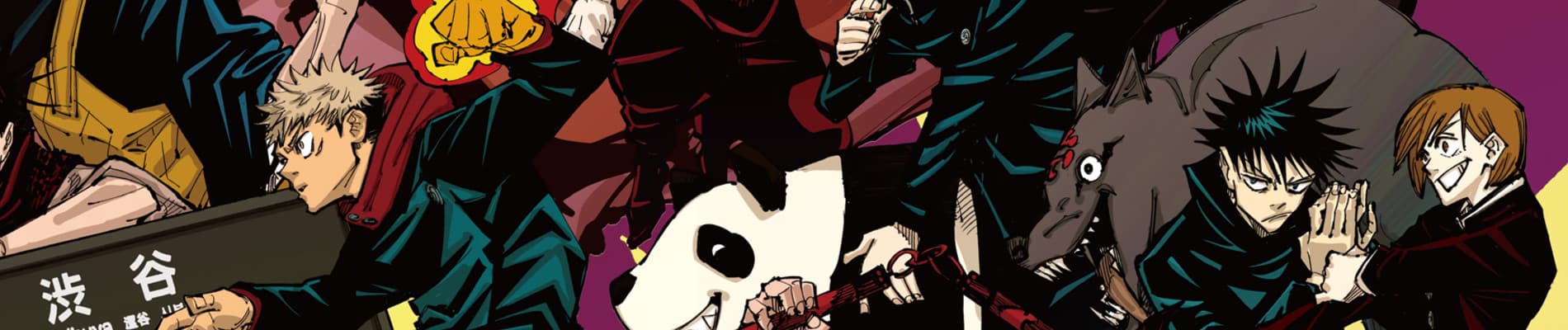
Jujutsu Kaisen
a review by Snguine
a review by Snguine
Re-reading Jujutsu Kaisen with hindsight perception in mind was like witnessing a completely different manga being played. First time reading, its action packed, frenetic battle scenes, by the seat of your pants pacing is easy to just roll with. A rereading, however, knowing the whole arc of the story and the characters, betrays a tale with a very intentional and crushing center. The work of Gege Akutami is not merely shonen battle manga, hidden within the genre that it continuously takes to pieces.
An underdog, Yuji Itadori, who initially appears as a conventional hero with a golden heart turns into a host to Sukuna, not only but to guilt, sorrow, and spiritual emptiness as well. Being aware of what will happen next the friends he will lose, the people he will not be able to save, the thing he will be made to handle every moment with him becomes a burden on re-reading it. His development is not heroic in a traditional sense; it is tormented and propelled only by trauma and not by ambition. Megumi Fushiguro also reads differently. His initial focus on rescuing people he feels deserving becomes morally cloudy and fully delusional the more you learn about his family relationships with his father and the eventual movement onward. His development seems not so much an evolution as a downward spiral.
Another character who stands out on the reread is Nobara Kugisaki. There is an intensity of wanting to be in control and to find meaning in a cursed world that feeds off of lives without mercy as reflected in her confidence and harshness. The battle she has with Mahito opens a whole new level when you realize just how integrated it is to her ideology and phobia- and how her death is both gruesome and so perfectly appropriate. Even our Gojo Satoru, the godly image many of us tend to associate, reads more human when re-read in context. He is very powerful, but aloof. His efforts to have the world in his back, to make the system and fix on his own, fails- and you start realizing that behind the charm and arrogance was somebody who was very much afraid of becoming helpless.
One thing that sticks out on my second read is the manner in which JJK is so thoroughly ideology-driven: each major character follows a particular philosophy and its clash of worldviews results in not only fistfights, but also the clash of ideologies. Sukuna is a pure ego, dominance, and chaos, he is the absolute denial of contact, he is the most bitter villain of Nanatsu no Taizai. Kenjaku is a cold, calculated evolution to the detriment of humanity. Even minor characters are characterized by their attitude to power, death, or their duty. It is not the case of heroes, but rather individuals striding onwards, in crushing load.
This structure of the story, so frequently mucky when delivered weekly, gains tremendously when read in big gulps. When you are not being tugged week to week, the Shibuya arc, in particular, feels less overwhelming and more of a tragic masterpiece. It is an arc where one breaks, mentally, physically and ideologically. Even The Culling Game reads much better on the second time. At first, what appeared to be aimless proves to be more of a gradual diving into nonsense and experimentation, a territory where Gege is able to push boundaries of what is and is not possible in terms of combat and character development.
Its artwork, which not only reaches a dramatic height but also changes dramatically over the series, is much more expressive than it receives credit. The anatomy and movement can appear crude at first, but it ends up being part of the language of the manga in that extreme distortion is of the sense of art in the scenes as the feeling and thematic intrigue. The panels are not necessarily clean, but they are always felt. Critical scenes, such as sealing Gojo, ultimate stand of Nanami, and the destiny of Nobara, land more heavily when you are aware of the consequences of what has happened earlier to the characters involved, as well as being able to track the breadcrumbs left to follow its trail.
Jujutsu Kaisen does not attempt to be comforting. Death is rapid. Justice is relative. There is something wrong with the system and the powerful cannot always defend the vulnerable. That is what makes it resonate, though. The re-read makes it clear that this is a series that very much knows the type of story it is telling and that it is not here to pull the wool over your eyes. It is not only about curses, the supernatural ones, but also about those that the society, the family, the institutes, and even identity makes.
It is not a flawless masterpiece: pacing can be a problem, some arcs (in particular, amongst the sheer number of extended cast) still feel insufficiently developed, but its emotionality and thematic scope are solid enough to support it. It is an exciting battle manga in the first read. Revisiting, it has a sad, stratified tragedy lurking behind the extensions of domains and flashy effects.
Jujutsu Kaisen is all about flaws. It is messy, inconsistent, at times unforgiving, just as the world which the show reflects is, but it is precisely its grit that makes it so captivating.
24.5 out of 26 users liked this review
