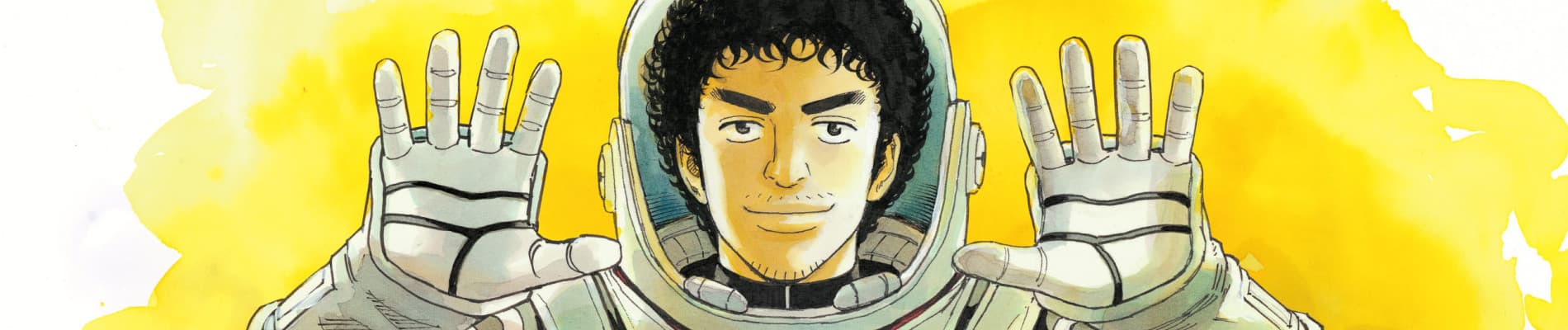
Space Brothers
a review by Snguine
a review by Snguine
Space Brothers is a truly wonderful piece of slice-of-life and aspirational drama, as the two brothers have nothing but the dream of being astronauts in mind. With more than 400 chapters, it is a very grounded yet emotionally nuts story that goes way beyond the premise it suggests and turns into a complex narrative that poses some of the most important questions about ambition, failure, and friendship.
The plot revolves around the elder of two brothers in the title- Mutta Nanba. Once full of promise, Mutta has in the meantime turned into a burned out salaryman following a career disaster, only to have his little brother Hibito line up to become the first Japanese to go into space going to the moon. This twist in the expectations is where the groundwork is done to bring in the very intimate journey of a character. The scaffolding of Mutta does not involve the most optimistic and overcoming all the difficulties storyline, but rather the gradual rise to success with self-doubt, red tape ranks among the insurmountable mountains, and all too human shortcomings of humanity.
The strongest aspect of Space Brothers is its character writing. Mutta is simply one of the best-realized leading characters in manga, neurotic, earnest, funny and so, so relatable. He is always shadowed by the success of his younger brother but his inner voice is never bitter. Rather, he continues to grow, notching little but significant wins. The manga does not shun the topic of failure and highlights how failure can be turned into stepping stones rather than a culmination. Actually, Hibito begins as the golden child, and the story cleverly breaks down his confidence when he must struggle with trauma and a lack of faith in his own missions.
Under supporting characters, which include astronauts in training, mature engineers, friends, and educators, are convincing and unique. All of the side characters also serve to enhance the main themes. Often even characters that are there but only briefly may make an impact, such as what Serika Ito has to say about curing ALS or how Kenji had to sacrifice his family to follow his goals. The stories of them do not seem like a distraction; they are what Space Brothers considers alive.
Space Brothers is a deeply thematic show. It does not pretend that ambition is a virtue to be aspired after but an unceasing, and even agonizing, impulse. It reflects on patience, age, duty and burden of the long held dream. It is also one of the few literary works in fiction that are actually able to capture the unmistakable banality and grandeur that the space industry exudes-the torturous trainings, personality tests, and bureaucracy that ultimately results in a few brief instances of celestial awe.
Chuya Koyama makes the choice of expressive realism in art. His character drawing is less than perfect and lovable, based on human eccentricities and human subtleties. The technical scenes, whether inside spacecraft or NASA buildings, are also given the attention that shows a thorough research has been taken and there is the subtle beauty in the way he draws earth as well as space. It is not glitzy, but it has never lied.
The second strength is that the manga manages to alternate between comedy and serious content. The zany behavior, expressions, and in-head dialogues of Mutta lend a light touch without driving down the emotive investment. The jokes tend to complicate depths of the characters instead of being a breach of tone.
The only criticism one can offer is that Space Brothers is paced slowly, by design. Dozens of chapters seem to pass in the journey of some arcs with hardly a plot twist. And that is exactly the point, it is about the long, hard life of fulfilling ones dreams. It reads like real life and it is not everyone is going to read it but the reward is so rich for those who do so.
At the end, Space Brothers is a hope manga. It has faith in people. It is sure that even when your plans are late, it is never late to be aiming at the stars. It does not guarantee you the results, but the meaning in the chase.
18.5 out of 19 users liked this review
