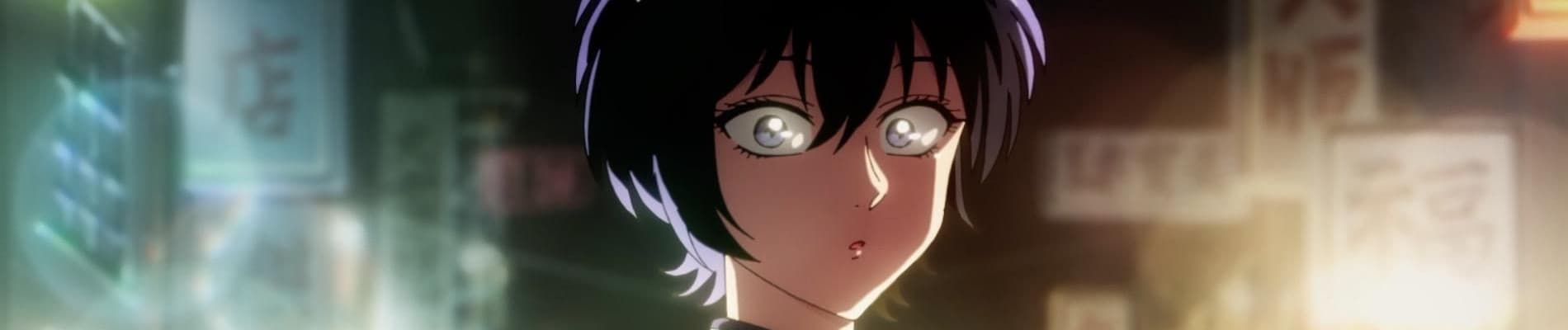

spoiler-filled review
'Kowloon Generic Romance' might appear to be just another forgettable romance, and it seems that even its title is poking fun at that fact. But once you watch it, it is anything but generic. It is not even romance as far as the execution goes.
§ Overview
Within the walls of the Second Kowloon Walled City lives Kujirai Reiko, a 32-something girl who is in love with Kudou Hajime, who is two years younger. They have a good relationship at work, but something happens that prompts Reiko to investigate her real identity.
§ Notes
The art style of 'Kowloon Generic Romance' reminds you of 90s æsthetics. It doesn't use cel animation, but it tries to reproduce the feeling of something made with cel animation.

You see, the Kowloon Walled City
Spoiler, click to viewclick to hide
doesn't really exist. It's a simulated reality made possible by the system called Generic Terra. The Kowloon City we see is based on Hajime's memory of Kowloon.
(The real-life Kowloon Walled City was a densely packed city and was demolished in 1993–1994.)

It's hard to recommend it for romance lovers, but it's more palatable for mystery lovers. It begs us to ask, Who is Kujirai Reiko really? How can fakes be real?
In this anime, a generic is a type of clone. A clone only requires that the body be replicated. But in the case of a generic, the soul and therefore the temperament of the original is also replicated.
The real Kujirai Reiko
Spoiler, click to viewclick to hide
is dead. The original, who is referred to as Kujirai B, only exists in Hajime's memory. The current Reiko is only a generic.Spoiler, click to viewclick to hide
How does she exist? Like I mentioned, it's all thanks to Hajime's memory of Kowloon, andMost have complained that it's boring. I can certainly see it to some extent. It doesn't rely on cheap fan service and the usual anime comedy. It's a mystery where we get to know, with each episode, the ins and outs of how the current Kowloon came to be.
Despite people's complaints, I like its style of storytelling. Every new information keeps you on your toes, and it leads you to ask questions and look forward to the next episode.
Some people complain about Hebinuma Miyuki and Tao Gwen's relationship and preferences, and how they are shown to be having sex much more than Kujirai and Hajime. It's as though they are the fan service.
I am neutral about these people, and, like them or not, they are key characters.
A complaint that one may hold is that the explanation for how Generic Terra works could have been better. Information is dropped piece by piece, but there's no definite version of the mechanics of how it works that is revealed.
My biggest complaint with this anime is how it displays bad metaphysicks. Since the existence of Kowloon depends on
Spoiler, click to viewclick to hide
Hajime's recollectionThis is advanced in §3 of his book A Treatise Concerning the Principles of Human Knowledge.
"Everyone will agree that our thoughts, emotions, and ideas of the imagination exist only in the mind. It seems to me equally obvious that the various sensations or ideas that are imprinted on our senses cannot exist except in a mind that perceives them—no matter how they are blended or combined together (that is, no matter what objects they constitute). You can know this intuitively by attending to what is meant by the term ‘exist’ when it is applied to perceptible things. The table that I am writing on exists, that is, I see and feel it; and if I were out of my study I would still say that it existed, meaning that •if I were in my study I would perceive it, or that •some other spirit actually does perceive it.
Similarly,
‘there was an odour’—i.e. it was smelled;
‘there was a sound’—it was heard;
‘there was a colour or shape’—it was seen or felt.
This is all that I can understand by such expressions as these. There are those who speak of things that ·unlike spirits· do not think and ·unlike ideas· exist whether or not they are perceived; but that seems to be perfectly unintelligible. For unthinking things, to exist is to be perceived; so they couldn’t possibly exist out of the minds or thinking things that perceive them."
This is where I take issue with the anime's worldbuilding. I favour a form of materialism in that space and matter have an independent existence from our perception.
Spoiler, click to viewclick to hide
If Generic Terra is providing the illusion, then Kowloon doesn't really exist but merely appears to be.Spoiler, click to viewclick to hide
Hajime and others survive despite eating and drinking stuff that's nothing more than an illusionAlso, to make Bishop Berkeley's claim even plausible is to assume the existence of God, the all-seeing universal mind. This is not realistic in the case of this anime as there is a natural limit to
Spoiler, click to viewclick to hide
Hajime's memory.I like the aspect of moving away from the illusion, which is true in the movie _The Matrix _as well as the kdrama W: Two Worlds. But the execution leaves a lot to be desired.
Spoiler, click to viewclick to hide
How was Kujirai Reiko, who is only a product of Hajime's mind, able to transition from the illusory Kowloon to the real world of Hong Kong?Yes, it is true that there are some things we know of ourselves that others don't, as we can see in the Johari Window. This theme can also be seen in Proust's masterpiece À la recherche du temps perdu.
The bonds between ourselves and another person exist only in our minds. Memory as it grows fainter loosens them, and notwithstanding the illusion by which we want to be duped and which, out of love, friendship, politeness, deference, duty, we dupe other people, we exist alone. Man is the creature who cannot escape from himself, who knows other people only in himself, and when he asserts the contrary, he is lying.'
— Marcel Proust in 'The Prisoner', volume 5 of In Search of Lost Time
___________________________
'No doubt very few people understand the purely subjective nature of the phenomenon that we call love, or how it creates, so to speak, a supplementary person, distinct from the person whom the world knows by the same name, a person most of whose constituent elements are derived from ourselves.'
— Marcel Proust in 'In the Shadow of Young Girls in Flower,' volume 2 of In Search of Lost Time
The biggest question is, how come only
Spoiler, click to viewclick to hide
Kujirai Reiko, from being someone who is illusory, was able to become someone who exists in the real world?§ Conclusion
The bad metaphysicks and this major plothole are why I am only giving this a 4 out of 10. In fact, I would have given this a 2 out of 10 if not for the art style and its storytelling.
NOTA BENE: A grade of 4 out of 10 [or 40 out of 10 in anilist] means I got some enjoyment out of this anime, but the issues are glaring, or simply I rank it higher than my 3's but below my 5's.
My enjoyment spectrum lies from 4 to 10. If I have scored an anime below 4, I actively dislike it.