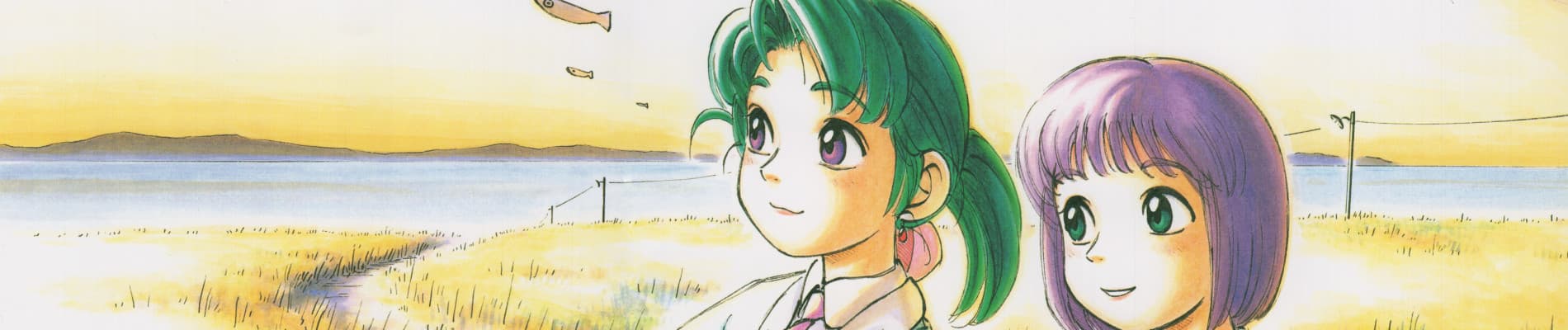
One idea that makes the melancholic ghoul nestled in my chest purr is the idea of twilight. It’s a dual natured thing like most things are, and these natures are almost seemingly contradictory with one another–the coming of the end, but gently. A life caught in the middle of decay to a rippling radiant orange. It’s something I think about often, because when I was young and impressionable I played The Legend of Zelda: Twilight Princess and got hopped up on melancholy like it was the hot new opioid on the block. But recently I found a work that also tackles this idea, but with a different, very interesting framing: Yokohoma Kaidashi Kikou.
YKK has been classified as an iyashikei, a sub-genre classified as specific to Japanese works, and essentially are defined to be “conflict-less” (which is a bit silly because conflict is pretty broad. like me writing this script or going to the bathroom is a conflict, in a way) but I don’t find that to be true at all for Yokohama. The average chapter of YKK is the main protagonist Alpha looking cute while being outright to vaguely content serving coffee or going on a walk, but there is a conflict underlying these things. The conflict is mostly conveyed through the subtext, embroidered into the art itself, the world crumbling and sinking, loosely hanging on. YKK’s main focus is showing the glow of the world through minute but evocative details while pushing and pulling that with the pervasive feeling of loneliness through the use of negative space on the page. The wistful glances from the characters, their poetic blurbs of reflection. The delicate push and pull of sadness and loneliness from time’s passage and decay between warmth, the plethora of little discoveries and sensations that come day-to-day.
The art is constructed perfectly; the texture of the world is always popping out of the pages. There’s a significant amount of negative space without it feeling empty to the point of lacking verisimilitude; a balance that allows it to convey the perfect amount of information. Looking at a page of Yokohama is feeling the lack of noise; a stillness in the water. The flurry of lines to convey shadows… greenery and manmade architecture and objects forming out of the white negative space; the color choice for color pages and chapter are perfect, and feel colored in through a vivid but meticulous crayon.
One thing that surprised me was how easy it was to binge read this manga, despite it being a relatively mundane work; not just for its quality of craft but there was a palpable sense of time drifting with each chapter; threads of relationships and ideas continuing from each chapter into the next. As I got a fuller picture of what the entire manga was trying to evoke, I was stunned by how much this was exactly the intent. The mangaka induced me to be swept up in its waves of marching time. Because of this, the pacing is incredible; everything feels meticulous without losing the aimlessness that makes the work spontaneous.
Why this work represents twilight is that it is a world slowly and melancholically greeting its end. The ending is something felt in subtext rather than the clouds separating to let down an angel hanging by strings, blowing an ominous horn to signal the coming of ragnarok. Land is lost to waves and weather, children seem to be sparse, like Japan and South Korea in like twenty years–only two adolescent characters have focus in the story. Alpha and them gain a special rapport - demonstrating that there isn’t a dissimilar amount of maturity between them, further shown in the suggestions of romantic tension between Alpha and the male adolescent, Takahiro. But with the passage of time, they get older, yet Alpha physically stays the same. Alpha herself acknowledges this with a melancholy, her soul being on a different boat than the rest of them. Takahiro and Makki will always be on that boat forever, but Alpha will stay floating in the same spot.
Misago or the Osprey is a specter of youth, an uncategorized phenomenon that always keeps the same age, only showing itself to children. Kind of like the crackhead that’s been haunting my neighborhood for a hundred years. The Osprey is uncanny and certainly off-putting to the children but also somewhat alluring. Like the way many things during childhood are when you are seeing it with fresh eyes. Takahiro, Makki, and Ayase (when he was young) all encountered the Osprey in the dawn of their days. There is something entrancing about her to the point that each person that encounters her wishes to continuously see her. But this is not the case, as each one of them grows up. Makki, being the youngest character, has a notable likeness to the Osprey, to the point that once she grows up we feel that we are in the twilight. Alpha never meets the Osprey, because her time is desynced. Never a child, but never really a proper adult either.
Time is always moving, but at different rates for everyone. Eventually those kids grow up, and way too fast. The world will become even looser, and her cafe will be swallowed up by the waves.
But there is this interesting phenomena in this world of memories of humanity being etched into the world itself. Street Lamps light up above and under the sea, lingering memories of where humans walked evolving into this transient image of lights in the water. The earth itself copies man-made creations, illuminating trees sprouting out of the ground like street lamps, mushrooms with faces of people napping, mushroom buildings sprouting out in the distance. Memories being seeds that cause the earth to sprout.
Alpha and her fellow robots are the same, Kokone coming to the conclusion that they are humanity’s children. An extension and monument to the soul of humanity. Song is flowing in their blood. Which is why I can’t stop myself from croaking out the refrain of Every Little Thing She Does is Magic during every full moon. Alpha is bursting with humanity, getting lost in song, mimicking birds with her hand. Twilight is a state of change and that is what the world is caught in, but maybe humanity remains through this change by these robots and the fungi of memories. Can our wonder survive change?
Alpha lists things she hasn’t done yet, one of which being “I haven’t walked the house counter clockwise yet.” which personally threw me back to being a wide-eyed kid, when one of life’s discoveries was doing exactly that. I remember having that exact epiphany when I was a child; doing it with my own and my uncle’s house. I did this with my same childhood home recently, with fresh eyes. And I was hit with a mixture of nostalgia and new sensations as my home has gone through all sorts of changes throughout the years. The wall colors have changed, the carpet, the furniture, the ceiling fan, new blu-rays stacked upon old DVDs; my parents are even considering when to replace our back porch because it is decaying into a state of disrepair and we’re starting to suspect it might be an accumulated homunculi of America’s ruling class. And that made me realize that… When everything is changing, everything is a new experience. And that can incite wonder.
Reading YKK is like learning to love life like Alpha tries to and that means feeling that same stinging in the chest whenever time causes another change. But Alpha is on a boat of perpetual youth. Ojisan comments that even though Alpha has noticeably grown up as she has changed throughout the series, she is still young and shouldn’t be saying cynical things about loving solitude. Like he is trying to get her to maintain that sparkle in her eyes that glaze everything in a unique sheen. To keep that childlike wonder; that the world is always something new and exciting. To be a beacon of humanity’s appreciation for life beaming brightly even as they are slowly fading away. She maintains this balance of nostalgia and anticipation of what tomorrow can bring; embracing the twilight of humanity as she becomes more and more filled up with experiences. And it’s easy to fit in the shoes of the character; all the wonderful sights like this rock cresting out of an ocean of silvergrass like a boat or a glowing vending machine swallowed by greenery colored blue by dusk makes fireworks pop in my brain. There’s a chapter where Alpha goes out to take photographs but is taken by too many sights that she ends up not taking any photographs. I feel this because I’m the type to always preserve moments that evoke something in me to the point I could be a datahoarder. Boy, I’ve got SO many screenshots of games. But lately I’ve been trying not to do that, to just let the moment wash over me and then away. I’m not sure why, maybe because I’m worried that my hard drive is going to wrinkle up and start smoking because I took yet another aesthetically pleasing anime screenshot–but I think it's likely that will help me feel moments like that again… idk.
Two older men look at a unique sight, ineffably moved. The streetlamps are being swallowed up by the ocean, but aren’t quite gone yet. They are in that transitory period, still there but on the cusp of being swallowed up completely. This sight is only possible because of change. Allowing ourselves to be taken in by all these sensations can reunite ourselves with life, and to always give it meaning. After all–
“When you get down to it people run on light, sounds or something like that.”
PS. You can also experience this writing in the intended format on my YouTube channel. ~ Logan.
44 out of 44 users liked this review