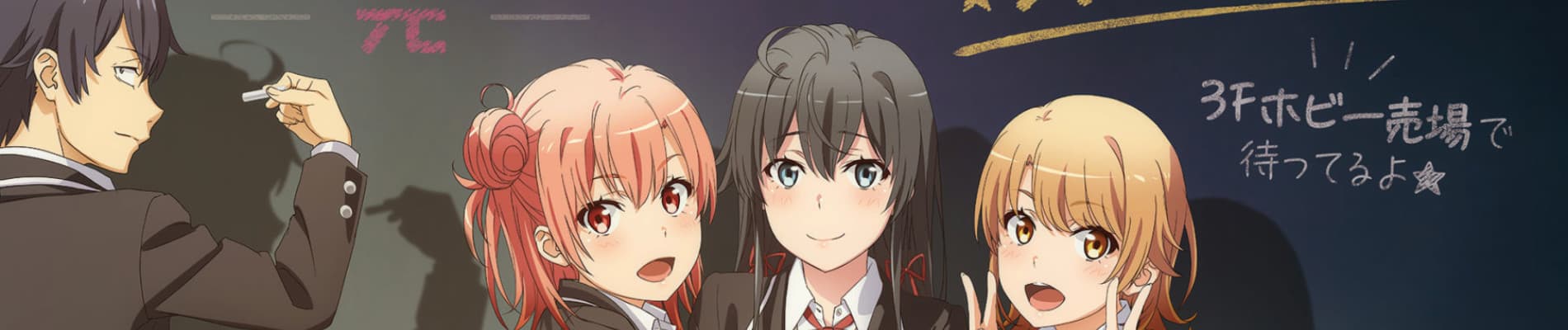
I recognize I may be in the minority here, but the third season, outside of its final few episodes, struck me as largely underwhelming. While I understand that the ambiguity, circuitous conversations, and the often maddening indecisiveness were meant to mirror the discomfort and emotional opacity of adolescence, I found myself yearning for richer, more consequential character interactions.
Hachiman's growth in perspective is evident, yet I struggle to perceive any meaningful evolution across the broader ensemble. The narrative hums a familiar tune—of faltering steps, quiet failures, and the inching pursuit of ideals that so often remain out of reach. In the end, both Yuki and Hachiman are granted a semblance of their desires, whereas Yui’s attempts at love—or at the very least, the articulation of her longing—remain unresolved, quietly sacrificed in the name of others' fulfillment.

The conclusion, though emotionally resonant for some, felt linear and overly predictable. Our two primary protagonists, whose dynamics formed the backbone of the series, ultimately found solace in a bond built on mutual recognition and the tentative promise of reciprocated feeling. And while that may offer closure, it does little to soothe the unresolved tensions left in their wake.
One of my lingering frustrations lies in the complete abandonment of the car crash subplot—a narrative device once imbued with great emotional weight. Rather than being granted a proper resolution, it dissolved into the ether, resurrected only once to serve as leverage against Yuki’s mother during the prom arc. There was no confrontation, no reflection, no acknowledgment of culpability. It was an elevated moment allowed to wither into irrelevance.
If I were to distill my dissatisfaction into two principal critiques, they would be: the abrupt dismissal of this particular plotline, and Yui’s stagnation as a character. Her arc, while emotionally charged, culminated in a quiet resignation. She adhered to Hachiman’s earlier prescription on how to win a boy’s heart—perhaps not out of genuine belief, but rather in the desperate hope that this performative affection would bring her closer to him.

And maybe therein lies her "big lie"—a misguided fabrication she clung to, believing that imitation could substitute for authenticity. But perhaps what Hachiman needed was never someone to mold themselves around his emotional fragility. Perhaps what he truly sought was something unfeigned. Someone who wouldn't tiptoe around his pain, but who could stand firm amidst it. Not a fleeting illusion, but a sincere, anchoring presence. Something—or someone—genuine.
15 out of 22 users liked this review
