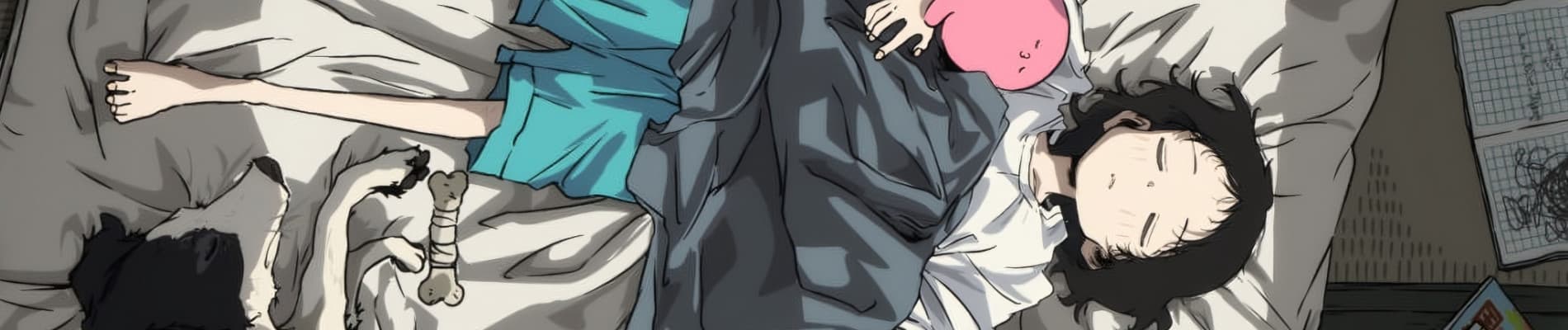
What is it that separates meaningful, affecting dark stories from misery porn? I'm sure we've all read, watched, or played stories that felt like pointless suffering for its own sake, hiding their shallowness behind a facade of cheap cruelty toward its characters and audience. But I'm sure we've also experienced other stories that are just as cruel, if not more, that left us sobbing wrecks and changed the way we saw the world. So what's the difference that separates the Evangelions from the Mirai Nikkis of the world? Simple: purpose. True darkness in storytelling comes not from the simple fact that bad things happen, but what those bad things say about the world we live in and the lives we live within it. Anyone can write a story where lots of characters suffer and die, but not everyone can use that violence as a backdrop to explore the horrors of prejudice and genocide as spectacularly as Attack on Titan. Not everyone can use that misery as a window into the evils of authoritarian control and bodily violation the way Gen Urobuchi does. And not everyone can turn the suffering of cute anime kids into something as wrenching, beautiful, and transformational as Takopi's Original Sin.
The premise, at least at first, is simple. You know shows like Doraemon, where an alien or magical creature of some kind comes to earth and helps solve some random kid's problems with their cool superpowers? Well, what if one of those child-friendly mascot critters was tasked with trying to help a kid who's problems are far, far more serious than a bad attitude or some missing homework? Such is the case with the titular Takopi, an octopus-like alien setting out from his homeworld on a mission to bring happiness and smiles to the people he meets on Earth. Unfortunately, the first person he meets is Shizuka, a nine-year-old girl suffering from bullying and neglect that's left her a traumatized shell of a person. It's a level of misery that Takopi simply doesn't have the emotional context to understand; hell, his species is so sheltered, they don't even really have a concept of cruelty. All he can understand is that Shizuka is sad, and he wants to make her smile. And it's only a matter of time before his naive, ignorant good intentions turn what was already a bad situation into a walking nightmare.
If that sounds like torture, well, it is. In just six episodes, Takopi's Original Sin manages to be one of the most viscerally upsetting experiences I've ever had in anime. Much of the show's tension hinges on dramatic irony thick enough to choke a walrus; we'll see Shizuka being menaced by her bullies, or neglected by her mom, and Takopi will misinterpret them as something nice and friendly with a simple solution. But we, of course, fully understand the horror of the situation, and all we can do is suck in air through our teeth as we wait for Takopi to happily bumble his way into making everything ten times worse. And when those moments come? Christ, do they mess you up. There are scenes in this show that left me struggling to breathe for minutes afterward, that's how hard they hit. I like to think I'm pretty desensitized to dark things in fiction at this point, but this show proved me so, so wrong. And the more the situation spirals, the harder and harder it is to see any way out of this miasma of despair Shizuka's trapped in.
So how is this not misery porn? What's the point of subjecting yourself to something so unrelenting and bleak? Well, again I return to that word: purpose. Takopi's Original Sin is not cruel for the sake of cruelty: this is a deeply, deeply angry show. Angry at the concept of "toxic positivity" that Takopi embodies, the mindset that you can just wish your problems away if you think happy thoughts while the reality remains as cruel as ever. Angry at the adults who let real kids suffer like Shizuka does, either willfully ignorant to their pain or actively complicit in it (without spoiling, let's just say Shizuka isn't the only kid in this show with demons hounding her every waking moment). This show is furious at our world for the way we let kids like Shizuka slip through the cracks, swallowed by misery that no child deserves to bear. And it's furious too at how easily we allow children to continue that cycle of abuse themselves. Pain in Takopi begets pain begets even more pain, kids repeating their parents' cruelty upon each other because they've never known any other way to interact with the world than with malice and rage. By the show's end you'll be hard-pressed to find anyone blameless... but you'll also find it hard to blame them for anything considering what drove them to the extremes they eventually reach.
And what of Takopi himself? Which of his mistakes counts as the titular "original sin?" Well, if you ask me, it's not any one event, but the very mindset that leads to them all: trying to help without first trying to understand. Shizuka's problems can't be wished away by a magic wand or banished with a friendship ring; she's a girl trapped by circumstance, crushed by structural rot and societal neglect that no quick fix can make disappear. In a just world, some rational adult would realize what she's going through and take action to save her, but Takopi is little more than a child himself. In the absence of people with the power to actually change things, Shizuka's only hope is an alien who doesn't even understand why things need to change, too immature to understand the true horror he's dealing with until the gristly consequences of his actions are staring him dead in the face. Only then, when it's far too late, does it finally start to sink in how unprepared he was for a situation this broken.
This, more than anything, is the point of Takopi's Original Sin: what does it truly mean to help someone? How can you save the people you love when the problems crushing them are far out of your control? There is no magic solution for Shizuka's misery, or the misery of any of the show's characters. Their traumas are the result of circumstances they have no power to change, that no amount of sci-fi gadgets or wishful thinking can make disappear. But that doesn't mean you can't help however you can. Even if it's as small and insignificant as being a shoulder to cry on, every miniscule act of kindness and compassion matters. And watching Takopi struggle his way toward that realization, forging his empathy piece by piece in the furnace of his time on Earth, makes every speck of light and moment of joy pierce this show's darkness like a lightning storm. Not because Takopi snapped it away with a single squishy tentacle, but because he gave Shizuka something far more valuable than any of the magic doodads he carries with him.
Because for all its darkness, Takopi's Original Sin is a story about hope. It's a story about what it takes to hold on to hope when your life seems determined to snuff it out. It's a story about how to give hope to others when it feels like there's nothing you can do. And honestly? That's a message I find more and more valuable with every passing day. As much as I love stories where everything is perfectly solved by the end, I know the real world, on a personal and societal level, won't be fixed that easily. There are so many people suffering like Shizuka, trapped by abuse, neglect, poverty, and countless other cruelties that can't be wished away no matter how much we try. But the empathy that Takopi develops over the course of this show is the empathy we all need to share with each other. We may not have the power to fix everything that's broken, but we can give each other the strength to bear our demons regardless. Through hell and high water, we will survive the worst days of our lives and find something better on the other side. And every single scrap of happiness we share with each other is one more weapon in our fight against giving up.
It also much be acknowledged what a spectacular job the anime staff has done communicating this message. It would be so easy for all these good intentions to be bludgeoned into submission by a production that wasn't competent enough to communicate the nuances of Takopi's themes. But director Shinya Iino and his team of veteran web-gen animators didn't just understand the assignment, they wrote a whole new assignment and graded the teacher on it. Every single frame of this show is a masterpiece. Every second bleeds with stunning animation and calculated intent. From the loose, grimy character designs that twist and contort with the story's extreme emotions, to the constantly off-kilter cinematography that sinks you headfirst into the tension of every scene, to the score that perfectly contrasts Takopi's naivite with the trauma he fails to recognize, this is one of the most impressive, fully realized anime productions I've ever seen. This is why visuals are so important in visual mediums; I can't imagine this story working nearly as well if it didn't do such a perfect job using its god-tier animation to capture the complex, often contradictory tone it uses to communicate its themes. The fact they nailed it this perfectly is honestly kind of insane.
Takopi's Original Sin is not a series for everyone. The first episode opens with two content warnings- first time I've ever seen that- and somehow even that feels like underselling how difficult this show can be to get through. It's a series I think everyone will come away from with different things they wished they got more of, different characters we got to spend more time with or ideas we got to dig into deeper (at one point Shizuka's character makes a pretty drastic turn that I don't think was executed as well as it should've been). But if you're able to brave its uncompromising twists and turns, you'll find something truly meaningful lurking in the shadows. This anime may be dark, but only so it can help the world shine a little brighter--- and I'd say it accomplishes that with flying colors.
43.5 out of 47 users liked this review