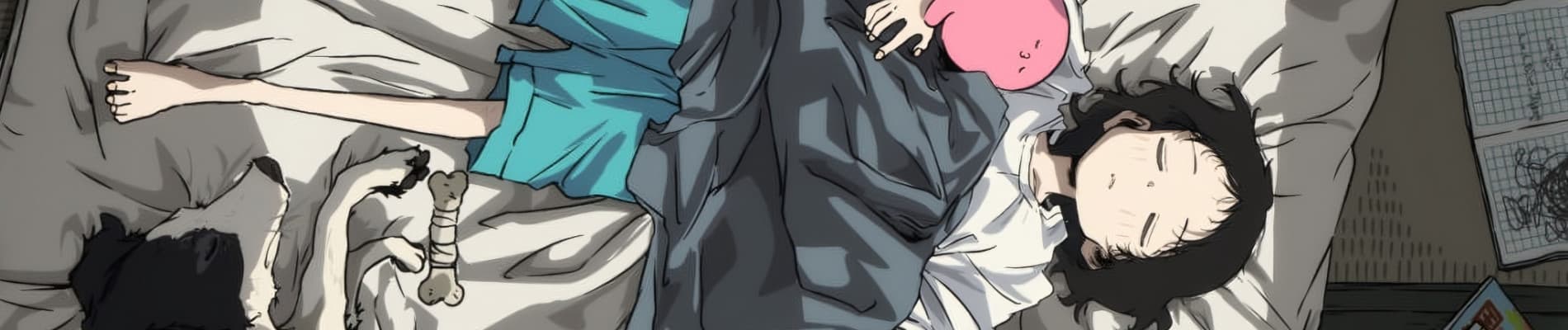
My opinion on the storytelling, which I believe is one of its strongest points, is that the story is densely and concisely told in six episodes. I will not delve too deeply into the plot in this review, as I have already discussed it in a separate post that you can read. I will focus more on the narrative structure of this story, which avoids any extraneous or unnecessary moments. The anime Takopi's Original Sin operates on the principle of "Chekhov's gun," where every element introduced is later utilized. As someone with some expertise in short story narratives and the thinking of the Russian writer Anton Chekhov, "Chekhov's gun" is a literary principle which posits that every element in a story must be necessary and play a role at a later stage. In other words, if a writer introduces an object, such as a rifle hanging on a wall, that rifle must be used in a later part of the story. If it is not used, it should not have been included in the first place. The story bravely tackles sensitive subjects such as school violence, suicide, family abuse, and their psychological effects on children. Through the tools provided by the writer, such as the creature Takopi, its abilities, and its various gadgets, each is utilized effectively. A simple example is in the first episode, where a simple ribbon, supposedly capable of mending a broken relationship, is used as one of Takopi's tools to develop the story into a heartbreaking moment. This has made the work not just for the strong-hearted, but a mirror for society to confront its darker aspects by understanding the motivations behind each character's actions. Chekhov discusses the impact of this principle in three points. First, in a story, an object must have a reason for its existence and contribute to the development of the plot. Every object in Takopi had a purpose, from the ribbon and the camera to the capsule and the kites, and even Shizuka's dog. Second, it makes a promise to the reader: when the writer draws attention to something, it is a promise that this object will be significant later. Therefore, the writer's act of drawing our attention is a promise that important events are unfolding beneath the surface of the plot, similar to the time travel in the first episode which left many wondering from the moment of Shizuka's death how this complex knot would be resolved. The third point is the avoidance of superfluous information. This principle encourages writers to steer clear of unnecessary details that do not serve the story. For example, questions like: Who is Takopi? Why is there a Planet of Happiness? Why must every Takopi bring someone with them? Or, what was the reason Shizuka's father left his wife? Who is Azuma's father? How did Shizuka return from Tokyo? Many such questions are extraneous details, and the writer often clarifies them through symbolism rather than dedicating screen time and scripting entire scenarios around them.
Is the story original or derivative?
To answer this, one must look at the seasonal anime offerings over the past few years. In my opinion, there is no work quite like Takopi, and the production of this type of anime is rare. I consider Takopi to be a special case because such scenarios are difficult to execute and can be psychologically unsettling. Studios and Japanese broadcast policies often don't permit such content unless a work is categorized as "seinen" (for young adult men) and rated for audiences over eighteen. Some examples of this genre date back to the 1980s and 90s. The most prominent recent example similar to Takopi is The Promised Neverland, a work that, in its manga form, delves into significant psychological, physical, and social burdens. Consequently, the studio felt compelled to sanitize the story and effectively derailed the plot in the second season. This same fate befell all four seasons of Tokyo Ghoul. However, if one explores the world of manga, dozens, if not hundreds, of works similar to Takopi can be found.
Is the story's progression logical?
There is nothing strange about the narrative's trajectory; events unfold according to their own established rhythm. My only reservation concerns the final episode, where some events felt unprepared for, culminating in a shocking conclusion for Takopi. Logic in this anime is primarily relevant to the theme of time travel; the other events depict the lives of ordinary children who have fallen victim to their family circumstances, a reality that needs no further emphasis.
Does the plot progress in an escalating manner, or is it step-by-step?
The previous question also answers this one.
Characters:
A thorough discussion of each character would require extensive commentary, but I will try to be brief. I'll start with Takopi, an alien from the planet "Happy" whose mission is to spread joy. His simplicity and lack of understanding of human pain and complexity lead to disaster from the very first episode. Takopi mirrors the blind goodwill that adults often display towards children's problems, attempting to find solutions without truly understanding the realities. Takopi's "original sin" is his ignorance and his interference in matters he cannot comprehend. In appearance, he resembles a psychiatric medication, as if to suggest that such medications can alter a person's mindset to a state of temporary, rather than permanent, "happiness." Takopi's help was temporary; in the end, he had no solution for the problems, as if to say that psychiatric drugs do not solve problems but merely leave them in a state of suspension.
Shizuka Kuze: A withdrawn girl who is the victim of constant bullying from her classmates and neglect from her mother. Her only source of comfort is her dog, Chappy. Shizuka's character is written in a way that elicits both pity and sympathy from the viewer, evolving from sadness to resentment. At the same time, she has a side to her that is capable of resorting to unexpected actions to achieve her goals, including manipulating others for her own benefit. She believes these are the right decisions to get what she wants. Furthermore, she has come to understand pain as a natural part of her existence. You see no pain, tears, or screams in her eyes; she has accepted her reality within the environment she faces.
Marina Kirarazaka: Initially appearing as the main antagonist who mercilessly bullies Shizuka, it is gradually revealed that she too is a victim of a broken family environment. The story does not ask us to condone her actions but encourages us to understand her motivations. Marina's environment is shaped by an irresponsible father and a mentally unstable mother who tries desperately to make her daughter understand her, seeking support from her child rather than providing it. Consequently, Marina believed that her actions against Shizuka were a way of supporting her mother, venting her own anger on someone she perceived as guilty, though innocent. In an environment where no one clarifies right from wrong, a scenario like this is created.
Azuma: A classmate of Shizuka who appears to have a perfect life but is under immense psychological pressure from his mother, who constantly demands perfection. This leads him to seek approval and affection outside of his home. He sees his mother's image in Shizuka and tries to win her approval to experience what it means to be accepted by someone. This is a kind of psychological complex where a person seeks from a similar individual what they cannot obtain from another, a product of family pressure. This is why many families, when a son or daughter makes a mistake, fail to see their own shortcomings, still believing the children were at fault. Any child who finds an emotional substitute outside the family will turn their back on their own. There are many other important aspects to Azuma's character, but to keep this brief, I will conclude my thoughts here. I may discuss him further in a dedicated post.
Animation: On an artistic level, there is much to be said, and critics of this anime have given it high praise. The anime has a unique visual style that perfectly complements its heavy psychological atmosphere and narrative. The character designs and color palette, particularly the use of flat colors and the avoidance of complex highlights and shadows, lend a raw and realistic feel to the production. This simple artistic style creates a stark contrast between Takopi's innocent appearance and the painful world he has entered. The clever direction and cinematic camera angles make you feel as if you are watching a live-action film. Among all the popular anime of its season, Takopi was number one. While people were singing the praises of Lord of the Mysteries, no one believed another anime could emerge as a seasonal competitor. In my opinion, the direction of Lord of the Mysteries was so focused on heavy backgrounds and showing off its technical prowess that the direction itself was not enjoyable. In contrast, Takopi's direction is a symbol of the story's success and provides direct enjoyment to the viewer and listener.
Regarding the opening, ending, and music: The music was beautiful throughout, the kind that lingers in the viewer's mind as the events unfold. Many anime have music so weak that it fades into the background during important scenes, unfelt and mismatched with the theme of the events. Takopi is an exception. The opening was not unlike that of any other typical anime of the season, and I believe there were better openings in other anime from that season. However, I think Takopi's opening is artistic and can serve as a good example for producing more distinctive openings. The ending was standard and fit the mood of the episodes, and the anime staff had a nice vision for it. I would give the opening an 8 out of 10 and the ending a 7.8. The OST and music deserve an 8.4.
Discussing the message and emotions: On this point, one of the most common phrases used by Japanese critics and viewers to describe the anime is "beautifully sad" (utskushiku kanashii). It is reminiscent of what Mikasa said: "This world is cruel, but it is also very beautiful." The end of the anime conveyed this message to us. From Takopi's perspective, the message "Talking brings happiness" conveyed the emotions. It is a message to families, society, and organizations to properly address the issues of children and to provide more educational messages.
I was recently reading interviews and comments from the author, who stated that the idea for the anime Takopi's Original Sin came about when they were told to draw something that caught their attention. Having loved Doraemon since childhood, they wondered what it would be like to draw something similar, but darker and more melancholic. The idea of incorporating time travel into the story was inspired by the anime Re:Zero. Also, instead of a human being transported to an "isekai" world, what if another creature, like Takopi, came to our world? In a 2022 interview, the author also stated that Inio Asano, the creator of Oyasumi Punpun, had a great influence on the start of their professional career and that they relied on his plans and outlines. In the same interview, they mentioned that they get ideas for their stories from social media, social networks, and games like Undertale. As I mentioned earlier, the Takopi anime is a rare and unique creation. An average viewer would be unlikely to find a story like this unless they consistently watch both old and new manga and anime. There are many good anime that address family, emotional, and social issues. I plan to create a list of such works in the future.
Final thoughts: In conclusion, Takopi's Original Sin is not an easy work to digest and is full of heartbreaking scenes. However, it is also one of the most honest and impactful recent anime productions, bravely discussing the pains of childhood and the failures of society. Its central message is that no one is entirely good or bad, and that often the greatest disasters stem from good intentions and misunderstanding, in addition to the social issues that are central to the anime's themes. My rating for the entire story is an 8.5 out of 10, though for many it might deserve more, perhaps a 9 or 10. Thank you for reading.
30 out of 31 users liked this review