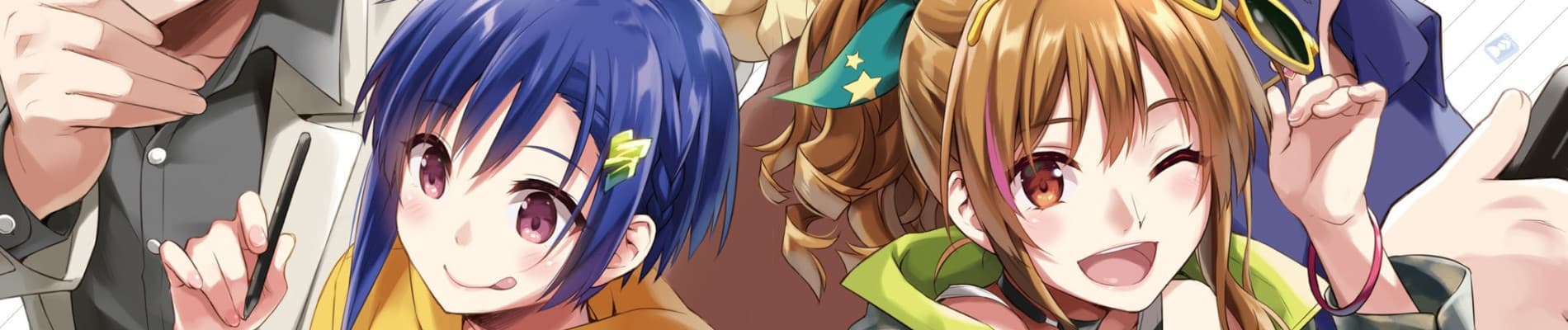
Remake Our Life! How is rebuilding one's life a necessary endeavor?
Finally, I've dedicated an article to the topic of decision-making, though it took a great deal of effort to even decide to write this post. For the most part, many events have occurred in everyone's life that may have made them feel hopeless about making the wrong choices for their future career and professional life. These events might have stripped them of the ability to act and succeed, leading to a kind of isolation, followed by resignation and the absence of any plan that could alter the repetitive rhythm of their lives and move it from point A to point B. What we are discussing today is the anime "Remake Our Life!"... and how rebuilding one's life is a necessary endeavor.
First, to understand the world of this anime, we must know that the story begins with a young man named Kyōya Hashiba. He is in his late twenties but feels old and weary. Although he was accepted into an art college, he didn't enroll because he feared the risks associated with his future and decided to attend an economics and finance college instead. After graduating, he drifted, taking on various jobs while learning skills he was passionate about, such as web design, music composition, basic programming, and so on.
One night, on his way home after being rejected for a job in game design, he saw a depressed-looking girl on a bridge who seemed about to take her own life. It turned out to be a misunderstanding. As fate would have it, that girl, Eiko Kawasegawa, was the project manager for a major game company. Her team included three key figures known as the "Platinum Generation," who were working on creating a game. Coincidentally, Kyōya was a fan of the artwork of one of the Platinum Generation members. Eiko mentioned that they urgently needed to fill a position on the project, and Kyōya offered to take the role, given his experience in game development.
Kyōya signed a contract and worked temporarily at the company until the project's completion. He quickly surpassed Eiko's expectations with his speed and dedication. However, the project was eventually canceled. Jobless and penniless, Kyōya went home and wished he could go back in time. When he woke up, his wish had come true. He had returned from 2016 to 2006 and now had the chance to attend art school with the future members of the Platinum Generation: Tsurayuki Rokuonji, Nanako Kogure, and Aki Shino. He would soon learn that things were far more complicated than he had ever imagined.
What is the important theme of the story?
The text above is merely an introduction. The main theme we are discussing is "decision-making." This is a timeless concept about implementing ideas to solve problems. These problems can be small and routine or fateful—like your future or someone else's, similar to Kyōya's situation—with a radical impact on an individual's life. But whether a problem is large or small, they are always interconnected. A person needs the ability to think logically to handle it, a skill that not everyone possesses but can be acquired and developed.
The anime's main character exemplifies this as he strives to resolve every issue. We saw how he solved the lack of a camera by using still photography. We saw how he uncovered Nanako's singing talent, showing her that it could be her path, and helped mitigate the side effects. We also saw how he solved Tsurayuki's financial problems by creating a game. These examples are shown to inspire us to be decisive.
There are many ways to solve and deal with problems, and these methods change with the nature of the problem. Some problems end with a solution, meaning they are resolved. Others don't end but can be lived with and accepted, like the breakdown of Kyōya's relationship with Tsurayuki, which altered the future of the Platinum Generation. He managed to solve their problems, but in doing so, he took away the most precious thing they had: their art.
Problem-solving can be defined as a cognitive act, much like Kyōya's decision in the final episodes to fix a technical bug in a game while providing the development staff with all the other necessary details. This simplified the task, allowing them to ensure the product's success in less than two weeks. Thinking deeply about problems leads to exemplary decisions.
How is this useful for changing your life?
Changing your life is difficult if you lack the necessary confidence and strength to pursue what you want for your future. For example, someone might become an architect but spend their time developing skills in other areas where they are more talented, such as web design, video editing, media, and other arts in which they are proficient.
The anime "Remake Our Life!" conveys the message that you can change your life by deciding what you want, not what others demand of you. A common issue many people face is the inability to oppose their family's decision for them to become a doctor, for instance. While they may have the aptitude for it, their passion, desires, and mental state can be barriers to success on that path. It requires personal passion and interest—a point that is surely lost on many.
There are many points to consider, but another aspect is the unhealthy reaction of some fans, which can break an artist. For example, labeling a person's voice as unpleasant can trigger a sudden negative backlash. Meanwhile, studies show that many artists experience suicidal thoughts. Most are held back by their public image, status, and other factors. However, many who feel they have nothing to lose but themselves do act on these thoughts. In the end, there is much more to discuss, but these points are sufficient for understanding.
What is the quality of the anime?
The quality of the anime is poor; I cannot say it is very good. However, its concept is strong. It would have been better if the pacing had been slower to build and strengthen relationships and to introduce more powerful events, as a lot of effort was put into the emotional aspects. But in some episodes, the core essence of the story is sidelined for more superficial elements. The direction is mediocre, and when the animation is stiff, you fail to connect with the characters' emotions and genuine reactions.
I give it a 7/10. Many others might rate it lower. But if you look closely and ignore the clichés, you can give it a good score.
4 out of 6 users liked this review