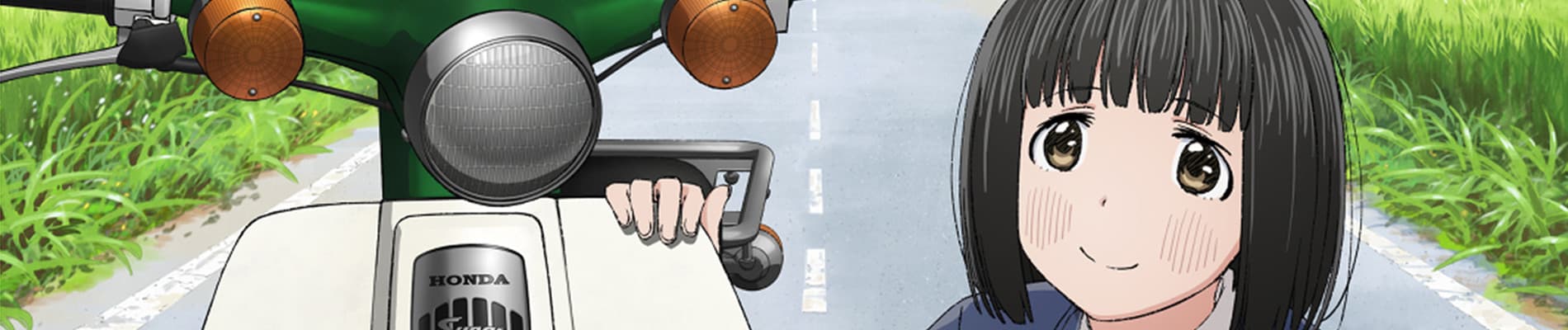

Super Cub is an anime that surprised me with its quiet charm, even if it didn’t fully win me over. One of the strongest aspects is its visuals. The backgrounds are gorgeous, giving the impression that the creators put real effort into faithfully reproducing Japanese landscapes. Even as someone who isn’t Japanese, I could feel the authenticity of the scenery. The animation itself is adequate — it’s not the fluid, action-heavy kind you see in battle anime, but it works well for a show focused on everyday life and small personal moments.
The soundtrack is neither a highlight nor a weakness. It does its job of supporting the mood without distracting, but it’s not the kind of music I’d go looking for after watching. The sound design blends into the background — fitting for a “healing” anime — but this also means it never truly stands out.
Character-wise, there’s a lot to appreciate about Koguma’s development. At the start, she is withdrawn, with an almost expressionless demeanor, and she lives entirely alone with no family around. Over time, thanks to discovering her passion for riding her Super Cub, she becomes more open and willing to help others. Her growth in handling requests from people around her is noticeable, although I found her a bit passive-aggressive in the later episodes. That slightly sour note didn’t ruin her arc, but it did make her harder to fully connect with at times. I also would have liked more explanation about her background. The fact that she has no parents, lives alone as a teenager, and sustains herself on what seems like a small “salary” is never clarified, which made it harder for me to fully accept her starting situation.
Thematically, the anime explores loneliness, independence, and the joy that comes from finding a passion. Like Yuru Camp made me want to go camping, Super Cub made me want to ride a motorbike. Unfortunately, in my country (Brazil), riding one isn’t nearly as safe as it is in Japan, so that inspiration stays in the realm of imagination. Still, it was satisfying to see the characters travel across Japan, showcasing both the landscapes and the freedom that their Cubs brought them.
The pacing is undeniably slow, as is common with “healing” anime. These series rarely have major plot twists or dramatic moments; instead, they rely on subtle changes in characters and situations to carry the story. While this can be calming, I was already a bit fatigued from having watched three seasons of Yuru Camp before this, which probably made me less receptive to another slow-burn series. The one part where the story tries to raise the stakes — the accident involving Shii — didn’t feel fully developed or emotionally impactful. However, the ending, with the long-distance Cub journey and Shii buying her own Cub, was a satisfying and optimistic close.
Overall, Super Cub is a well-made slice-of-life anime with beautiful scenery, a gentle atmosphere, and a strong central character arc. However, its slow pace, lack of emotional weight in key moments, and underdeveloped backstory for the protagonist kept it from being great for me. It’s a nice watch if you enjoy quiet, atmospheric series, but don’t expect dramatic highs or unforgettable music. For me, it lands at a solid 6/10 — pleasant, but not essential.
7.5 out of 11 users liked this review
