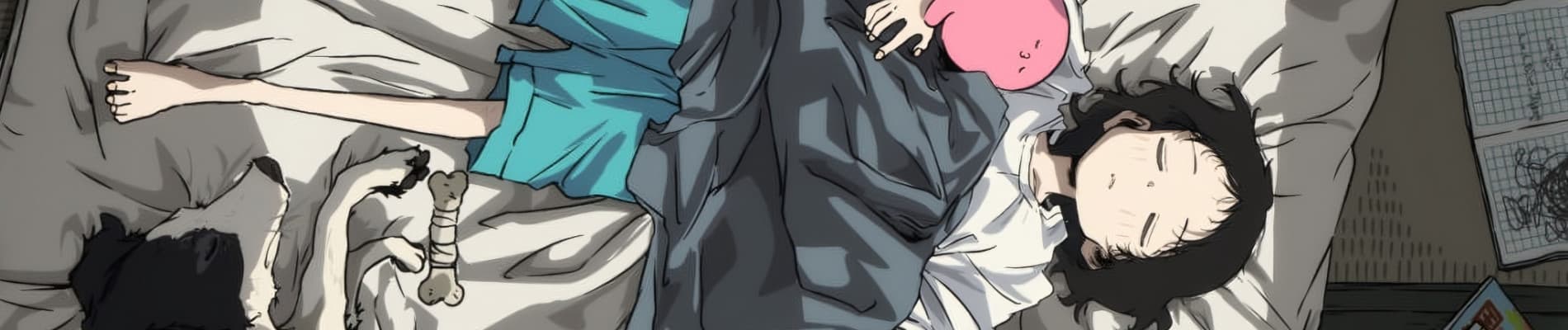
I believe this anime offers a compelling exploration of childhood psychology, showcasing how children’s actions can, in fact, be deeply damaging. Not everything is a game, and being a child doesn’t excuse one from causing serious harm. What stands out is the constant shift in perspective, how the anime presents the narrative through different lenses, gradually giving you more reasons to hate someone you once loved, or love someone you were convinced to despise. In this review, I want to unpack my thoughts on our three main protagonists, with particular attention to Naoki, who, in my opinion, hasn’t been discussed enough since the anime’s ending yet he remains an incredibly intriguing character.
Starting with Shizuka, our introduction of her is literally seeing her being relentlessly bullied by Marina, who hits her, verbally abuses her, belittles her daily, and even goes so far as to plot to take away the only thing she has left—the companionship of her loyal dog. Shizuka’s life is a never-ending torment, with her bond to Chappy being the sole ray of light. Once that too is taken from her, it becomes the final drop—her breaking point. At that moment, she gives up, convinced that her life will be nothing more than misery, abuse, and humiliation from that point on.
The anime, in just a few minutes, creates the sense that there is no escape from this hell. But Takopi eventually manages to break the cycle—despite multiple failed attempts to eliminate Marina. It’s here that we see Shizuka’s true emotions come to the surface for the first time. Her mask drops. All that rage and trauma she had internalized bursts out, and she finds herself wishing for Marina’s death—seeing it as the only possible resolution.
Of course, Marina’s actions up to this point are indefensible. But what’s equally unsettling is the joy Shizuka feels at her death, and how easily she begins to plan how to cover up the crime. Despite once being a broken girl pushed to the edge, once Marina is gone and her problem seemingly "solved," she feels at peace—even if it means sacrificing Naoki in the process.
Later, within the same timeline, we see just how deeply damaged she has become. Longing for Chappy once again, she goes as far as to kidnap two innocent girls as a response to the emotional pain inflicted by her father. Her behavior consistently reveals a pattern: acting out of selfish desperation to get what she wants, regardless of the cost or who gets hurt along the way.
The anime doesn’t try to paint anyone as a saint. It shows that under different circumstances, even the most seemingly innocent person could act selfishly when given power. It's a brutal but honest reflection of human nature: people often decry injustice until they’re in a position of privilege—at which point they may cause harm for their own benefit without a second thought.
You can't fairly judge Shizuka for anything prior to Takopi’s irreversible act, but it’s important that we got to see this darker side of her. It adds layers to her character, reinforcing the idea that things are never purely black or white. When one side dominates, even the kindest soul can commit inhumane acts.
!Alt Text
Marina is first introduced as the classic school bully—quick to abuse and humiliate Shizuka at every opportunity. At first glance, she fits the stereotype of the rich, popular girl who targets the weakest link to assert dominance and maintain her status. But that perception quickly falls apart.
We soon learn that Marina's behavior is not rooted in simple cruelty, but in a deeply personal vendetta. Shizuka’s mother, who works as an escort, was a factor in Marina's father abandoning their family. Her hatred is not born from jealousy or social superiority, but from emotional manipulation and trauma inflicted by her own mother.
Instead of holding her father accountable for leaving and wasting all the family’s money on alcohol and sex workers, Marina’s mother channels her rage into blaming women like Shizuka’s mother—and by extension, Shizuka herself. Marina, already a victim of both psychological and physical abuse, is further brainwashed into believing this twisted narrative. As a result, her cruelty towards Shizuka becomes a tragic form of misguided revenge.
In alternate timelines, Marina’s suffering continues, with her mother never ceasing her emotional warfare. She becomes a vessel for her mother’s unresolved anger—a child being punished for sins that were never hers.
One particularly poignant moment is when Marina’s mother breaks down, begging Takopi—disguised as Marina—to give her daughter back. Even though he looks exactly like her, she immediately senses the truth: it’s not her real child. (Admittedly, this isn’t a huge stretch of logic, but I respect what the anime was trying to convey.)
Even in the so-called "good ending" timeline, things don’t magically fix themselves. Marina still bears a scar on her face, a literal and symbolic reminder of her pain. However, she is no longer alone. Someone stands by her, supports her, and helps her move forward. Her mother, too, begins to step back and change—slowly.
Children mirror their parents, and often repeat what they learn. But Marina manages to break that cycle. She reclaims her identity without completely cutting her mother out of her life. We don’t know for sure, but it’s possible she even forgives her in the end—a decision she was never obligated to make, but one that shows how kind-hearted she may have been before the abuse warped her.
# Focusing on Naoki: A Neglected Yet Fascinating Protagonist
Beyond the two heroines, the story also centers on Naoki, who initially appears as a kind-hearted boy—someone who loves Shizuka and truly wants to help her. Beneath that exterior, however, he is battling deep psychological struggles that distort his perception of others’ emotions, as well as his interpretation of events around him. Unfortunately, many overlooked him—and that’s why I’d like to delve deeper: he deserves more attention, especially in my view.
At first, he seems shy but earnest—a good student eager to offer help. Yet we come to understand that he too carries wounds of his own. His greatest conflict stems from constantly living in the shadow of his older brother, striving—at least a little—to match him, in the hope of earning his mother’s love. This anime captures that destructive facet of ourselves, and I find Naoki to be a profoundly relatable character, particularly in terms of the burden of expectations.
Expectations—especially when they demand becoming someone you’re not—can compel a child to sacrifice their own self. From an early age, Naoki was told that he was the only one capable of achieving success—or worse, that he must surpass his limits to be seen as the heir to his mother’s medical clinic. Many have endured similar pressure from parents or those around them, where lofty expectations presented as the sole path to acceptance are often devastating—even when the parents had the best intentions in mind.
Before writing my own review, I watched several analyses and noted that many reviewers seem to have missed an essential aspect of Naoki’s character. A common frustration is that he ignores Shizuka at the end and chooses to be with other kids—finally those who see him as he is: a young person with his own worries who argued with his brother and aired his concerns—not a lifeless robot programmed to fulfill parental ambitions at the expense of his own identity.
At that point, he no longer believes he must fulfill someone else’s dreams at the expense of his own needs. For the first time, he expresses genuine interest in everyday joys—like playing on the PS4, something other kids admire and view as “cool.” Finally, Naoki finds his footing. He begins building friendships not founded on toxic ideals—unlike when he first bonded with Shizuka under desperate, self-destructive pretenses. Here’s what I mean:
In one of the latter episodes, Naoki is drawn to Shizuka simply because she resembles his mother emotionally and in gestures. He mistakes attention for affection—an acknowledgment he’s yearned for all his life: a sign that his struggles meant something to someone. That single sincere smile from Shizuka—when she stands by him by covering up Marina’s murder, or holds him to comfort him as they face surrender to the authorities—is what he’s been desperately seeking from his mother, or at least someone who felt like her.
I believe that’s why he doesn’t end up with Shizuka at the story’s conclusion. He’s found himself. He’s resolved the issues with his brother and opened up emotionally, allowing him to tackle the problems at the core of his suffering. He finally hears someone who genuinely cares say: “Follow what you love. Be yourself.” No longer chasing a shadow, he embraces his own identity—his interests and his personhood—and can now coexist with others and live the life that was once kept from him by the chains of third-party expectations.
At this section i want to point out the misses and overall criticisms i have about the show that hold it back from a higher score although i usually rate things pretty strict, (spoilers) a 75/100 is pretty high for me and i appreciate this show deeply for everything else... i am sure you can tell by the sheer volume of words i have to express towards this!
Here are a few elements that slightly detracted from my experience:
Plausibility of Children's Behavior
Some of the children’s actions feel exaggerated for their age—particularly Shizuka’s 180-degree shift when she gains power over others. While isolation can blur moral lines, the extremes she goes to—attacking Takopi repeatedly and nearly dismembering two little girls to reclaim Chippi—felt somewhat removed from my sense of realism. Although disturbing bullying exists in real life, seeing it portrayed so graphically in a young child occasionally pulled me out of the narrative.
Runtime & Pacing
At approximately 2 hours and 20 minutes, I feel the anime could have been trimmed to closer to 1 hour and 40 minutes—without sacrificing clarity. For instance, we already grasp Marina’s suffering before watching the timeline where she finds Takopi. Repeated exposure to the same pain made it feel overplayed.
In my opinion a Rushed Ending
The resolution, triggered by a simple glance in a notebook, feels a bit cheap—a Deus ex Machina with little forewarning. It jolts the emotional connection between Marina and Shizuka forward. A concept I would have loved instead: maybe more timelines where they swap places (via Takopi’s gadgets), living each other’s experiences. That could have helped them understand each other in a deeper, more emotionally grounded way. As is, the ending feels a tad forced—but not entirely unsatisfying.~~~~
Takopi isn’t just symbolic of happiness or its arrival; he embodies a type of innocence inexplicably absent from the other three children, eroded early on by their traumatic experiences. From the outset, he offers laughter and joy through his gadgets and gentle smile—only to learn by the end that life is never that simplistic. Across multiple timelines, he discovers that human beings are layered, complex, burdened by issues that escalate, and that healing only begins at the root.
On numerous occasions, Takopi finds himself unaware of the gravity of situations until he's thrust into someone else’s shoes—like when he impersonated Marina and experienced the abuse of her mother firsthand. Moments earlier, he believed the verbal violence was just playful connection between mother and daughter. Often, one must step into another’s suffering to truly understand the depth of pain they endure. It’s a powerful reminder: empathy requires immersion.
It's not magic or technology that solves everything—but shared existence. Only through shared human connection can these characters find unity, allowing Shizuka and Marina to stand together and face adulthood as allies, something none of the previous timelines offered.
In the end, Takopi may have vanished—but he leaves something deeply imprinted on the two heroines, a bond formed through shared suffering. Their trauma, once isolating, becomes the tie that opens them to each other. With someone to lean on, they can finally coexist.
!Alt Text
(damn if you made it here reading all this, hope you found it worth it and thank you for following my somewhat incoherent rumble!)
The series leaves me profoundly optimistic: even in the midst of emotional and physical abuse—when you’re driven to inhumane acts or self-destruction—being met with someone’s steadfast presence can make life worth living. Not someone who rescues you from afar, but someone who stays—consistent, caring, sharing the burden with you—that kind of human connection matters.
And here's the anime’s most vital piece of advice: if you’re in situations like this, seek help. Just like our heroines—letting go is not the answer. You may not find a magical gadget-wielding friend like Takopi, but through empathetic relationships, joy becomes attainable.
There’s always light at the end of the tunnel and no matter how bad the situation gets dont forget that, you are never truly alone.
29.5 out of 34 users liked this review