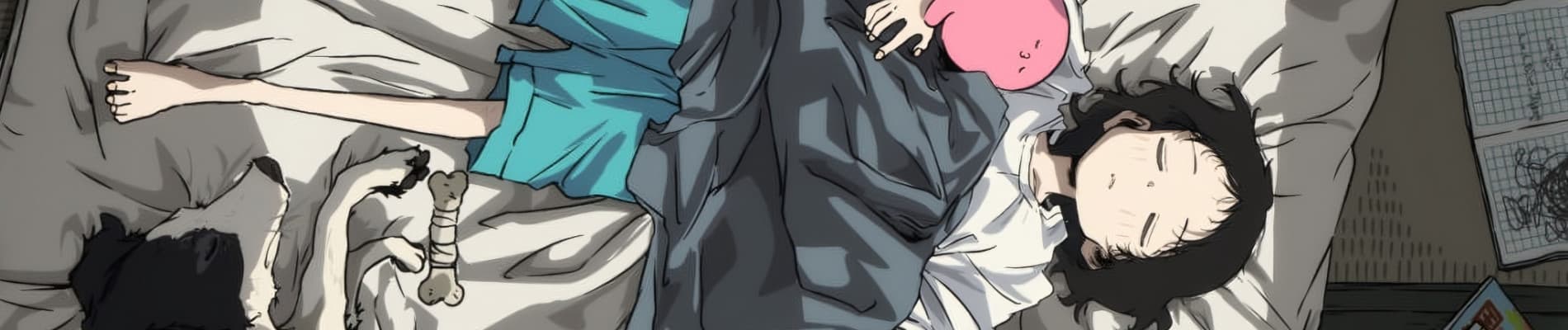
This anime left me divided. It has very clear strengths and weaknesses, and although I didn’t hate it, I can’t ignore its problems. The biggest one, without a doubt, is the exaggeration. The characters often don’t make sense and the situations feel forced, as if the work wanted to shock the viewer at any cost.
Interestingly, my experience with the anime started off better than with the manga. I read the manga in 2022 at the recommendation of my cousin, who is a fan of heavy works like Happy Sugar Life and Mahou Shoujo Site. Even back then, I thought the manga was bad and over-the-top, although it had some positive aspects. I ended up dropping it. When the anime was announced, I didn’t expect much, but the first episode surprised me. I gave it a score of 9, mainly because the adaptation managed to be more sensitive than the original, both in direction and script. The soundtrack helped balance the heavy moments, and the visuals worked well. Unlike the manga, which seemed to want to shock all the time, the anime portrayed intense scenes in a more restrained way.
Even so, the problems soon reappeared. From the second episode onward, the exaggeration came back strongly, especially in the characters’ personalities and the situations they were involved in. We had Marina’s bullying and her early death, the mother’s violence against her daughter, the episode focused on Azuma (which was lighter, but poorly developed), and then the death of Marina’s own mother. The biggest problem, however, was the protagonist Shizuka: initially presented as a normal character, she ended up turning into a psychopath without any convincing transition.
That said, some positive aspects stand out. The way the work tried to humanize Marina was interesting. Initially portrayed as cruel and exaggerated, she eventually received nuances that made her a richer character. The same goes for Marina’s mother who, despite being aggressive, at one point showed that she loved her daughter. This type of approach appeals to me, reminiscent of works like Shingeki no Kyojin, which transformed initially detestable characters into more human figures.
In Azuma’s case, however, the execution was flawed. Despite having a backstory that could have provided strong moments, the character was sidelined and ended up serving only as a trigger for Marina and Shizuka’s madness. Shizuka’s transition, in turn, is perhaps the biggest flaw of the series: she goes from bullying victim to full-blown psychopath without any plausible development, culminating in an ending that feels forced and incoherent.
In the end, it feels like the author wanted to tell something bigger, a story with meaning behind all the exaggeration. At times, it’s even possible to glimpse this intention, but the poor execution and excessive dramatization end up hurting the work significantly.
One of the biggest issues with the anime lies in the development of the protagonist. Shizuka, initially shown as a lonely girl who saw Chappy and later Takopii as her only source of comfort, undergoes a sudden and poorly constructed shift. Out of nowhere, she starts acting like a psychopath, even trying to kill Takopii himself. This transformation lacks a solid narrative foundation, sounding only like yet another exaggerated device to shock the viewer. The result is a sense of superficiality: the author seems to want to manipulate strong emotions such as despair and anger without delivering a coherent evolution of the character.
Despite this, the ending delivers a message that could have been very powerful. The conclusion bets on reconciliation and dialogue: characters who were previously in conflict manage to understand each other and become friends. This message of hope, especially in a work centered on bullying, is valuable. The problem is that the anime didn’t build the path toward this convincingly. Everything happens too quickly, with a blatant deus ex machina: Takopii reveals a special power that, metaphorically, awakens empathy and humanity in those involved. The idea is good, but it was thrown in without preparation, serving only as a shortcut to a “beautiful” ending.
Narratively, the work suffers from a lack of consistency. There’s a constant escalation of increasingly extreme situations in the early episodes, but by the end, the structure breaks down: there is no new climax, no plot twist, just a rushed conclusion. Furthermore, the characters don’t have satisfying internal resolutions. Marina and Shizuka become friends, but the work doesn’t show any concrete process for this change — just Takopii’s metaphor. Azuma, for example, is practically forgotten, with no relevance to the resolution. The anime insists on details of its internal logic — time travel, aliens, devices — but all this only weakens the central metaphor that should sustain the narrative.
If the story leaves much to be desired, the technical production is top-notch. The direction managed to bring nuance and subtlety to scenes that could have been even heavier. The visuals are impeccable, possibly among the best of the year, with design and settings that dazzle. The openings are also striking, conveying much of the anime’s atmosphere. Even in the final episode, the direction tried to elevate the work with creative choices, although it wasn’t enough to save the structural problems of the plot.
Overall, the anime ends up being a contradictory experience. It is extremely well-produced and conveys a unique atmosphere, but it stumbles on poorly developed characters and weak narrative solutions. Still, these technical elements sustain the work at a positive level. In my evaluation, it stands between 7 and 7.5: a good anime, but superficially good, upheld more by its production than its story.
My friend, who watched it with me, gave it a 5, precisely because she values the narrative more than the production. In the end, Takopii no Genzai is a work that divides opinions: it may captivate with its technical execution and its final message of hope, but it can also deeply frustrate due to the lack of consistency on the way there.
27 out of 41 users liked this review