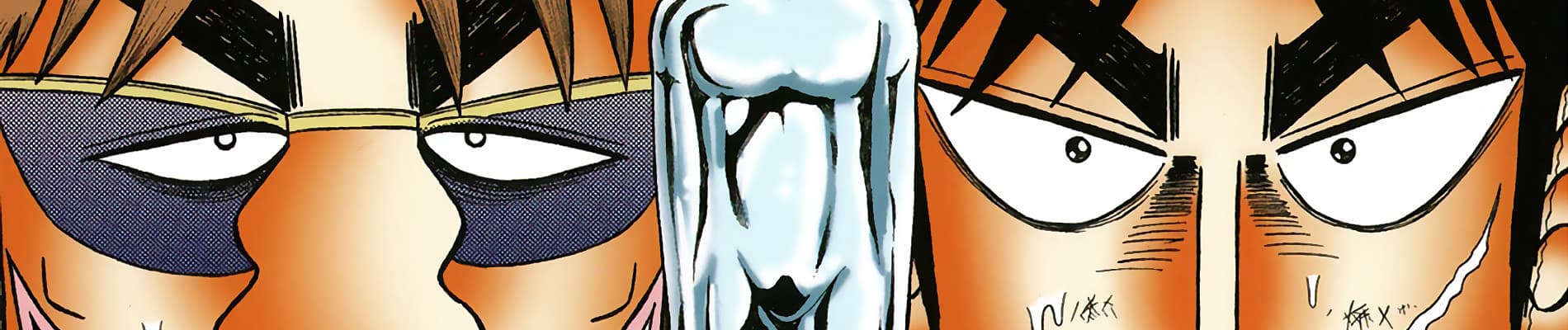
This is my favorite manga. For you to understand why I care so much about One Poker-Hen, I first need to show you who Mother Sophie is. Looking at the Greek etymology of the word Sophia, it means “wisdom.” In the tradition of Pistis Sophia, Sophia is attributed to Mary, and more generally, in Gnostic myth, she plays a very important role in the creation of the universe. You’re probably reading what I’m writing with some disdain, but I ask that when you read the manga, you think about what I’m saying. At the beginning of the story, Kazuya compares Mother Sophie to a goddess who will decide the fate of Kaiji and himself. We actually have evidence of what Fukumoto is pointing to—it’s not simply a coincidence of names. Even if Fukumoto didn’t consciously use this symbolism, Sophia did it.
Now I need you to pay attention to the story I’m about to tell, because it’s important. In The Republic, Plato introduced the Allegory of the Cave. In this allegory, some prisoners, chained since childhood, can only look forward and see objects by their shadows. Socrates then theorizes that if one of those prisoners were freed and taken outside, forced to interact with the world beyond his knowledge, even if he returned to the cave, he would never again be able to see the shadows as the original objects. This would happen because he would have seen, for the first time, the objects of the material world and experienced the light of the sun, realizing that it is the sun that illuminates the world. In the analogy, knowledge is identified as the force that leads us toward the perfect forms—especially the Form of the Good, represented by the sun. According to Plato, the Good is the master of reason and truth, the most difficult category for the soul to perceive in its ascent to the intelligible world.
So, why is this story of the cave important? Because the moment I read it, something very obvious came to mind. If we try to understand Sophia—“knowledge”— we must also understand what the Good is. And well, there is a character in this manga who has a very obvious difficulty grasping that concept :). If you’re familiar with Fukumoto’s works, you’ll notice that, partly due to the cultural background of Mahjong, he often makes use of Chinese concepts as symbolism. Kaiji, in my view, it’s no different. If we see the machine as an oracle, like the Book of Changes, even more connections start to appear in my mind. At the beginning, Kazuya says that Mother Sophie is cruel and indifferent—and that’s exactly why you have to read this manga: so you can decide for yourself whether this machine is really that cruel, and once and for all, decipher who Mother Sophie truly is in your heart.
25 out of 26 users liked this review
