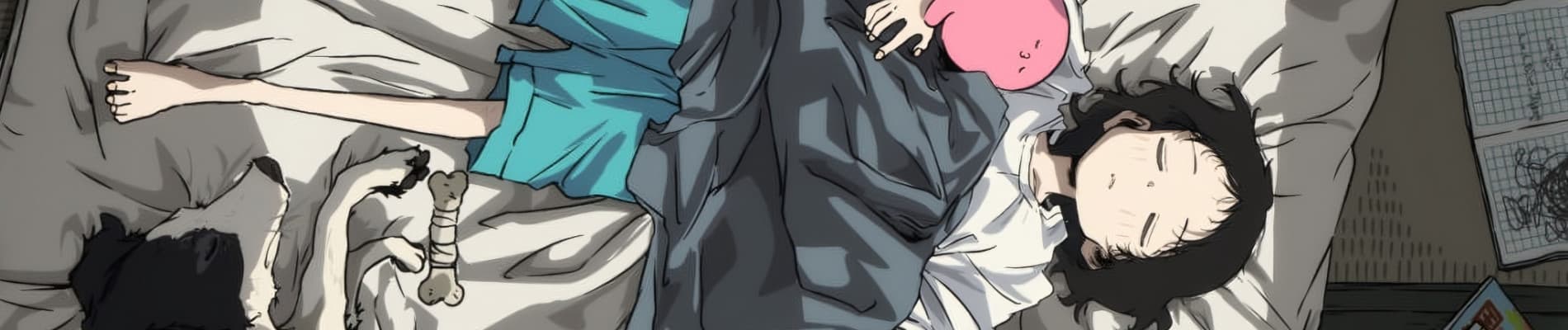


Actually never mind I'll elaborate a little bit. Takopi wrestles with three main ideas: inhibited trauma, inherited trauma, and inherent trauma. Children are used as vessels to portray the loss of innocence and the heinous capacities of evil that reside within them, mirroring the environments that raise them and cultivate differing modes of "values" (debt, perfection, etc.) This marks a bold and stark departure from the usual rose-tinted image of children we hold; of perfect angels with inherent capacity for good. Takopi, taking a chaotic neutral stance on this, posits time and again the value of "communication." In what begins as the premise of "Inside Out," Takopi exists as an ignorant "happiness merchant," a chaotic invoker of smiles who does not understand the broad spectrum of emotions. This creates numerous instances of "humour," childlike juxtaposition of adult life and childish ignorance. What thrusts Takopi into self-actualization parallels the reality of our three miserable children; in which its persistence in trying to iron things out via "talking" is met with the cruel reality of these ruinous lives.


At this point in the show, you wouldn't be wrong to expect the psychological probing to expand a little "further" than nature vs nurture. After all, there has to be a narrative value beyond just "life sucks, amirite?" The show then, in a desperate attempt to retain engagement, expands horizontally by dropping head spinning plot revelations about the supernatural machinations of Takopi. And while that lengthens the plot, the breadth remains paper thin. None of these events catalyze into a proper exploration of trauma or psychological degradation, or bullying, or anything really, instead discarding the odd juxtaposition of humour and tragedy, it goes full blown tragedy, with events upon events of loss in all forms imaginable. Then the show climaxes with magical self-sacrifice being the ultimate bringer of happiness. So, people can't heal on their own, can't reckon on their own, instead they need a third party to intervene, reset, and usher in understanding by turning into a ghost of influence... creepy.


The show in general has this odd sentiment regarding foils and equivalency between abuser and abused. Since the narrative at this point only successfully ties Naoki's perfectly realised one-episode arc, then disintegrates into timeline mumbo jumbo, it cannot handle contextual clues necessary to establish justice and catharsis between Shizuka and Marina. Instead, the show leans on its tacky "hurt people hurt people" messaging, reducing its foundation to a mere afterthought as the two forgive each other and bond over their mutual agony, supposedly.
Social commentary cannot work without establishing and analysing the structural makeup of people's lives. Takopi broadly gestures towards this by sketching out parental roles and negligence that bring about pain and hatred in otherwise pure souls. Yet this effort collapses every adult into cartoon caricatures. One might argue that this is wholly from the perspective of kids, but hyper-subjectivity without an established framework offers little insight. What does perspective reveal without grounding context? With no social blueprint bar implications? With neither precision nor scaffolding? The text then merely circles back to its single truism: trauma is cyclical, hammered home with no dramatic finesse. The result feels less like hardened social critique and more like kitsch at best, exploitation at worst.
Now the question is: what is the thesis of this show? The wrong answer is "communication may not heal us, but it is still a worthwhile step to take." The right answer is "children are all evil hellspawns. I hate children. Fuck them kids."

There is something to be said about how far this show goes in hyper engineering despair at every given turn. There needs to be some form of lapse that doesn't register as "haha this is all tonal whiplash btw wink wink" while you sit there in wait for the next gruesome scene of someone dying. Even Midori, for all its mundanity compared to its reputation, at least nourishes its scars with stretches of relief and hope. Takopi's attempts at any empathic maturity betray themselves as inauthentic and shallow. There's nothing more to be said. Nothing here unfolds with organic realism. It is inconsequential, and answers little in way of people dealing with similar issues. It's an exercise in obscene, emotional tedium. A seemingly proverbial examination of suffering conflated with cruelty manufactured to implausibility. Misfortune as pretext. Sensationalism: the anime.

Spoiler, click to view
Dope ass animation though phew. The merch sales are going to be through the roof for that pink octopusAlso appreciate the references to One Piece and Penguindrum. Very cool.


.