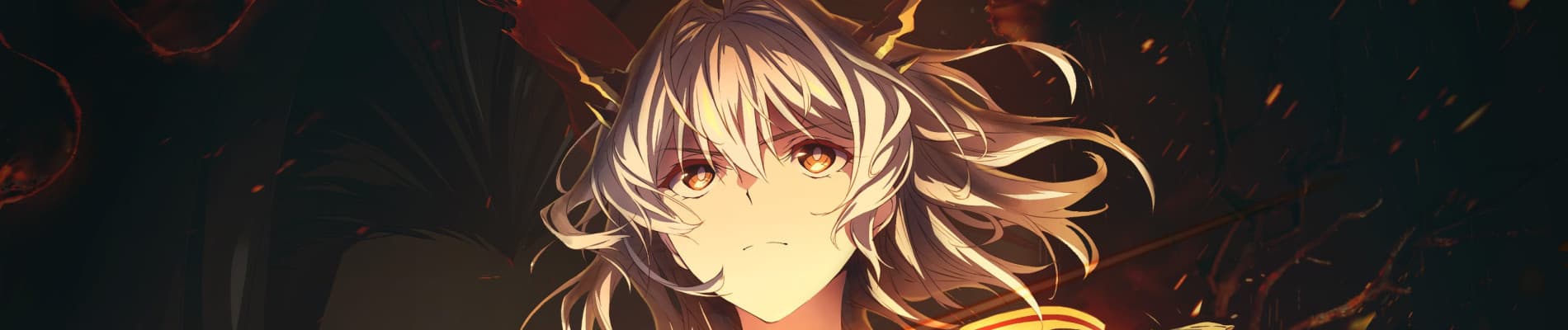


Unlike most gacha games, Arknights is one of the few that actually care about its world-building—rich with history, politics, and moral conflict that go far beyond "good guys vs bad guys"—more than just being a simply pretty setting. And for anyone, who values well-thought-out story, that definitely sounds like a dream come true … or does it?
First of all, the world-building is astounding and the adaptation benefits from a high-budget, but the core story is simply so bad that it barely matters. The main character is just unimpressive and hard to justify in the first place, they function more as a mere plot device than a believable person—mainly there to push certain points and preach morality in a forced way. This lack of depth makes it difficult to invest in the story, no matter how strong the world-building may be. Arknights also seems to likes to narrate stories from a "big picture" point of view, which gives a broad view but keeps it from ever going into detail about each character. When the characters come into the story, they often seem to be fully developed. Their essential ideas and personalities are set in stone as soon as they show there, and their arcs, if they have them, rarely shift or challenge those foundations. The so-called conflict of ideals here is never truly a conflict—their beliefs are destined to lead to the same result, and once the characters realize this, they become nothing more than voices of ideology. The antagonist could have good points, but the story and the narrative make sure they always lose, both in terms of the plot and in terms of morals. A great dystopia story always encourages the audience to question the author's vision by making them reflect about "what if" scenarios and trends in society, rather than pushing a certain ideal.

Talking about this season, there are ups and downs. Picking up where the previous season ended, with more attention given to characters like Talulah, W, and Patriot. That ironically ends up more compelling than our bland self-insert character, Doctor—who always seems important but never has a significant impact; even the strategy thing is not convincing at all—and our beloved Amiya, who is always naive and unbearable with shallow characterization. By the third season, there still not even a slightest glimpse or foreshadowing of what truly lies at the foundation of her naivety. Instead, we’re left with a soft power system that squanders the potential of the world-building, turning her abilities into little more than tools for forced sloppy melodrama.
Overall, this season shows clear improvement compared to the earlier ones, though it still suffers from the same problems, particularly in its sluggish pacing. That said, as mentioned before, the anime does benefit from a high-budget adaptation by Yostar Pictures—the visuals are captivating, cinematic, and thematically cohesive, with each episode feels like watching a film.

What’s most frustrating is that both the anime and the game had the potential to be something truly gripping, yet poor execution in the writing held them back. The story is ambitious but overcrowded, asking the audience to invest in too many things at once. Inevitably, the drama grows overwrought, and each scene is treated less like a natural moment and more like a symbol of Terra’s condition. While it strives to be morally complicated, but often plays it safe. It wants to be character-driven, yet it portrays a lot of its characters as set symbols instead of people who change over time. Worst of all, instead of letting its rich visuals and world-building carry the information naturally—through setting details, dialogue flow, or foreshadowing—it constantly freezes mid-scene to dump lore, as if afraid the audience won’t understand without overexplanation. Until then, Arknights will remain a work of wasted potential—something that I want to love, but struggle to do so.
