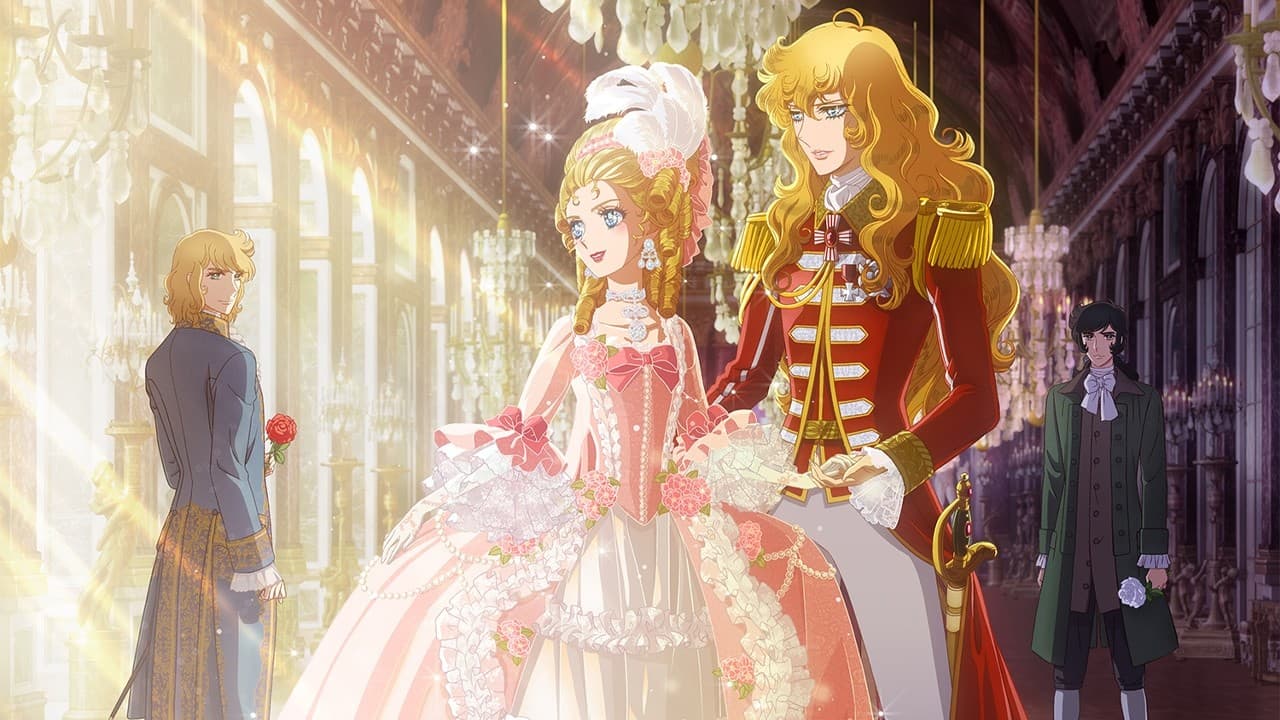
I love the Rose of Versailles manga. It's a melodramatic, gorgeously illustrated tour de force filled with passion and tragedy. This movie, while it cuts a lot of very strong and iconic material, ultimately understands the key points of the story, and is willing to take adaptational risks to create a film that doesn't cover everything—and doesn't try. By cutting a couple major storylines, the movie narrows in on the relationship between Oscar and Andre, which was my personal favorite part of the narrative. Though it cuts Rosalie, the main commoner character, it also doesn't lose sight of the story about the lives of the common people. The thematic overtones of breaking free of bonds and restraints and living as you truly want come through perhaps even more strongly in this movie than the manga, due to its compressed form, and make the narrative feel very cohesive as well as twining the four main characters together as people restrained and restricted by their class and social position.
I especially like the musical-like aspect. It conveys the intense drama and emotions of the original in a medium that can do more than dramatic panelling, illustrations, and full-page spreads, and also pays homage to how one of the most famous adaptations of this story is, in fact, a musical. The movie isn't a traditional musical, bearing more similarities to movies like Promare—which have distinct backing tracks with lyrics—but, of course, the source material isn't either. I think adding songs in the way that's done here really suits the tone of crescendoing, intense emotion. Because of this, and because of how thought out the choices of focus and cut content seemed to be—cutting important things, yes, but nothing that destablized the plotlines they chose to keep—it feels like this was done by people who liked the source material and put thought into the adaptation.
The animation isn't especially noteworthy—it comes through in important moments, but can sometimes be stiff—but that makes total sense, as the movie is replicating a detailed artstyle. It was beautiful to look at, with gorgeous still frames and a good amount of motion.
In terms of complaints, I disliked the narrator, finding her saccharine, and the English dub (the only way I've watched it so far) felt wooden at times—though it's generally pretty good. Rosalie lovers, of course, are generally not happy about the movie from what I've seen, and they have a right to be. I was startled that she was gone—and with her loss and the cutting of another scene, the one where Oscar goes to a marriage ball in her military uniform to protest getting married—the explicit homosexuality in this story is gone. I'm even tempted to call it censorship; though that seems out of the ordinary for Mappa, which began its career with queer stories others wouldn't produce. Marie Antoinette, too, is simplified, losing the story where she's manipulated by a corrupt advisor as well as what I think is a very good, impactful story about the loss of her child. The compression of her continuing story into the credits was also rough (and that's probably what I would add back in if given an extra 10-15 minutes).
However, those wouldn't've fit in the runtime. I think the best way to view this movie is as a summary movie, the ones frequently done for all sorts of anime series. The story is trimmed down and missing a lot of beloved elements, but the animation has advanced by leagues and it as a whole is a more digestible, beginner-friendly way to approach the series. I plan on rewatching it, and potentially showing it to my friends to try and hook them on the series. Focusing on what's cut out makes it too easy to ignore what the movie does well. If you're considering watching this movie, I highly recommend it. If you've watched it and want more or feel dissatisfied, please check out the manga or the original TV series, as there's much more good content there.
10 out of 17 users liked this review