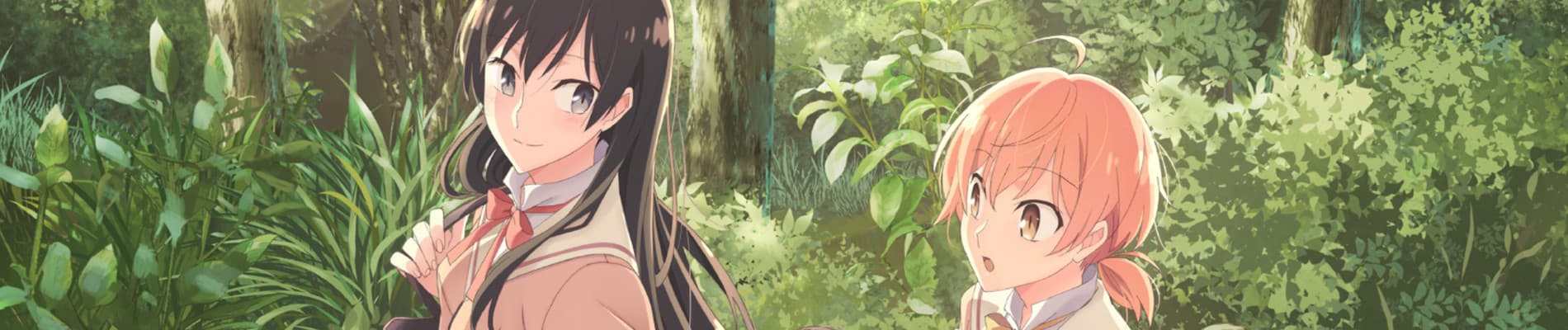
Bloom Into You
a review by AguyinaRPG
a review by AguyinaRPG
Bloom Into You is a typical story told in an atypical way. Beyond being a high school romance with all that entails, there's the plot about the perfect girl who can't let anyone see the "real her" (see, Horimiya) as she recovers from a tragic event in her past. The unusual thing about this story is that you get some of the steamy elements of a romance story very early between Touko and Yuu - then you're meant to see the much slower and more intimate parts of the relationship as the progress. It's not quite an inverse curve but it really does throw the whole feeling of the story off center. The emotional journey is unique, even as the story is straightforward.
What I've picked up from other discussions is that people are particularly attached to seeing parts of a romance with this couple you don't typically see. I personally didn't see anything that I'd never seen before; it was mostly just framed differently because of Yuu's emotional detachment to what would normally be a passionate escalation of emotions. It took me a really long time to even wrap my head around the impression of Yuu's lack of passion, as I more got the impression that she was simply a reserved person rather than lacking anything inherently. The story feels genre-savvy whilst also taking wide routes to try and not be obvious - which creates a confusing route to absorbing the emotions of the story.
I did find the characters very vibrant, with strong first impressions and general likeability. I really enjoy the disparity of Touko's moods and her passionate personality which is not just limited to romance. Yuu showed her kind-hearted nature in stepping in to help people, even while lacking the express motivation for it. I was very attached to Kanou's story even though there was no emotional arc and Maki's somewhat voyeuristic perspective was strangely wholesome. I do, however, think the cast was too wide for its own good, which made for problems later in the story. Considerable screentime is given to Kodama and Hakozaki, which works alright for accenting Sayaka's story but I don't think really demonstrates anything more than "same sex attracted adults can also exist" which then takes up screentime. Sayaka had a very strong moment in her dedicated episode, but she too overstayed her welcome as a focus - we should have stopped being inside her perspective after that. The story is unbalanced, which drives it away from the target of hitting my heart rather than serving as an intellectual exercise.
There was one thing that got the closest to directing me to that doki-doki feeling: The presentation. While the original manga is classified as a shonen, there's a lot of shoujo techniques such that I recognize from Nana, A Sign of Affection, and Fruits Basket that give you a really ephemeral lift of emotions. Views through the eyes - both first-person and reflections - with a wistful wind framing the object of affection. While the presentation wasn't consistently brilliant, there were some really cool directorial tricks. If you like visual symbolism and meaningful camera framing, you're going to have a field day with this show.
Sound and music was also quite interesting. Music was very out in front in the mix, which is unique for such a quiet story. I don't think any of the compositions really elevated the meaning of the scene, but they were noticeable and cool - with a real grand piano sound that I am a very big fan of. Silence was very effectively used in the mix, accentuating a lot of poignant cinematic moments with interesting framing of surrounding sound effects.
I think plot and character progression are what I really value over pure emotions, which meant the quality of the show really undulated for me. I really loved the moments of straight character-to-character interaction and growth which gave you a good amount of time to live in the shoes and perspectives of the characters, especially Yuu. Moments in Yuu's room, when she goes out shopping for the study group, and the scene at the river bank are super memorable for what they say about the characters.
But then you get this really gradual introduction to Touko's inner conflict which just kind of sits in the background with neither Yuu or Sayaka really penetrating the details for the entire season, leaving it as a lingering question. The characters definitely end up in a different place from where they start but the journey it sometimes feels like a drag getting there; not at all straightforward. I'm not saying every story has to be predictable, just that I should understand how we got from one state of being to another. When I look back on Bloom Into You, I'm not sure I get that. All the worse for how it ended.
Thankfully, one defiance of expectations was very welcome. One of my worries with yuri and BL stories is often that it feels more exploitative than sincere, relying more on novelty of being "that romance you shouldn't approve of" than a true understanding of same-sex relationships. I think Bloom Into You really treats the subject well, neither going into a polemic on prejudice nor ignoring the slightly taboo nature of the subject within Japanese society. It also does well servicing both a male and female perspective, with Maki as the surrogate guy and the three main girls showing the dynamics of a somewhat strained female friend group. It demonstrates a good understanding by the original author of Japanese teens, which is appreciated.
Bloom Into You, I believe, is a story built more on symbology and relatability rather than trying to draw people into its off-center perspective. I struggled to understand Yuu; it took more than halfway through the series for me to really see things through her eyes. The dialogue didn't properly explain that crucial element - I had to wait until her actions really spoke to the changes she was experiencing to understand that she was on a journey at all. The ride was pleasant overall - the romantic moments were pleasing, there were some genuine laughs and smiles at moments between friends, and I only questioned the internal logic of characters a few times.
Yet I always felt distant from the point it was making: Perhaps a bit like Yuu herself.
21 out of 24 users liked this review
