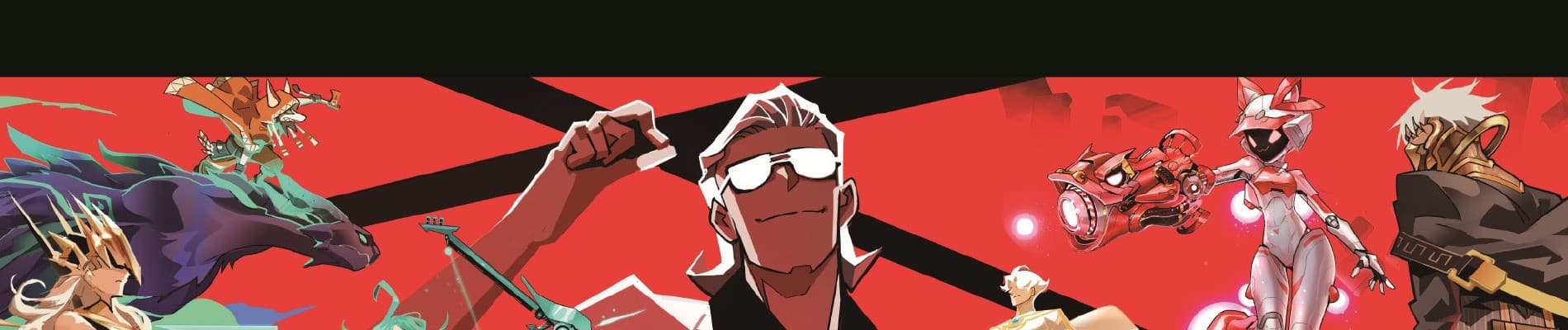
To Be Hero X
a review by AlexSonicfun2012
a review by AlexSonicfun2012
I recently finished To Be Hero X (《凸变英雄X》),directed by Li Haoling (李豪凌), the acclaimed creator behind Link Click (《时光代理人》),Flavors of Youth (《肆式青春》), and the earlier To Be Hero series. Upon its release, the series created a major cultural wave in China, trending across Bilibili (哔哩哔哩) and Weibo (微博), and later gaining traction worldwide. Thanks to its unprecedented production values, it became one of the most talked-about Chinese animations of the year.
But does it truly deserve the hype?
Narrative and Structure
To Be Hero X adopts an anthology format across its 24-episode run. Each arc is essentially self-contained, though loosely tied to the overarching mysteries of “Trust,” “X,” and the superhero system. Viewed individually, many arcs are engaging—particularly Nice (Episodes 1–4), E-Soul (Episodes 6–8), and Loli & Ghostblade (Episodes 14–17), which stand out for their strong thematic focus and character work.
However, the anthology structure becomes a double-edged sword. While it allows experimentation in tone and style, it sacrifices narrative cohesion. Compared to To Be Heroine (《凸变英雄·INE》), which maintained tighter character-driven storytelling, To Be Hero X at times feels unfocused. The mystery elements—regarding the origins of Trust, X, and the system—too often rely on “mystery bait,” offering half-answers while pushing resolution into a potential Season 2. The finale in particular functions more as a sequel hook than a true narrative conclusion, prioritizing spectacle over closure.
This issue reflects a broader challenge faced by modern Chinese donghua: balancing cinematic spectacle with narrative depth. While Japanese anime has long refined serialized storytelling and American animation often emphasizes character arcs, Chinese productions sometimes struggle with pacing and thematic integration, especially in large-scale anthology projects.
Production Values
Where To Be Hero X shines without question is in its production quality. This series represents one of the most expensive and technically ambitious projects in Chinese animation history. The hybrid use of 2D and 3D animation demonstrates remarkable fluidity, rivaling top Japanese studios like Ufotable and MAPPA. The directing is sharp, with choreography in fight scenes, nuanced character expressions, and atmospheric worldbuilding all executed at the highest standard.
The voice acting (配音) cast delivers strong performances that match the emotional tone of the narrative, and the soundtrack complements both the quieter character-driven arcs and the larger action sequences. The “rule of cool” is in full effect here, and even casual viewers can enjoy the series on a surface level for its sheer visual and auditory polish.
Critical Evaluation
Despite its triumph in production, To Be Hero X illustrates a common issue in China’s emerging animation industry: scriptwriting that struggles to keep pace with technical artistry. While the anthology format gave freedom, it limited world-building and left character arcs underdeveloped. With more time, tighter writing, and fewer digressions, the show could have balanced its ambition with narrative substance.
Nevertheless, the show remains a landmark for the Chinese industry. As scholar Li Xiaojie (李晓杰) noted in her study of Chinese animation trends, “Production quality has now reached a global standard; the next decisive step lies in narrative maturity” (《中国动画研究》, 2022). To Be Hero X embodies this very tension: dazzling on the surface, promising in scope, but still uneven in storytelling.
Conclusion
Overall, To Be Hero X is a good donghua, though not a masterpiece. Its anthology arcs provide flashes of brilliance, but its overarching story lacks cohesion and relies too heavily on sequel bait. For all its flaws, however, it is undeniably a showcase of how far Chinese animation has advanced.
Compared to To Be Heroine, which felt more focused and emotionally coherent, To Be Hero X is bolder in scale but weaker in narrative payoff. Even so, I recommend it—not only for its entertainment value, but also as a marker of China’s growing ambition to rival the established powerhouses of Japan and America. If the industry can now give equal weight to scriptwriting as it does to production, it will soon become a dominant force in global animation.
40 out of 52 users liked this review
