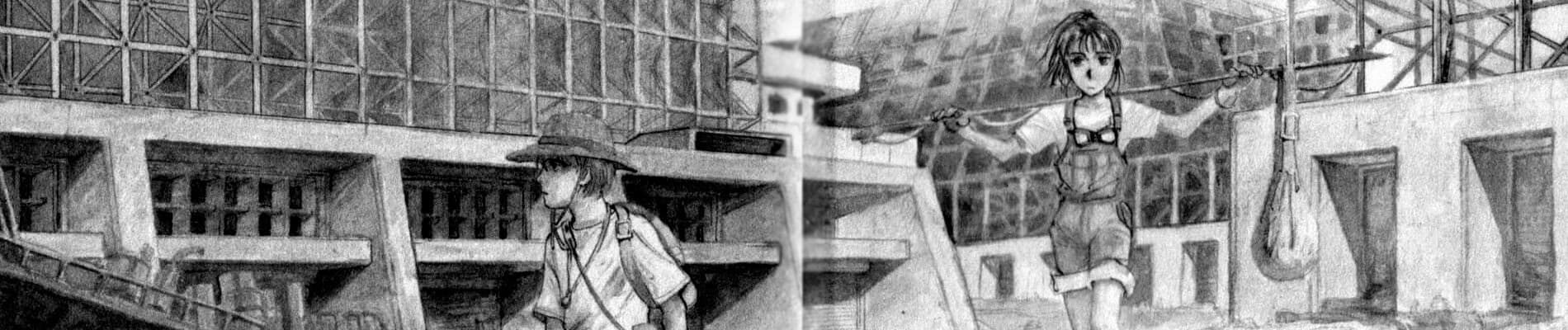
Eden is a manga I started reading almost 13 years ago, as of writing this review. Back then, I had to put it on hold because editions in my language were unavailable, and it stayed on pause all this time. This year, I made a point to pick it up again, and I must say the experience has been just as good as I remembered. Unfortunately, that only holds true for the first 80 chapters or so.
The manga introduces us to a cyberpunk world devastated by a virus known as the "Close Virus." The story begins with a group—specifically Ennoia and Hannah, the characters who kick off the narrative. They possess an immunity to the Close Virus due to multiple experiments they were subjected to on the island where they lived. The plot gets a bit confusing early on, involving the foundation of an organization called Propater and a scenario where Ennoia kills his father under murky circumstances. It's never entirely clear if he knows the identity of the man he kills or if he does it consciously. After this, Ennoia and Hannah leave the island.
From here, we jump into the future and connect with who will be the main protagonist for most of the story: Elijah Ballard. Elijah is Ennoia's son, lost and fleeing from Propater's mercenaries—the men who kidnapped his family—in an abandoned city. This marks the start of a years-long odyssey where Elijah will try to rescue his family from their captors. Throughout this journey, he undergoes a coming-of-age process, exposed to the world's injustices and forced to develop his own response to them.
My favorite part of this manga is encompassed in the first 50 chapters, which essentially cover everything I've just described. This is the section with the most potential. After this, there's an intermediate period highlighted by a small arc focusing on Kenji, one of the characters who could be considered a protagonist. This arc isn't bad, but it doesn't contribute much to the overall narrative beyond making a single point.
However, one of this manga's core problems is that many of its premises are built on mysteries and questions that seem destined to be answered later, but as the plot advances, the answers are often disappointing or simply never arrive. For example, early on we're told that after killing his father, Ennoia decided to collaborate with Propater again, but at some point, he betrayed them due to ideological opposition to their goals. The issue is we never learn the specific reason for this rift. Ennoia himself remains largely an enigma, an overly stoic character which becomes confusing when the narrative suddenly gives him a predominant role in the final story arc.
Nevertheless, the real and main issue I have with the work is how it shifts from an intimate story portraying human nature's inequalities, ambiguities, and moral gray areas, along with its social conflicts, into a story about saving humanity. At a certain point, the virus returns—a mutated strain called the "Open Virus"—which transforms the infected into a kind of intelligent crystalline structure called "colloids."
This is where I believe the manga's decline begins. Generally, there are two major stumbles from this point onward:
The resolution to plotline of Elijah trying to save his family is, for the most part, unsatisfying. Worst of all, it doesn't even feel like there's a point to it. The way the entire situation is resolved comes off as extremely random. In fact, it seems that past this point, the author no longer knew what direction the story should take. Consequently, the plot begins to spiral into a series of apocalyptic events, one after another, whose occurrences are utterly bizarre. Not only does the Open Virus appear, but it is preceded by a series of super earthquakes that happen for no reason, followed by a ball of dark matter that, for no particular reason, approaches Earth, nearly collides with its atmosphere, and releases a massive amount of gamma rays. If this sounds random to you, you're right—it absolutely is.
By the end of the story, the author has become too comfortable with killing off characters. While this isn't inherently bad and did happen early on, the deaths eventually lose their narrative purpose and start to happen just for the sake of it. In addition, new characters start appearing whose inclusion is strange and seems to respond more to flaws in the overall plot structure and a lack of planning. Suddenly, mercenaries connected to a minor character appear to forcibly kidnap someone, or a secret member of Propater is introduced who had never been mentioned before, seemingly because the author was no longer satisfied with the antagonists that had been established up to that point. Likewise, towards the end, certain characters are suddenly given a disproportionate importance in the narrative. This prominence is conferred without any prior anticipation and feels thematically unjustified, as these characters are underdeveloped or their core traits simply don't align well with the pivotal roles they are forced into in the finale.
At a certain point, I have to say that the plot had not only strayed from what initially interested me in the story, but many situations felt arbitrary and devoid of thematic meaning. They became extremely messy and lacking any interesting direction. Nevertheless, the story's final note—about the need to find meaning in life despite the world's inequalities and injustices—is where I believe the central theme is perfectly summarized. It's an aspect that, unfortunately, I don't think the author knew how to execute very well, ultimately leading to a rather poor conclusion for the story. Even so, I must say that its first part is an impressive manga, and even if it didn't fully meet my expectations, I wouldn't call the final part catastrophic or terribly bad. With all its flaws, I believe "Eden: It's an Endless World!" is a work I would undoubtedly still recommend.
6 out of 6 users liked this review