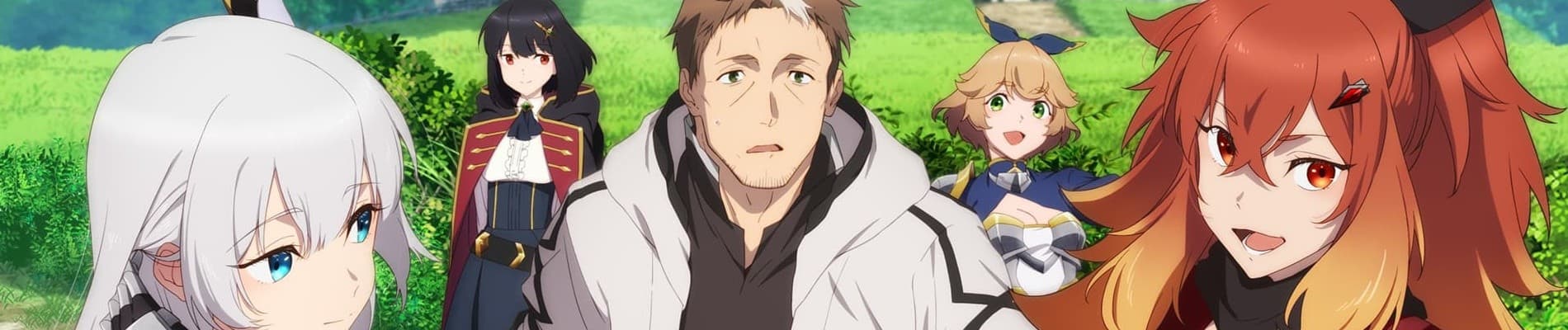
From Old Country Bumpkin to Master Swordsman is a great fantasy action anime that shouldn’t be overlooked. At first glance, one might assume this show is just another run-of-the-mill harem series, but surprisingly that’s not the case. The story Shigeru Sagazaki has crafted is quite different from the usual narratives found in many of its contemporaries. As its title suggests, the series follows a middle-aged sword instructor from the countryside named Beryl Gardinant. For two decades, Beryl has diligently honed his skills while teaching swordsmanship at his family’s dojo. Unbeknownst to him, he’s gained a reputation as an exceptional teacher given that many of his students have become successful adventurers and knights after graduating. However, despite his extraordinary ability to cultivate the skills of fledgling swordsmen, Beryl hasn’t accomplished much since taking over the dojo from his father many years ago. No longer striving toward his youthful dream of becoming a famous swordsman, he has grown quite content with his simple life.
Beryl’s plans to spend the rest of his days teaching in Beeden village are ruined when his former student, Allucia Citrus, arrives at his house with a letter authorized by the king. Recognizing his extraordinary talent with a sword, Allucia recommended him as a special instructor for the Liberion Order. Unable to refuse an order sanctioned by the king without being severely punished, Beryl leaves his home to fulfill his duties instructing knights in the city of Baltrain. Shortly after he arrives there, Beryl is reunited with several of his former students, and his years of training are quickly put to the test as he duels strong allies and clashes with dangerous enemies.
Considering the plethora of isekai, reincarnation, and party banishment stories that have been adapted lately, this show’s narrative is a breath of fresh air. As enjoyable as those types of anime can be, a large chunk of them are derivative of one another and are plagued with issues that have held those sub-genres back as a whole. Way too many of them lean into the same tired cliches and prioritize viewer gratification through fan service or embracing a power fantasy element, rather than focusing on telling a meaningful story. Thankfully, that isn’t the case for this series, as Beryl’s rise to master swordsman status is a more purposeful and unique tale. Nowadays the genre is mostly dominated by stories featuring young protagonists, so the fact that this is centered around a seasoned swordsman is a welcome change of pace. It's also refreshing to see a cast that consists primarily of adults, several of which graduated from Beryl’s dojo.
The author did a good job setting up some of Beryl’s former pupils earlier in the story. Shigeru introduces each of them in a way that highlights their different personalities and informs the audience about their time under his tutelage. They each had their own reason for wanting to learn swordsmanship and have become quite proficient in their chosen profession. Unfortunately, only a few of Beryl’s old disciples are explored beyond their initial introduction. Recurring characters like the easygoing knight Curuni Crueciel or the playful mage Ficelle Harbeller aren’t as fleshed out as their other fellow graduates. While this isn’t a huge issue given their degree of importance to the story, it would’ve been nice to learn more about them. Ficelle seems like a fun character, but sadly isn’t given as much screen time as other core characters. Regardless, I’m actually far more interested in her than Allucia whose main motivation is to show the world how great her master is. While Allucia is a much more developed character than Curuni and Ficelle, she isn’t nearly as compelling as Beryl’s other former students, Surena Lysandra or Rose Marbleheart.
Rose and Surena were written with a bit more nuance and their goals seem much less self-serving than Alluica’s desire to have Beryl’s skills acknowledged by more people. Surena, for example, became an adventurer not just to explore the world, but to help protect people and prevent them from suffering the grief that comes with loss. Similarly, Rose joined the Holy Order to safeguard the children of her country. Their core motivations are a little more admirable and noble compared to the driving force behind some of Alluica’s actions. Without spoiling anything, she didn’t join the Liberion Order out of some overwhelming sense of duty or desire to help those in need. The show explores the events that led Allucia on the path toward her current goal as the organization’s knight commander through a lengthy flashback in episode two. Although it's not as captivating as the flashback covering Surena’s backstory in the subsequent episode, it effectively explains why Alluica is so determined to see Beryl make a name for himself. Much like his father and his old student Randrid Patrolock, she recognizes her master’s talent with a sword and didn’t want his potential to be wasted teaching in the village. While all of Beryl’s students revere his abilities as swordsman, a few of them harbor feelings deeper than just pure admiration.
Since the cast is almost entirely composed of female characters, I was expecting the author to lean into the potential harem aspect of the series by having most of the women fall for Beryl. Fortunately, Shigeru doesn’t really frame these characters as potential love interests for him and the protagonist dismisses the idea of getting with one of them due to the huge age gap. His feelings on the matter could obviously change over the course of the story, but right now the love Allucia and Rose have for him is one-sided. Aside from the Allucia-centric episode 8, the show doesn’t focus much on their affection for their master. Although there might’ve been room to explore Rose’s adoration for him a bit more, I don’t think it was highly necessary. The same could be said regarding Surena, whose feelings seem more ambiguous than the others. Considering her past with Beryl and her behavior in a couple scenes, one could interpret Surena’s love for him as filial rather than romantic in nature. Regardless of whether she’s actually in love with Beryl or not, this aspect of the character is handled slightly better than it is with Allucia. Unlike Rose and Surena, Allucia’s feelings are expressed more overtly throughout the series, which makes her love for Beryl feel shallow. It's made abundantly clear from the very beginning that she adores and idolizes him. Rather than show the audience how Allucia feels at certain points through subtle actions and behavior, Shigeru deploys a character quirk in which she quietly says her desires or how she feels about a certain situation. Although this odd trait adds to her personality, it also makes Allucia less interesting. Despite being one of the most fleshed out characters in this show, her writing is arguably the weakest.
Aside from Allucia’s flawed characterization, Shigeru’s character writing is pretty good for the most part. He doesn’t rely too heavily on common tropes and every character behaved in a manner consistent with how they were previously established. As I alluded to earlier, the author is quite proficient at introducing characters in a way that efficiently informs the viewer about them. A few of these intros feature humorous interactions between multiple characters. For instance, the scene in episode two where Beryl first meets the Magic Corps commander, Lucy Diamond, and mistakes her for a lost child was quite amusing. Lucy is an extremely skilled mage who makes herself look young using magic. Shigeru incorporates the overpowered loli trope with this character, but thankfully doesn’t have her behave childishly or include any scenes that sexualize her. Instead of pandering to the audience by making her cutesy or inserting gratuitous fan-service, he simply presents the character earnestly like the rest of the cast. While Shigeru generally handles his characters competently, they’re a little underutilized in relation to the protagonist. More specifically, they aren’t used to further Beryl’s characterization beyond what’s established within the first few episodes.
Relatively speaking, the characters mainly serve as a vehicle to showcase his humility, modesty, and caring nature. Although these traits are adequately conveyed through his dialogue and actions, the author could’ve emphasized them more effectively by including a direct foil or parallel to Beryl. This also would’ve allowed him to highlight other facets of the character besides the same handful of positive traits. There are a couple characters that would’ve fit these roles nicely. Considering the few similarities Beryl has with Rose, she could’ve made for a solid mirror character. And with some adjustments to her personality, Lucy might’ve served as a decent foil for the protagonist, given the differences in their looks, age, combat speciality, and station in life. That being said, keeping her as a confidant for Beryl and crafting an entirely new character that contrasts his various qualities would be a much better option. Perhaps there could’ve been a knight in the Liberion Order who’s arrogant and conceited. Such a character would’ve allowed the author to highlight Beryl’s modesty and humility more subtly, without having him frequently downplaying his own sword skills. Ultimately, without a proper foil or parallel to help compensate for the protagonist’s lack of depth, the character comes across as a little flat.
Another factor that contributes to Beryl feeling slightly two-dimensional is his lack of meaningful character development. Although his life changes drastically after moving from the countryside, Beryl himself remains exactly the same. Shigeru allows the character to stagnate, failing to show even the slightest shift in his perception of his own swordsmanship. Even after everything he accomplishes by the end of the season, Beryl continues to underestimate his own abilities, insisting that his expertise is nothing special. The author should’ve given him some kind of arc to add some dimension to the character. At the very least, he could’ve had Beryl start to reassess his skills and gain a bit more confidence in his abilities. Instead, Shiegeru keeps the protagonist oblivious to his amazing talent as swordsman, which is one aspect of Beryl that could get old after a while. Regardless of his lack of complexity, Beryl’s admirable qualities and general lowly attitude make him a pretty endearing character. I really enjoyed his scenes with an orphan girl named Mewi and what direction their relationship took.
Unlike Beryl, Mewi Freya is a much more dynamic character that experiences noticeable growth within the span of a few episodes. She starts out as a rude, standoffish thief, stealing to raise enough money to have her sister resurrected. However, after Beryl and Lucy help her, Mewi eventually becomes a lot kinder and more trusting of others. I love that the author didn’t write Mewi like a typical angsty teen and allowed her to gradually evolve in a realistic way. Her cynicism doesn’t just disappear the moment she receives a helping-hand from Beryl and Lucy. The way she addresses him doesn’t immediately change either. As Mewi spends time with Beryl and his allies, she starts to soften and other sides of the character are slowly revealed. Shigeru deepens her characterization, showcasing Mewi’s perceptiveness and thoughtfulness through some of her actions. Overall, she’s a well-defined character that the author uses effectively to illustrate Beryl’s capacity for kindness. Mewi’s integration into the story also gives him a chance to act on his own volition rather than out of a sense of obligation.
Before I switch gears and talk about the story, I would be remiss if I didn’t touch on this show’s problematic English dub. The English version of this series has several issues which are likely the result of a rushed production. One such problem prevalent throughout the last third of the season is the inconsistent quality of the voice work. While the performances for the main cast were generally pretty good, there were occasionally times where the line delivery sounded a bit off. Sometimes the dialogue wasn’t spoken with enough emotion or the tone didn’t quite match a character’s feelings during certain moments. In a few rare instances, the voice acting sounded very stilted, which really stood out in one particular scene with Mewi and Beryl during the finale. Unfortunately, many of the flaws with this dub are glaringly apparent throughout the last episode of the season. The season finale is the most unpolished episode dubbing company Blu Digital Group Studios has produced for this series. In addition to a few strangely volatile performances in certain scenes, there were some instances where Rose’s lip-flaps were completely out-of-sync while the character was talking. Another issue exclusive to the English version of this show is the poor casting for Rose and her superior officer Gatoga Lazorne. Shannon O'Brien and Varian David’s voices don’t quite fit their respective characters and their voice acting isn’t on par with the rest of the cast.
Character miscasting aside, the biggest problem with the English Dub is the script. While it isn’t terrible, there were multiple lines of dialogue that could’ve been written better. Some of the revisions made from the original script have resulted in dialogue that either sounded unnatural or didn’t quite fit certain scenes. The best example of this would be Mewi’s line regarding Beryl’s new clothes in episode ten. The comment she makes is worded in a way that would only make sense if Mewi were asking someone else their opinion on his outfit. In the Japanese dub, it's clear that she’s making a statement and the actress's tone matches her intent. Although the English version of this series doesn’t quite measure up to its Japanese counterpart, it’s still a viable way to enjoy the story despite its obvious flaws.
Shigeru has come up with a pretty solid story that doesn’t take too long to get into its two major conflicts. While I thought the pacing was fine, others may feel like it slows down too much past the midway point. Episodes 7 and 9 don’t progress the narrative much, with the latter kinda feeling like filler up until the last couple scenes. Fortunately, the story ramps back up going into episode 10, which kicks off the second major conflict involving an assassination plot against royalty. During this particular storyline, Beryl and his comrades are tasked with protecting a prince and princess as they visit certain areas around the Kingdom of Liberis. The middle portion of this three episode mini-arc was really entertaining. There’s a lot of action at this point in the narrative and things start to get really tense going into the finale. Episode 11 has a very intense fight scene toward the end that was presented very well. Apart from the exciting action sequences, the show briefly touches on an interesting political power struggle instigated by religious zealots from Rose’s homeland. This will probably be elaborated on further next season along with the goals of the Church of Sphene’s radical faction, which have been at the heart of every main conflict so far. Beryl’s previous encounter with that fanatical group was the biggest highlight of the season’s first half. There were a couple solid emotional moments in episodes five and six that stemmed from the callous actions of one of the Church’s bishops. The situation with Bishop Reveos is capped off by a fantastic fight scene with Beryl taking on one of his followers. Shigeru provides a satisfying conclusion to both storylines involving the religious extremists—setting certain characters on a new path while hinting at potential conflict with the group in the future.
It’s worth noting that outside of those two short arcs there are plenty of nice, calm slice-of-life moments with Beryl doing different things with various characters. The author sprinkles in a little humor during some of these peaceful scenes, which rarely fell flat and never felt out of place. Aside from these short bursts of comedy, Shigeru leans into Beryl’s job as a sword instructor by including moments where he assists the knights with their training. Occasionally, he engages them in a mock battle and points out the flaws in their approach. Each duel further solidifies how incredible his skills are—with Beryl always searching for his opponent’s weakness rather than relying on brute force.
With that said, this series has some pretty remarkable action sequences! Animation studio Passione has done an amazing job with the overall presentation of the fight scenes. I was very impressed by how seamlessly they integrated the CG animation alongside the standard 2D style. It blended in so well that I initially didn’t notice whenever the studio switched between the two mediums. I was very surprised by how smooth the movement of the 3D models were and how expressive they managed to make the characters. Quality-wise, the disparity between the two types of animation was often pretty minuscule. Passione deserves a lot of praise for how well they utilized the CG in this series. Its implementation felt less like a cost-cutting or time-saving measure, and more like a tool they used to bolster what they’ve already constructed. Some of the best battles in this anime feature a mix of both 2D and 3D animation. The studio really went all-out when animating a few of these action sequences, especially during the last arc. Animation aside, several of the tracks they used perfectly complemented the atmosphere and tone of certain pivotal battles throughout the show. The camerawork was also a bit more dynamic in these scenes and the fight choreography was generally impressive. After seeing what they’ve achieved here, I’m confident that the studio’s next endeavor, Chained Soldier Season 2, will turn out just fine.
All things considered, From Old Country Bumpkin to Master Swordsman is a refreshing fantasy series with an engaging story, likeable mature cast, and wonderful action scenes that often feature impressive CG animation. While the characters are established well, some of them are pretty static and could be elaborated on much further. The most notable of the bunch being Allucia and Beryl. Their lack of depth and insufficient characterization really stood out amongst the central cast. Apart from those character flaws, the English Dub has multiple problems that likely could’ve been avoided if the dubbing company were given more time to produce each episode. This was the studio’s first time working on a same-day dub in English, so it's possible they weren’t able to refine everything under a tighter weekly schedule. Regardless of the show’s shortcomings, I’d still recommend giving this anime a shot if you’re looking for something a little different from the usual genre offerings.
10.5 out of 14 users liked this review
