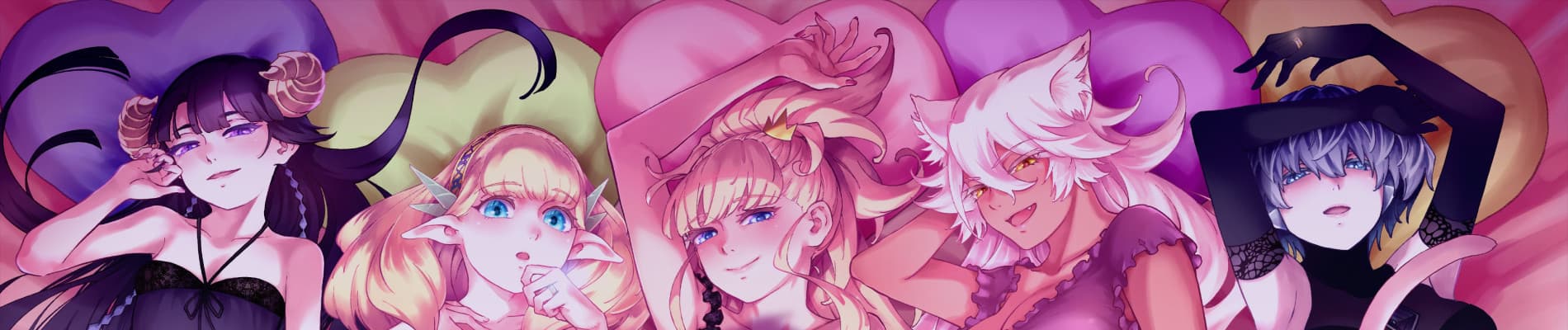
Tales of Wedding Rings is an isekai romance anime based on a manga written and illustrated by Maybe. The show is centered around two teenagers, a boy named Satou and a girl from another world referred to as Hime. During the 10 years since Hime first arrived in his world, they developed a very close relationship with each other. One day they decide to go to the summer festival where Hime tells Satou that she and her grandfather are going back home. On the night of Hime's departure, he notices a bright light in the sky and sprints outside to stop her. She then tells him the truth about being from another world and that she's getting married. Blindsided by this news he rushes through the gate to her homeland Arnulus and crashes the wedding ceremony. When the venue is suddenly attacked by a monster, Hime quickly kisses Satou, thus making him her husband and bestowing upon him not only the mantle of "Ring King", but also the Ring of Light. As the Ring King, Satou is tasked with sealing away a powerful evil entity known as the Abyss King who was defeated once before by his predecessor. In order to save Hime's world from the Abyss King, Satou must obtain the remaining Rings of Power from the four Ring Princesses that reside in other nations. Accompanied by Hime, her grandfather the "Great Sage" Alabaster, and Marse, her former betrothed, Satou embarks on a quest to gather the rings before the Abyss King is fully resurrected.
This show boasts a distinctive premise that strikes a balance between familiarity and uniqueness, setting it apart from the multitude of isekai series that have saturated the landscape. Maybe has taken the cliché genre trope of the legendary hero prophecy and made it more interesting by injecting new elements into it. I was immediately intrigued by the concept of this anime when I first learned it was in production last year. An isekai adventure series centered around marriage is something I've never seen done before. Besides its originality, Tales of Wedding Rings has a nice setup that establishes the close bond the main pair have with each other before they venture out into the other realm together. This is very much a "childhood friends to lovers" kind of story, but in this case there is a sudden shift in the relationship between the two primary leads due to the circumstances of their situation. As a result, their transition into newlyweds is way more awkward than that of couples portrayed in conventional romance narratives. There are some amusing moments that arise due to their mutual nervousness during a few of the scenes they share alone together. In general, the interactions between Satou and Hime were delightful and its easy to believe that these two truly care for one another.
For the most part, the author has written these protagonists fairly well. Maybe used several archetypes as the basis for these characters while giving them enough personality and depth to make them appealing. For example, Satou is a mix between the typical every-man and standard hero archetypes. That being said, he isn't just some shallow self-insert character designed to easily fit a certain mold. He has a distinct identity and isn't simply a surrogate for the audience. Satou is driven by his profound sense of duty and his undying love for Hime. Initially, his unwavering commitment to her is the primary factor motivating him to save Hime's world. However, Satou's resolve is strengthened when his perspective on her homeworld changes after meeting various people on their journey. Unfortunately, Satou's lack of power frequently impedes his efforts to fulfill his duty as Ring King throughout the season. That said, what I found so endearing about this character is his sheer tenacity and ability to persevere even when the odds are stacked against him. I don't have too many issues with how Maybe wrote him apart from a couple instances where he has Satou behave idiotically for the sake of bringing levity to a scene. Objectively speaking, there's a minor flaw regarding how he's characterized at one point, which I'll touch on a bit later. Overall, I think Satou is a decent protagonist that has some admirable qualities to him and is distinguishable enough from other run-of-the-mill isekai leads.
Regrettably, Hime is a much simpler, less compelling character than her valiant other half. She completely fits "the lover" archetype to a fault as there isn't a lot to her character outside of her desire to be happy with Satou. Hime's focus shifts from her responsibilities as a ring princess to her relationship with Satou fairly quickly. As one might expect, she isn't keen on the idea of Satou marrying other women early on in the series and it isn't long before she starts getting jealous. While Hime doesn't evolve significantly over the course of the season, she at least grows enough to accept the fact that she can't have him all to herself. She becomes less envious of her husband's other wives, but never forgets to assert herself as his "number one". All things considered, I don't think Hime is a bad character, but she's not given a whole lot to do outside of powering up Satou with a kiss, which is a duty inherent to all the ring princesses. The Wind Ring Maiden, Nefritis Romca, doesn't do much either, but she's a way more rounded character that has much more going on with her during the early stages of the story.
Nefritis is a shut-in princess from the elven village of Romca governed by her overprotective brother Jade. Initially, she is very timid and afraid of both strangers and the world outside the palace walls. At the same time, Nefritis has developed an insatiable curiosity about the outside world and yearns to explore it, but is unable to for multiple reasons I can't get into due to spoilers. The author uses this character to highlight and contrast Satou's remarkable courage and self-confidence with her fear of the unknown and shyness around new people. Nefritis exhibits the most substantial amount of growth out of everyone in the cast and is arguably the most complex character in the story.
Conversely, the fire nation princess, Granart Needakitta, is a fairly straight-forward character, practically devoid of any actual depth or substance. She's essentially just a horny musclebrained warrior who wants to make babies with Satou. Prior to joining Satou's group, she led a nomadic nation of cat people and was their strongest fighter. Granart's combat prowess allows her to play a more active role during encounters with the Abyss King's forces unlike Hime and Nefritis who just watch from the sidelines. Outside of battle, there are many light-hearted moments between her and the main cast that were very amusing. All in all, while I liked Granart and appreciate what she adds to the group, I do wish that the character wasn't so paper thin.
The water ring maiden, Saphir Maasa, is a good foil to Granart and is way more fleshed out by comparison. While she may not be as physically fit or as strong as her, Saphir is far more intelligent and cunning than Granart. This character kinda balances out Satou's growing harem as she isn't really interested in him unlike his other marriage partners. In fact, her attitude toward Satou and the way in which she's introduced was actually refreshing. When they first meet Saphir is more concerned over the fate of her country and the marriage is basically a means to an end in her eyes. Although I don't have any issue with how Maybe wrote this character, similar to Satou, I feel as though he slightly mischaracterized her at one point. There's a scene in the ninth episode where a merchant describes her as a "wise tomboy", which struck me as odd because she doesn't behave like a boy at all. I initially assumed this was a poor translation when I initially saw the scene in Japanese months ago, so I surprised to see it was in the English dub version too.
The instance involving Satou earlier on in the show is a bit worse in my opinion. Near the end of episode four, there is a scene where the elder elf Peridot is talking to someone about Nefritis. She describes him as being meek, which I don't think is accurate at all. While Satou isn't the argumentative or confrontational type, he is by no means submissive or spineless. There was never a point in the narrative where he struggled to speak his mind about a situation. Sure, he's kind-hearted and even-tempered, but Satou's also pretty strong-willed too. The fact that he didn't conform to what his friends were telling him to do in regards to his courting matches with Granart is evidence of that.
Unfortunately, there are far more egregious flaws with the writing than these minor nitpicks. For starters, there is a major plot hole and some pretty glaring plot convenience surrounding the final ring princess Amber Idanokan. I can't say too much about this character or go into too much detail without venturing into spoiler territory, so I'll be vague first before I elaborate for those familiar with the series. To put things simply, Amber's course of action prior to meeting Satou and Hime is illogical given that the Ring King was never supposed to come from Satou's world. This is most I can say without spoiling things for those who haven't watched this show yet, so with that being the case, I need to briefly get into a bit of spoilers to expand on this fault within the narrative.
Another notable flaw with this show's plot involves the black rings introduced in the fourth episode. These mysterious items are used by the Abyss King to take control of someone and transform them into a powerful warrior referred to as an abyss knight. While visiting the different ring nations, Satou's group is eventually attacked by one of these soldiers that were sent there to steal the rings of power. Although I like the idea behind the black rings, there were a few instances where these items are inserted into story in a way that feels contrived, for lack of a better word. For example, there's a scene in episode six where a jealous knight walks into a room and puts on the black ring that he happens to finds on the floor. Why was the ring just lying there waiting for someone to pick it up? Its never explained how it got there or established that the Abyss King can just plop them anywhere he pleases. Even if we're to assume he has the power to do so, in a couple of cases the appearance of these vile rings seemed awfully too convenient. Overall, the setup for some of these abyss knight's could've been handled a lot better.
In general, the antagonists aren't anything to write home about, but they serve their purpose within the narrative well. That said, there is one part of the story that could've been better if the villain wasn't so obvious from the moment she first appears. As for the main antagonist, the Abyss King, he's built up as this major threat throughout the season, but he doesn't get a whole lot of screen-time, so viewers don't get to see him do much. While the character came off as bland to me, I appreciate how he's kinda like an omnipresent evil force constantly sending his minions to hinder Satou's quest to collect the rings.
Anyway, Tales of Wedding Rings' narrative moves along at an acceptable pace with only one episode not progressing the story too much. Season one's story can be broken up into five parts or narrative arcs that only last a few episodes each. The first couple episodes establish some of the cast and setup the main conflict involving the Abyss King. Each new arc introduces one of ring maidens and showcases a different part of Hime's world. In terms of worldbuilding, Maybe does a pretty good job expanding on the different countries Satou's party visits through various bursts of exposition that thankfully don't last too long. Writing-wise, I think the first-half is a lot stronger than the latter portion of the season. Taken as a whole, the last six episodes are slower, a bit predictable, and the climax is brought down by the plot issues I've mentioned previously. With that said, I still enjoyed a lot of the comedy and the more serious character moments in the last batch of episodes. The finale may not have been amazing, but it at least properly set the stage for the second season and it had the best action scene in the series so far--though if I'm being honest ain't saying much.
Although the story isn't the greatest, the characters are used effectively to help solidify its core themes for the viewer. The author heavily emphasizes the themes of personal responsibility and self-sacrifice throughout the narrative. Tales of Wedding Rings is littered with instances where an individual willingly relinquished something for the sake of someone else. Moreover, the burden of responsibility is a recurring theme that Maybe explores through Satou, Hime, and the majority of the ring princesses. Ultimately, I believe the story's central message is that a person's happiness doesn't have to come at the expense of neglecting one's duties. While the author does a decent job handling the narrative's themes, I thought he could've done more to examine them with characters like Granart and Nefritis.
Putting aside its narrative themes, the production quality of this anime is largely unimpressive. Generally speaking, there's a noticeable absence of stylistic flair in how scenes are presented to the audience. For example, the cinematography for most of the action sequences is flat and unremarkable. These scenes could've benefited from more dynamic camera work and were typically mediocre both in terms of execution and how the combat unfolded on screen. The action itself is quite rudimentary with characters often attacking and dodging in a rather straightforward manner. These sequences could've been way more captivating if the fight choreography was more creative and elaborate.
Anyway, the weakest aspect of the production is by far the animation. While it's pretty decent for the non-combat scenes, the animation quality for the fight sequences is way more inconsistent. It usually dips whenever a character is landing a massive strike or when certain attack spells are used. During these moments, the studio halts the action and briefly stays on a singular shot. Sometimes the animation will be limited with little to no camera movement. In other cases, the studio will use a static image and just move the camera a bit. This is such a boring way to present the action and one could argue that it's detrimental to the pacing of the battles, given that the flow of these scenes is interrupted temporarily.
The one saving grace in regards to the presentation is the visuals. I really dig the art style of this anime, which is reminiscent of Staple Entertainment's previous work, Am I Actually the Strongest? The beauty of this show is most apparent in scenes flooded with light, allowing for numerous aesthetically pleasing shots. Its within these well-lit scenes that the artwork for the characters can truly shine. Generally speaking, the character designs for the ring maidens are solid. On the other hand, some of the monsters didn't look too good and some of the CG effects--especially a couple in episode eight, stood out like sore thumb.
Before I close this video out, I need to address the abundant amount of fan service scattered throughout this series. This is one aspect of the show that is sure to turnoff folks who hate seeing a lot of sexualized imagery and nudity in their anime. While it's not overdone to the point that it becomes a distraction or detracts from certain moments, there's enough here that could've been trimmed in favor of developing the characters more. That being said, for those that like this kind of ecchi content, you'll surely be satisfied with what this anime has to offer on that front.
As a whole, Tales of Wedding Rings is an entertaining, but very flawed fantasy series with a unique concept and fun characters. As much as I liked this anime, it's tough to give this one a glowing recommendation given it's lackluster production, subpar action scenes, and copious amounts of fan service among other things.
9 out of 10 users liked this review