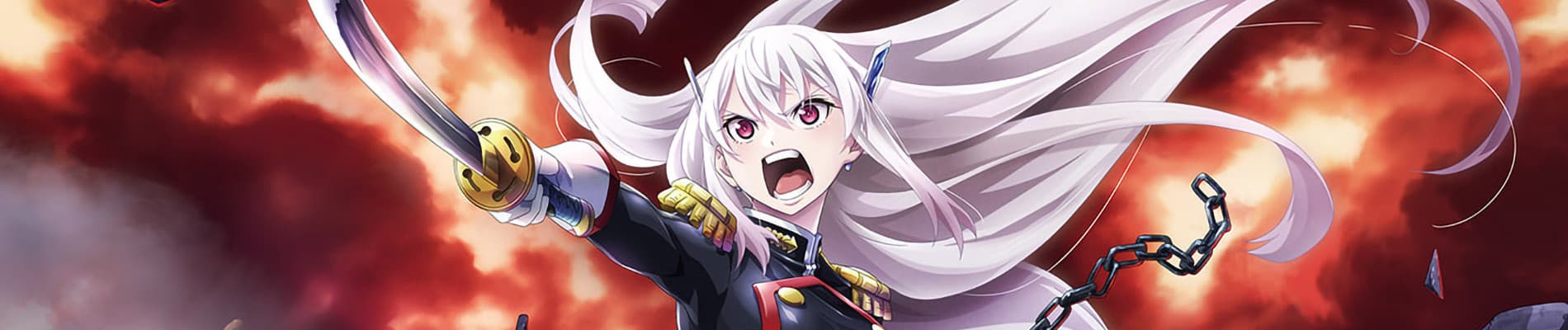
Chained Soldier is a dark fantasy action series based on a manga written by Akame Ga Kill creator Takahiro and is animated by Seven Arcs. As a big fan of the source material, I've been eagerly awaiting this show ever since I read the first volume back in 2022. With season one now wrapped up, I figured this is the perfect time to share my thoughts on the series. Before I get into my overall impressions on this anime, let me explain what it's about for the uninitiated.
Chained Soldier is set in an alternate version of our world back in the year 2020, in which gender equality is a thing of the past due to the discovery of another dimension called "Mato" several decades ago. Mato is home to dangerous creatures called "Shuuki" as well as mysterious "peaches" that only grant powers to women when eaten. Portals connecting our world to the other dimension are scattered across Japan and are safeguarded by the Demon Defense Force. This military organization was established by the government to deal with Mato-related incidents known as "Mato Mishaps" and consists entirely of superpowered women. The Demon Defense Force are responsible for exterminating Shuuki and protecting civilians that randomly appear in Mato by accident.
This show primarily takes place in Mato and is centered around a young man named Yuuki Wakura who suddenly finds himself stranded in the other dimension one evening while walking home from a job fair. Not long after he arrives there, he's chased by a horde of Shuuki and rescued by the leader of the Defense Force's 7th Squadron Kyouka Uzen. When they find themselves surrounded by a multitude of monsters she asks Yuuki for his assistance in dealing with them. Kyouka uses her power to make him her slave, thus transforming him and granting Yuuki immense strength. After they eradicate all of the nearby Shuuki, Kyouka proposes that Yuuki come work for her, but not before giving him an unexpected reward for his efforts. He agrees in the hopes of becoming a hero and avenging his sister who disappeared years ago in a Mato Mishap. Later, when they return to the squad's dorm, Yuuki is introduced to three of unit seven's members and is disappointed to learn that he can't join the team. Instead, he serves as the squad's new caretaker when he's not fighting alongside Kyouka as her slave.
The first few episodes focuses on the central cast as they eliminate hordes of Shuuki together and Yuuki becomes better acquainted with the members of squad seven. Not long after he begins working with the group, they encounter powerful new foes prompting them to train and work alongside the sixth unit to combat these unprecedented threats.
When I saw the Jump Festa preview for this series back in December of 2022 I began to worry about whether Seven Arcs could do Takahiro's work justice. I was concrened over the show's production and possible censorship given the explicit nature of certain ecchi scenes. I also outlined the three things I felt that they needed to get right for this series to be successful--those being the action sequences, the comedy, and the fan service. While I have some gripes with the production and certain creative decisions, I think the studio did a decent job bringing the manga to life.
Its worth noting that this isn't exactly a 1-to-1 adaptation. Seven Arcs has removed or rearranged some scenes from the manga in addition to streamlining certain interactions. As a result, the anime is much faster than the source material, but I wouldn't necessarily say that the pacing is better. The manga is pretty breezy as it is with chapters usually consisting of about 18 to 25 pages. At first, I was a little worried that the show might've been plowing through content a bit too quickly, but thankfully that wasn't the case. I'm glad that they didn't try to cram too much of the narrative into each episode. That said, going through three volumes of story in seven episodes would probably be problematic for many other series out there. Anyway, most of the cuts and changes made throughout the show were fairly reasonable. For example, the studio omits numerous scenes from the second chapter, such as the one where squad seven guards a gateway to the human world from nearby shuuki. In the manga, this is where the portals are explained and Kyouka's subordinates--Himari Azuma and Shushu Suruga are first shown using their abilities. They appear much earlier during the premiere and each of the girls are given a chance to utilize their powers. With that being the case and the fact that gateways were already explained in the previous episode, its understandable why they chose to exclude this particular part.
Unfortunately, the studio's decision to leave out specific scenes and details has resulted in much weaker world-building compared to the manga. Seven Arcs doesn't dedicate a lot of time to fleshing out the human world, which is a shame since its actually pretty unique. Society functions a bit differently due to the abolishment of gender equality practices as a result of women becoming stronger than men through the power of the peaches. Women now control the world and have way more privileges than men. However, barely any of this is conveyed in the anime since the focus is primarily on the events that take place in Mato. Seven Arcs doesn't explicitly establish this show's world as a female-dominated one where men lead a much harder life than women. Aside from a couple scenes in the premiere, there isn't much that informs the audience of this.
I was disappointed that they took out the scene where Yuuki and his friend was riding the train in the first chapter of the manga. Not only are these two contrasting panels amusing, but they perfectly encapsulate the disparity between the lives of men and women. The anime doesn't effectively highlight the inequality between the sexes or cement the widely accepted notion that women are superior to men. While Seven Arcs' decision to not emphasize this part of the source material doesn't negatively impact the overall story, it does make the scornful attitude a couple characters have toward men early on in the series less understandable. Initially, Himari and the 10th unit's Ginna Bizen despise Yuuki simply because he's a man. Although I didn't like Himari at first due to how harshly she treats him, at least her behavior kinda makes sense given the kind of world they live in. Its safe to assume that she's down with the whole idea of female superiority. However, unlike the manga, the anime lacks the full context to support their contempt toward the opposite sex.
Anyway, aside from the inferior world building for the human realm, the anime still does a decent job expanding on Mato and the Demon Defense Force over the course of the season. The studio also elaborates on the backstories of the main cast even more than the manga by adding extra flashbacks showing their past before working for the Demon Defense Force. There's more exposition here than in the source material, but its quick and doesn't disrupt the flow of the story. Scenes depicting Yuuki's childhood with his older sister Aoba or Shushu at school with her friends were nice to see.
Chained Soldier has a great memorable cast that stands out from one another due to their distinct personalities and solid character designs. Each character has been written very well and for the most part remains faithful to Takahiro's original work. Yuuki is the only one whose characterization seems slightly off compared to his manga depiction. The studio has altered or removed some of his lines and have honed-in on Yuuki's core motivations--his dream of becoming a hero and avenging his sister Aoba. Yuuki's desire to be useful and popular with the ladies isn't really touched on outside of the premiere. Series writer Yasuhiro Nakanishi leans heavily into the protagonist's heroic side, while downplaying his yearning for a girlfriend and concerns about being needed in the beginning.
Kyouka is still a confident leader who can be pretty stern, but also friendly and understanding depending on the situation. She is usually quite cool-headed and is very supportive of her team. Kyouka's goal is to become the Demon Defense Force's next Supreme Commander and eradicate every shuuki. She also wants revenge on a powerful one-horned shuuki that slaughtered the people of her village. Kyouka's power--Eternal Chains: Slave allows her to "enslave" living things and draw out their full potential. After trying out her ability on Yuuki as a last-ditch effort to save them from a group of Shuuki, she decides to partner up with him in order to get the most out of her peach's blessing. However, Kyouka's power has a rather fitting drawback which compels her to reward whatever she enslaves based on the effort they put in. These "rewards" are dependent on the slave's latent desires, which in Yuuki's case tends to be quite perverse and unusual. The scenes where he is being compensating for his work are quite humorous and generally feature a good amount of fan service. These reward scenes serve as a nice reprieve after an action sequence and usually contain some amusing interactions between the characters given the things Kyouka is forced to do. I'm not exaggerating when I say that there are some really absurd moments in this show, especially later on in the season. I love how Yuuki is always shocked by his own depraved cravings and asks whether what's happening is part of his reward. Also, Kyouka calling him out for being a pervert always got a chuckle out of me.
Generally speaking, the ecchi scenes are written wonderfully with the author always inserting the fan service in a way that feels organic. This show has a lot of fan service in it--from brief panty shots to longer moments containing some uncensored nudity. I was very glad when I heard that this anime was going to be available without any censorship. Given what happens during some of Yuuki's reward scenes, there was no way they could've done the manga justice had they censored anything. That said, there were a couple moments I wish were handled differently in terms of how it was presented. The studio used what I assume was a bloom effect for a couple of them, which I thought was way too bright. There was also one particular scene that I felt was a bit too quick. Nevertheless, most of these sequences were executed fairly well and were very entertaining.
I was always looking forward to seeing what ridiculous scenario Yuuki's subconscious would come up with next. Its a shame that Seven Arcs had to cut a couple of these reward scenes as a result of the studio omitting the events that preceded them. There was one particular moment that was pretty amusing in the way that the author plays with the expectations of both Yuuki and the reader. Episode four has a similar kind of unexpected reward scene in which he earns a more modest reward for his efforts. In general, Chained Soldier's comedic moments were always on point and were handled competently. There are some very funny sight gags and physical humor throughout the season.
Anyway, Takahiro manages to perfectly balance the ecchi and comedic elements with the other facets of the series. One of the ways he offsets the abundance of fan service and sexuality is through the inclusion of Squad 7's youngest member Nei Ōkawamura. This cute character brings some much needed innocence to the show as she provides support for Yuuki and her squad-mates. Nei serves as the team's scout by utilizing her clairvoyant powers to search Mato for Shuuki and other abnormalities. Unlike Himari, Nei is very welcoming of Yuuki and fully embraces her role as his superior without talking down to him.
Kyouka's lieutenant Himari admires her commander's strength and hopes to be just like her. As I expressed earlier, I couldn't stand this character in the beginning due to how hostile she was toward Yuuki. Thankfully, Himari becomes a bit more likeable as her opinion of him changes after closely working with Yuuki during the Mato Exhibition Games Arc. I can't go into the specifics of her true power due to spoilers, but like most abilities in this series its fairly balanced. For example, Shushu's Paradigm Shift allows her to manipulate the size of her body, but using it exerts a lot of energy, so she tends to run out of stamina quickly due to her particular fighting style.
The fun-loving Shushu was one of my favorite characters when I first began reading the manga. She's a thrill-seeker that came to Mato for an exciting experience and is typically less serious than Kyouka or Himari. Episode two focuses mostly on her and Yuuki's first interactions with each other as she teases and tricks him for her own amusement. In general, Shushu has some great scenes with him and squad six's Sahara Wakasa.
Sahara and her comrades Lieutenant Yachiho Azuma and Commander Tenka Izumo are introduced during the Mato Exhibition Games Arc along with a few of the series primary villains. The members of the 6th unit have some pretty OP abilities and striking personalities that make them very likeable characters. Sahara, for instance, is cheerful and a bit playful, yet not nearly as energetic as Shushu. She works nicely as a foil to Shushu with many aspects of the character contrasting perfectly. Besides having a more mellow attitude than Shushu, Sahara is also a lot more mindful about how she uses her power and behaves in a less foolhardy manner. As for her ability, Crazy Sheep, it's basically just Super Saiyan with a time limit modifier.
There isn't as much focus on Sahara as there is for Tenka or Yachiho, but regardless I did enjoy many of her scenes. A decent amount of time is dedicated to fleshing out the distant relationship between Yachiho and her younger sister Himari near the beginning of the second arc. Yachiho quickly became my favorite character as I began reading the second volume of the manga. I love how Takahiro wrote her as this conceited overconfident woman who initially looks down on Himari and sees her as useless. Nene Hieda does a fantastic job voicing the character and really nails her self-satisfied laugh. Later, once their on better terms with each other, Yachiho's true feelings and desire are revealed in a really comical way, which I won't spoil. Her ability, Golden Hour, allows her to stop or reverse time for a minimum of five seconds. I like how she strikes a pose whenever she uses her power. That's an aspect of her character that I think JoJo fans will appreciate.
Commander Tenka is a tough one to talk about without venturing into spoiler territory, so I won't say too much about her. Much like Kyouka, she's usually quite even-tempered, but is also way more easygoing and impulsive by comparison. She gets a sizable amount of screen-time during the second half of the season with episode seven showcasing just how strong she is. Tenka is the most powerful member of the Demon Defense Force introduced so far and its easy to see why she's such a fan favorite given her unexpected behavior off the battlefield. There are many great moments with this character several of which involving Yuuki.
Anyway, the main villains of the series, The Eight Thunder Gods, are established effectively as a real threat to humanity. However, their motivation for why they want to destroy humankind is sorta unclear at the moment. One of the group's members, Rairen, makes his hatred for the human race very clear at one point. Conversely, their leader Shikoku seems to be fascinated by humans, while Jouryuu appears indifferent about them. Without knowing exactly why they want to wipe out the people of Earth, I can't really say that their great or compelling villains yet. There also just hasn't been a lot revealed about each of these so-called gods to make a definitive judgement right now. At the very least, they function well as an opposing force for the heroes to contend with and their actions against them have been sensible so far. Its also worth mentioning that there was a decent little twist near the end of the season involving this group and some other characters. Before I move on, I just want to add that Rairen's high-pitched voice doesn't really fit the character. I envisioned him having a deeper more imposing tone for his voice, so this took me by surprise.
Anyway, the final storyline of the season, the Hidden Village Arc, focuses on another trio of antagonists introduced much earlier in the series. It has an interesting start with Yuuki suddenly being abducted by one of them, prompting squad six and seven to go rescue him. The resulting conflict was very enjoyable and it's easy to sympathize with Yuuki's kidnappers given the events that led up to their current living situation. Unlike the Eight Thunder Gods, these characters are more developed and the driving force behind their goal is made absolutely clear. Overall, this was a very solid story arc that had some good fights and light-hearted moments. The season ends on a high note, setting the stage for the next major threat from the Thunder Gods as Yuuki and the others move forward with a renewed resolve.
Before I wrap this review up, I need to discuss the quality of the production and action sequences. The way in which Seven Arcs has presented the battles scenes in this anime is largely unimpressive. While they managed to capture the scale and scope of certain moments from the manga, the cinematography could be much better. This show could've used more dynamic camerawork similar to what was done in the first episode when they briefly switch to a first-person perspective as Yuuki carves through a horde of shuuki. Simply changing the perspective or rotating the camera at specific points would've improved a lot of these sequences. Also, I'm not a fan of how dark some of these scenes are. The lighting in this particular scene is way too dim and it really took away from this moment in story rather than supplementing it by reflecting the mood of the characters. I was very disappointed by how this part looked in comparison to the source material.
Generally speaking, the art direction of the anime doesn't come close to Youhei Takemura's excellent artwork from the manga. I wasn't very keen on this show's art style when I saw the preview years ago and I still wish we got something different instead. That said, one instance where I thought the art direction truly shined was during Shushu's match against Sahara. The animation seemed a lot more polished compared to what the studio had produced up to that point. Perhaps the way it was animated and the lack of CG allowed me to appreciate it a little more. In any case, I actually enjoyed this fight way more here than I did reading it in the manga.
Unfortunately, Seven Arcs tends to utilize CG a ton throughout the series and the 2D animation can be inconsistent with some parts looking smoother than others. They switch between these two mediums quite often, so it can be a bit jarring and depending on the quality of the 3D models, it may also be very distracting at times. Occasionally, the CG was so bad that it kinda took away from my enjoyment of certain action scenes. For example, there's a brief moment in the series premiere where Yuuki's model looked like it was ripped from a Nintendo 3DS game. There was also some pretty rough CG for Yuuki and Himari in the fifth episode that I can't show as it contains spoilers. As awful as the CG can look sometimes, it's far from the worst I've ever seen. It never drops to the same level of quality as some of the hideous stuff found in shows like Kamikatsu or Arifureta. The CG used for the random shuuki that Yuuki and his comrades encounter can vary in terms of quality. However, the 3D models used for the three named shuuki during the last few episodes looked way better than the generic ones that usually appear throughout the show. Nevertheless, the studio's excessive use of 3D during many of the combat sequences really lowered the production values--essentially making the show look "cheap".
Animation aside, the action itself is actually pretty solid. Takahiro has come up with some really cool and exciting fighting scenes. Episodes ten and eleven have the best combat sequences in the series so far and feature some very interesting match-ups. Himari and Yacchio's battle against Naon and her shuuki Akura is probably the most tense fight this season. It was nice seeing the two sisters working together. Both that fight and Sahara and Shushu's struggle against Coco and her shuuki Kuma had awesome moments that I won't spoil.
All things considered, Chained Soldier is an okay anime adaptation that could’ve been an amazing one if it were handled by a more ambitious and talented studio. Production companies like Trigger, C2C, Bibury Animation Studios, or Passione probably would’ve been a better fit for this kind of series given the source material. While Seven Arcs has put forth a decent effort, I can’t say that I’m totally satisfied with what they’ve made as someone who’s a big fan of the manga. The visuals are mediocre in comparison to the original artwork and I don’t like some of the creative decisions they made in regards to cut content and how they handled the shuuki. Moreover, as thrilling as some of the action scenes can get, I don’t believe they ever reached their full potential due to the fluctuating animation quality, over reliance on CGI, and average-at-best cinematography. With all that in mind, it's hard to recommend watching this show over just reading the manga instead. The anime provides a faster alternative to the manga with little modifications made to bolster the story, but the world-building is a bit weaker. It still retains the author's terrific sense of humor, but the show's big hook, Kyouka's power and Yuuki's rewards, might be a turnoff for some people. If you have an aversion to fan service and ecchi scenes, then this series may not be for you.
12 out of 13 users liked this review