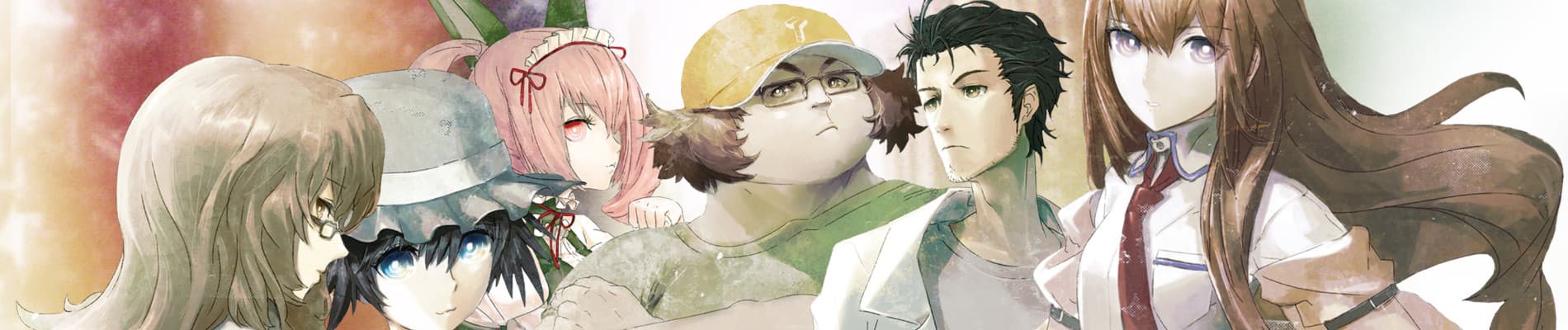
Steins;Gate
a review by Dogninja
a review by Dogninja
 (via: https://anilist.co/activity/958477913)
There’s something about time travel that creates that feeling. You know that feeling right? Even if you can’t aptly elocute said feeling–it murmurs in your chest softly, and it’s not high blood pressure induced from watching Nathan Fielder interact with anyone.
Time and space are inseparable from each other, and we are part of space. When you move our point in time, our perception of space doesn’t move with it–the space we are taken to clashes with the space that we know. There’s a shudder that comes over us from that thought… and…it is… familiar?
Why do we know this feeling? We’ve never time traveled before?
This is something that Steins;Gate answers for us, or more so illustrates for us to put it together ourselves…
Whenever people regard Steins;Gate’s time travel, it’s as this intellectually sound and intriguing storytelling device but it’s way more than just cerebral: it is visceral. People get caught up with the mechanics, but really it’s the sentimental aspect that is valuable. This cerebral concept of time travel isn’t intellectual play in this story as much as it is a medium to help us understand ourselves better…
There is a pervasive feeling of loneliness in works centered around time travel, my other favorite examples other than Steins;Gate being the Nintendo 64 Zelda Duology. Time travel always causes disconnection–the time traveler from the world. Time travel frequently depicts a feeling of disconnect from others around you, making someone further and further an outcast as they become isolated from the world around them. And to be honest… all of these feelings can be… relatable. This high-concept sci-fi narrative device evokes that very intimate, human feeling.
Whenever someone praises Steins;Gate it is with the whole “oh yeah the time travel mechanics are really well developed, there’s no plot holes, yada yada.” but I think anyone who actually cares will tell you that all that only really works because that time travel was discovered accidentally by experimenting with a microwave and cell phone by a group of college students plus one little ditzy high school girl as quirky and idiosyncratic as this idea.
The characters are all offbeat in some way but… there is a constant feeling of humanity bubbling underneath the surface of these characters throughout that becomes more apparent as the story unravels these characters. There are layers beneath these outlandish personality traits because Steins;Gate wants you to come to understand these characters and in turn, it wants to help you understand people and what is important to them and one of the most oppressive things to the human condition. A theme so seamlessly tied into every aspect of the anime from its plot, character-writing, and presentation style that creates this perfectly cohesive package. And that all starts from establishing its visual style: blinding harsh searing white light of Summer sun seeps in, reality being bleached out. This is the consistent texture of the environment in the anime. Engulfing the viewer in the shoes of the characters, a world of hazy reality.
The setting of Steins;Gate is the perpetually busy, densely populated city of Tokyo… yet it feels nebulous, behind a blurry white texture away from the characters. A texture that evokes the audience to feel the same as the characters. Like, when it comes to socializing, I can only really describe the characters as like a toddler playing the tutorial level of Banjo Kazooie. There’s endearing mannerisms as they “guh-huh” their way through a conversation, even if they get hit by a carrot and go “OH.” But this is a wall for people who don’t know how to earnestly connect or communicate.
Time travel does not establish the character’s loneliness. These aspects are already there before timelines are ever messed with. Okabe is in his own world with his chuuni-isms before he ever accidentally sends a d-mail. What time travel does is highlight these things, as he becomes further and further isolated from his friends and the world as he becomes the only one to know the world as he knows it. The shops he used to frequent with friends are now nonexistent to those same friends. The only one who knows of the tragedies looming around the corner, the only one affected by the trauma of those events while the world around him is oblivious to this suffering.
D-mails are a brilliant storytelling device that allows these characters to shift the past with a carefully worded, personal email. It is giving these characters a way to exhume any oogie-boogie-men in their closet. An exploration of the things weighing down on them. Feyris indulges herself in her hobbies by spreading Moe culture throughout Akiba to distract herself from the loneliness she feels by the void left by her father’s passing when she was just a young girl. It’s escape by overstimulation, escape by creating an otaku Alice in Wonderland. It’s like the 2009, rich, Japanese girl version of infinitely scrolling TikTok to not think about any of your problems. Ruka feels discomfort inside their own body because they feel like they can’t properly connect the way they want with the one they love due to their biological sex. An anxiety enhanced being raised as an heir to a shrine, constantly facing traditionalism. Feryis uses the d-mail to prevent her father’s death; Ruka uses the d-mail to change their sex.
Steins;Gate’s character exploration through time travel is superb. Suzuha’s displacement throughout time explores her struggle to find a place to belong due to Fate’s morbid whims; World War III taking her loved ones; a thunderstorm taking away memories with her loved ones; a mission that takes her to a time period without her loved ones. Her story brings out a different side to the pervy, seemingly aloof joke character Daru that empathetically paints his social terrorism as a struggle with vulnerability–leading into one of Steins;Gate’s most emotional moments where he earnestly belts his feelings at the top of his lungs at a leaving Suzuha.
Characters like Moeka and Mr. Braun works in tandem to foil the primary characters and explore the crippling damage of loneliness through the desperate measures they take. FB gives Moeka meaning by making her feel special to him, and she CRAVES this like a starving feral beast drooling over scraps. These scraps lead her by the nose, telling her which way to go. Like “dress in skin tight leather and kill a high schooler.” Mr. Braun takes advantage of Moeka’s suffering and takes her agency hostage under a fake pseudonym for his own ends. But Okabe takes care of Mayuri through a fake pseudonym out of love and helps her come into the lively, emotionally intelligent girl she is today while never actually taking her hostage like he says he does, respecting her agency. You can see this with how they react to distance. When Mayuri notices Okabe has been distant, she acts sincerely sad that she hasn’t been able to be around her best friend but mostly worried about him. Then with Moeka, it’s like a drug she’s become dependent on has been taken away. FB has been shooting her up with empty positive reinforcement, whittling away when she is cut off. Mr. Braun says at one point in his tough guy hardass store owner personality that he envies Okabe, not for any major accomplishment but for his ability to screw around in his lab surrounded by friends. There is a much deeper truth to this than what would seem, as he lacks that agency to foster connections in his life.
Is the line between Okabe and Braun so fine? When Okabe introduces himself to the audience it is through a TV, suggesting a performance. Underneath the mad scientist performance are these little looks, lines, actions that pave the way to bigger looks, lines, and actions–giving us an awkward young adult who more than anything desires connection and kinship, and he, unfortunately, does not know how to do that in a normal, functioning way so he… dons a lab coat. Delving into the Houioun Kyouma persona gives him the ability to bypass any sort of social awkwardness and turn anything into something at least somewhat amusing. Because that genuineness can feel uncomfortable and vulnerable. He can offer to help Suzuha by framing his actions as the “crazy coo coo whims of a mad scientist’s experiments” instead of revealing his earnest feeling of wanting to help someone, keying in that he may care about them. He can laugh off his comforting words to Kurisu as a scheme she “fell for” because earnestly meaning words claiming her as an important ally would be uncomfortably vulnerable.
The moment you see the conception of the mad scientist persona is the moment you start to understand what Okabe values. A small sweet girl, about to get sucked up into stardust to meet her deceased grandmother. A kid, not knowing what to do but to save his friend, re-enacts a TV show. That’s where it started, a child's emotional defense mechanism. How can a kid say something stupid and vulnerable like “I love you, so please stay with me.” How would they react to his feelings? Would being earnest even work? A flaw that follows him to now, with everyone.
But it gets across. His feelings. Mayuri still treasures him deeply and sees through his act and understands him deeply. The way he helped her through her depression is something that she always feels thankful for, and this leads to a nuance about Okabe’s character that I adore. That despite this guise of a wicked mad scientist, his true character always shines through this persona. To people around him, who he actually is–is obvious.
The same goes for Okabe’s consistent partner and love interest, Makise Kurisu. She doesn’t make an amazing first impression for Okabe (mostly his fault) but it doesn’t take long for him to see beneath the sardonic surface. She’s a dork. She’s sensitive about her relationship with her dad. She has little nuggets of wisdom that go beyond her years. She’s a reliable source of support and that more than anything she wants a place to belong to just like he does. This dynamic ends up as one of mutual transparency as Okabe sees past her exterior just like she sees past his. This relationship between Okabe and Kurisu ends up being the emotional core and payoff of the series and is Steins;Gate’s answer to its conflict of the loneliness of time travel. Even when he’s shifting worldlines and nothing makes sense or inconsistencies poke holes in reality, he still develops an important bond with Kurisu. No matter where he ends up she ends up always being there. He’s not alone, not as long as he opens up to her, she is always there. Every time.
There’s just something about these two’s relationship that strikes this chord with me in a way so powerful it’s hard to express. It’s almost like a memory lost in time. I can’t make out the full concrete shape of it, but the feeling lingers like a throbbing wound on the heart. Even beyond the thematics of it, the nuance of the execution creates so much pathos. The fun in having someone you can banter and tease relentlessly with, the comfort in having someone who sees you for who you are and accepts you and being able to act as support for each other in the cold unrelenting reality of the world. There’s a rawness in every interaction, all the teases and banter that feel like they are genuinely themselves when they are around each other.
Something about being able to just find that person that you can connect with on a truly emotional level is something that all people desire. There’s just something about falling in love that brings out this part of you that feels so genuine. I believe Savannah Brown said “Love is trying to recreate the euphoria of childhood together, maybe.” and they always feel like children, having fun, bickering–to the point, I feel like a child watching them too.
Mayuri says she doesn’t think the illusion conductor is a bad guy, her way of saying how this make-believe mad scientist and hostage situation isn’t at all a bad thing. Even though their current relationship is built on a pretend premise, there’s nothing false about the affection and happiness the two have for each other. Mayuri’s wisdom here is profound. Houioun Kyouma isn’t this wholly unhealthy coping mechanism, it’s something that has allowed him to be able to connect with others while having a good ass time. And the same can go for the other characters too. There is still warmth in all the character's friendships with one another. Some of the character’s personalities might be illusory but are these connections as well? Okabe’s moments of warmth and connection he finds with people may fade away like an illusion after he time-leaps, but so what? Feelings can transcend time after all, so why can’t they transcend just a teensy little bit of pretense? Mayuri understands all of that, she sees through all the walls people put up but loves all of them, walls included all the same. This is symbolized through the Stardust Handshake. She seems to be reaching toward this oppressive white light threatening to blot them all out, but she’s actually reaching for the stars. Something that can’t be seen all the time but is always there.
Okabe channels Hououin Kyouma like this for his final operation to save Kurisu, not as this “make-believe” persona that has a bitter undertone to it, but in a way that is triumphant. A way to reject the fatalistic nature of this world that is seemingly hellbent on making him as broken and lonely as possible. As he meets Kurisu again in the last scene and goes on one of his tangents, his voice and eyes exude a transparent warmth as his intentions come out more directly, the two parts of him coalescing more maturely.
To get back to that worldline Okabe knows more than any worldline he had to come to understand the people who make that worldline what it is. It’s only through coming to know the other side of the people around him, their pain and loneliness that he can return to a worldline without that loneliness.
Okabe is the perfect protagonist for Steins;Gate because in the end not only does he know more than anyone else how crushing loneliness is, but he is also aware of all the other’s loneliness as well. Okabe can fully develop empathy for the characters of the series by the end, and due to the viewers being in his shoes this empathy is communicated to us.
“People’s feelings are memories that transcend time” is true. Steins;Gate places so much importance on feelings of connection and love that those feelings leak over into different worldlines. So it makes the most sense that the one with Reading Steiner, the ability to remember different worldlines, is the one who values connection the most.
There is a shot from the first episode of Steins:Gate where Okabe is caught alone with no one else on the City streets after he time leaps for the first time, and I find this symbolic of Steins;Gate’s and Okabe’s conflict but it comes full circle in the absolute last scene of the show as Okabe is swarmed with people around him but only one other is clear in front of him as he is ready to make that leap to make a connection with the person he loves the most, with a connection that hopefully transcends time. Within a sea of infinite possibilities, maybe such a thing is possible. Such a thing almost feels bigger than us, such an intimate, visceral connection–that when it happens it feels like the choice of the universe. But… maybe it’s us who can make it possible. Maybe THAT is the choice of Steins;Gate.
37.5 out of 38 users liked this review
