

When I finished the anime, I immediately switched to the manga.
It's a complex work that starts with a simple premise, and you can tell it's an older work because of the themes it touches on.
I've read several of the author's works, and they all have that thriller feel; he always knows how to make something ordinary seem terrifying.
I really liked this work. I feel it's a unique work within the author's catalog because, if you notice, the three protagonists here are all equally crazy. There's always a "Victim, Bully, and Savior" theme. The author plays a lot with the roles the protagonists play and assigns them those roles so the plot develops smoothly. However, I think this work breaks that pattern. Here you have Nakamura, a girl with Asperger's who sees reality in a distorted way. I really like the complexity of her philosophy, in which human beings who conform are shit, while those who break with the system are the ones who reach the "other side." That's why Kasuga comes to the conclusion that the "other side" only exists within Nakamura, because she sees things that others don't. Speaking of Kasuga, he's the one who plays the role of the victim protagonist that the author likes to use —for example, Youhei in Okaeri Alice, Marie in Boku wa Mari no Naka, or Seiichi in Chi no Wadachi—. Kasuga has a good development since the work shows you how, little by little, the monster that was always there comes to light. On the other hand, the character of Saeki is interesting because she's the one who would normally play the role of the savior, but here, however, she seems to feel towards Kasuga what he feels towards Nakamura: a compulsive obsession. I liked Saeki's character because she's the one who breaks with that scheme, she's the one who makes you, as a reader, feel that the situation is surreal and that none of the three are okay.
The show is divided into three parts: the beginning, where Kasuga loses his sanity because of Nakamura; the development, where Kasuga gets even crazier than Nakamura; and the end, where Kasuga confronts his past. Each part shows you a different side of the characters and their evolution, and I'm going to spend a little time talking about each one.
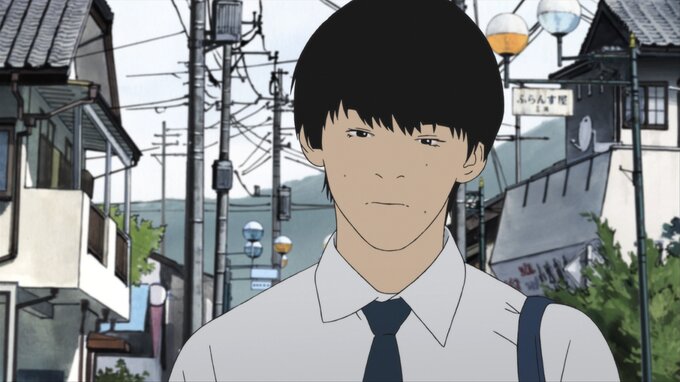
The first part, which I saw in the anime, seemed sublime to me.
I really liked how the show managed to convey that feeling of not belonging, of feeling the need to escape. There were incredible moments, like when the three of them are on the mountain or when they destroy the classroom. They show you how none of the three are right in their heads, and I feel that's partly what the show wants to convey.

I really liked the second part because it reminded me a lot of Oyasumi Punpun —a work on which I realized the author based a lot—.
Watching Kasuga and Nakamura become criminals in love who simultaneously hate each other is such a rich read; it's so well done. I feel like it's when the protagonists, especially Kasuga and Saeki, sink to their lowest point, when they reach the point of no return. A clear example is the planned suicide that was going to take place at the summer festival. It was one of the hardest scenes I've ever seen, almost on par with Johan Liebert's perfect suicide, Eren's Rumble, or Lelouch's Zero Requiem. It was a scene in which the protagonists were literally giving their lives to demonstrate their philosophy, and the fact that it's teenagers who are the protagonists makes it even harder.
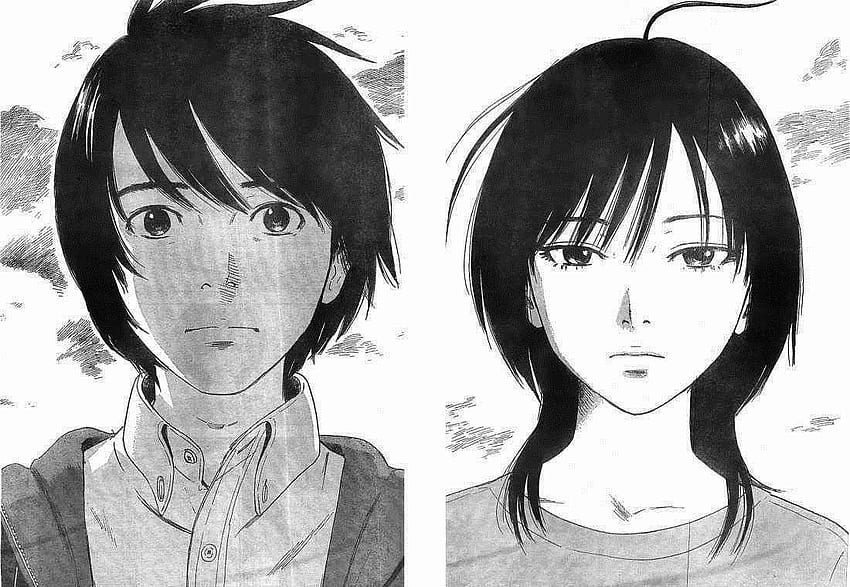
The third part is interesting.
For a second, I thought the author was going to use the same damn timeskip he did with Chi no Wadachi, but thank goodness he didn't. Personally, I hate timeskips, as they seem like a very cheap way to show development, almost forcing it or pulling it out of nowhere. That's why I always praise Oyasumi Punpun for how it managed to sublimely pull off what many others fail to do. Well, at least here the author at least managed to give the plot a very decent conclusion, unlike the crap he made with Chi no Wadachi. Anyway, speaking of the final part, here you see how the three protagonists have separated and moved on with their lives. I really like seeing how Kasuga moves on with his life and happily meets Tokiwa, a girl who accepts him and doesn't let his attempts to move forward fall by the wayside. Kasuga wanted to climb out of the hole, but he was already feeling tired. While Kinoshita was the one who prompted him to reunite with Nakamura, it was Tokiwa who stood by him, who never left him alone, and who supported him through his most difficult moments. Seeing Kasuga return to the town that caused him so much suffering to confront his past, this time with Tokiwa, his emotional support and the one in whom he finds hope, reminded me of the concept of the Silent Hill saga and, a bit, of Oyasumi Punpun.
In the end, we see how Nakamura moves on with her life, living with her mother in a restaurant. She's still the same; she's just grown up and matured. She's just settled with her lifestyle, and that's why she no longer feels the same despair. Reuniting with Kasuga seems to have done her quite a bit of good, and that was enough to make her feel like the setbacks she experienced in her adolescence are resolved. One point worth noting is that I'm not entirely convinced by the explanation of why Nakamura pushed Kasuga during the kerosene incident. Perhaps the "I don't know. I forgot" response is the author's way of conveying the idea that the past doesn't matter, that remembering the pain doesn't matter, but it seems to me a vague way of clarifying why she did it. I mean, what ends the second part and begins the final part is precisely that, and if the author can't provide an answer to why Nakamura betrays Kasuga, that's forcing the plot. No matter how hard I tried, I couldn't find an answer to why Nakamura pushed Kasuga during the kerosene incident. Generally, when an author doesn't tell you why things happen, it's because it's open to interpretation; it's because the author wants you to think, to analyze. However, because of how it happened and, more importantly, WHEN it happened, it seems like a great script to me. You can't just throw in a scene that changes the course of the plot and the characters without giving any context, because that's a great script. Both Nakamura and Kasuga had planned it, both were willing to die, both were full of kerosene; there was no reason for Nakamura to betray Kasuga, beyond a great script on the author's part to "justify" the timeskip.
At least that's my opinion. Despite that, I didn't think it was a bad ending at all. As I said, coming from Chi no Wadachi, I felt like dropping this show as soon as I saw the timeskip. Thankfully, it turned out well. In the end, ironically, Saeki is the one who turned out to be the most disturbed, since she didn't solve her problem, she just buried it and continued living, and the fact that her new boyfriend resembles Kasuga is proof enough.

Overall, Aku no Hana is an amazing work. It's not quite a masterpiece —first, because it has a few terrible plots and second, because the author didn't handle the timeskip well—, but it is an amazing work, both for the themes it addresses and how it addresses them. I'd dare say that, despite all the dark shit, this is the author's happiest work I've read, even comical at times, due to the underwear issue and how Nakamura keeps calling Kasuga a pervert.
It's an excellent work that I recommend to fans of Oyasumi Punpun for the way it develops the plot in such a mature and realistic way without falling into cliché.
What I admire most about Aku no Hana is that it doesn't feel convoluted, like Chi no Wadachi.
In short, is an excellent work, recommended, and one that will undoubtedly become a personal reference.