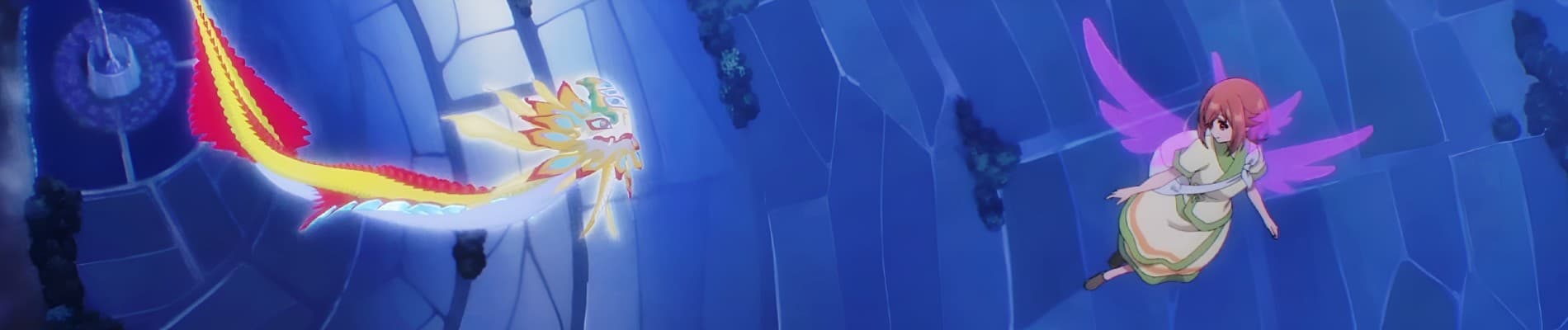


For me, an isekai’s job is to take us to another world, especially as our coping mechanism for escaping reality has gotten stale, with barely any heart left in its place. It's an obvious turn-off to someone who fell in love with anime for the sole reason of escaping the harshness of being an adult. The greatest crime for a series is being too predictable—knowing the exact tropes it wants to use, and proposing its world-building without even showing it.
As my time grows shorter and my internship looms in the background, the less I get to immerse myself in the world of anime and embrace the life of adulthood.
With that said, before I start my internship, there is an “isekai” anime I’ve been waiting to see—and it’s Bâan, an 18-minute short created by Garnt (a.k.a. Gigguk), a creator I’ve had my eyes and ears on for years now. Though I’ll admit my expectations for this anime were rather low—after all, how can you condense a story into 18 minutes with flair and spectacle?—yet it did something I didn’t expect: it hit me with the exact feeling I needed to hear.
***

Bâan starts off immediately as we follow Rinrada (Haruna Mikawa) and Daichi (Shouya Ishige) as they cross through worlds. Their reasons aren’t immediately told, but that gives room to fill in the gaps. The gaps I’ve filled are that they left their current world to escape an aching feeling they carried, choosing instead to experience life in a different world where they felt like they belonged.
Daichi’s desire to escape the monotonous, tech-driven world in favor of one where he can dictate the paths he wants to take is utterly relatable, hitting that unconscious desire we all share to escape normalcy. On the other hand, Rinrada traverses into the land of our familiarity—a world filled with rejection and aggression—and yet she finds a bit of solace in its gray-scale existence. This reflects our own reality, like leaving a rural town to venture into an urban life. Despite how uncomfortable and discouraging it may be, you take on the challenge to prove to yourself that you can make it on your own.
While Daichi and Rinrada’s journeys are told separately, as a viewer, it feels like their paths form one person’s conflicting journey through adulthood. Like Rinrada, stepping out of her shell to explore a world that’s unfamiliar and uncomfortable. And like Daichi, yearning to escape that very discomfort and carve out a path of his own. It’s an adult’s personal dilemma—navigating through life, torn between opposing desires. A fine line of adulthood, expressed through the theme of isekai, and respectfully captured within its 18-minute run.
For everything else, this was a blast. The music—while not always present—hits hard when it does. Its animation is respectable, and the world it builds is nuanced enough that you can fill in the gaps with your own imagination. Most importantly, it’s an isekai anime that doesn’t just provide a basic how-to-isekai storytelling, but instead makes a meaningful attempt at depicting the dilemmas of adulthood: on one hand, escaping into a world where you drown yourself in adventure and carve your own path; on the other, conforming to mundanity as a self-fulfilling goal of surviving through adulthood.
I just wish it could have been a full series, to truly give justice to the story it wanted to tell. ***