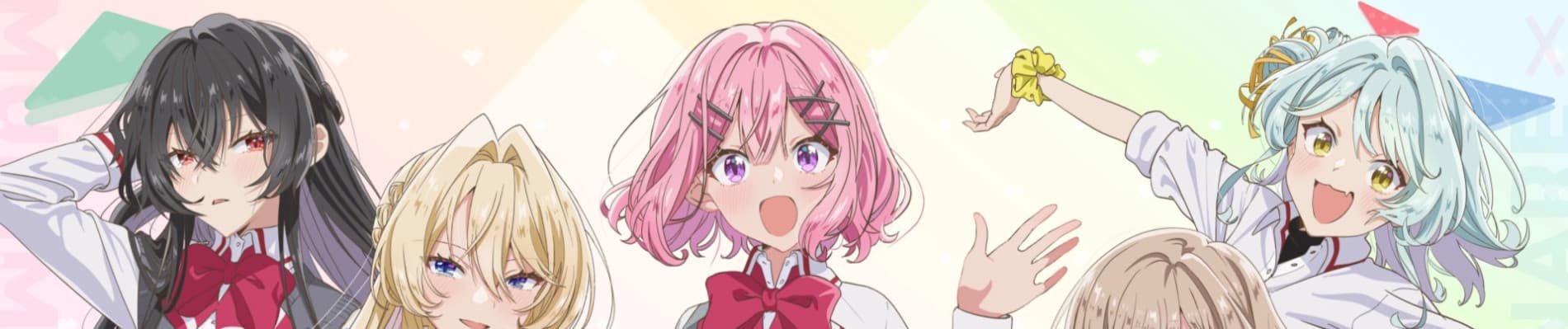
Something I've learned from years of talking about anime is that some shows are really hard to hate. Bad anime is a dime a dozen; no one's losing sleep over dropping the latest seasonal isekai slop or trashy rom-com. They were always going to be worthless and disposable, easily consigned to the dustbin of memory. But then there are the other ones. The shows you want to root for, where you can see the potential for something really special, yet fail to come together in the end (or just shoot themselves in the foot) and leave you with the bitter disappointment of yearning for a better version that you're never going to get. This could've been good! This should've been good! How dare you not give me the good version of yourself! There's a reason so many of us still can't stop thinking about Wonder Egg Priority all these years later; that kind of demoralization sticks with you. And it's a feeling I've been forced to content with once again, thanks to this absurdly titled mess of a show that I will henceforth refer to as Watanare for the sake of my poor keyboard.
See, I'm a yuri fan. And one of the hardest parts of being a yuri fan is accepting that most anime adaptations of yuri manga are going to suck. The animation will be bad, the pacing won't do the source material justice, and you're not getting more than one season. That's finally starting to change, thank god, but the industry is still deeply uninterested in telling queer stories and even less interested in telling them well. A single episode of Jujutsu Kaisen having less than 240 frames per second is a national outrage, but Whisper Me a Love Song's production crashing so hard the studio fell apart? That's just Tuesday. So there's this need for yuri fans to cling to any positive scrap of content we're given, no matter how flawed, because we're allowed so little of it. We don't have the luxury of choosing between five sakuga-fest shonen action series or lavishly animated hetero rom-coms (some of which are good, to be clear, but that's not the point). In this economy, our only option is to lower our standards and accept that middling-to-average is good enough and worthy of celebration.
So when Watanare's trailer dropped, showcasing some of the snappiest, most expressive comedic animation I've seen in a yuri rom-com, I almost lost my mind. How was this possible? A show about goofy gay girls with actual production polish? Where jokes could be accentuated by animation instead of relying on voice actor over-emoting over panning backgrounds? With an obvious love for the source material bleeding from every aspect of its visual presentation? This was it, I thought. This was the yuri series that would finally prove this genre's worth as a contender on the global anime stage. Finally, studios would learn that queer stories were every bit as worth investing in as straight stories, deserving of just as much care and support from the artists bringing them to life. And then I had to actually watch the show all that excellent, expertly-crafted comedic animation was attached to, and I spent the next twelve weeks ferociously biting back a growing sense of betrayal. You let great manga like The Two Sides of Seiyuu Radio shit out a hackjob adaptation with no regard for quality, but this is what gets the gold-star treatment? Am I being punked?
But alright, let's set the stage a little first. After spending her middle school days by herself, crippled by introversion and anxiety, Renako Aomori is determined to finally make some real friends in high school. And as luck would have it, she manages to earn a spot with the most popular group of girls around- one led my Mai Ouzaka, a picture-perfect rich socialite queen if there ever was one. Except, as Renako quickly discovers, that mask she puts on in public hides a snarled tangle of insecurities and character flaws she doesn't want anyone to know about. She's lonely, isolated, desperate for someone to truly know her but so trapped by her reputation she can't risk letting anyone in. Small wonder she attaches so quickly to Renako, the one person who can accept her real self without judgement; after all, she knows very well what it's like to be scared of letting people in. There's just one problem, though. Renako determined to make friends. But Mai? Mai wants more than that. A lot more.
This sets the stage for Watanare's central hook: the Love/Friendship game. Renako is convinced that having a lover would be a million times more stressful and overwhelming than the kind of friendship she's hoping for, while Mai doesn't think a simple friendship would ever be enough to handle her (very sudden and childish) infatuation with Renako. So, they make a bet: they'll be both at the same time! Some days they'll act as friends, some days they'll be lovers, and they'll both try to convince each other that their preferred kind of relationship is the best way for them to be. Of course, the irony there- an irony Watanare understands, to its credit- is that when you get into the weeds, it's very hard to draw a clear line between what qualifies as friendship and what qualifies as romance. Is having a girlfriend just like having a friend you can kiss? Or is there something more to it that neither girl is mature enough to articulate? And that's not even considering Renako being so far in the closet that she can almost go catatonic from groping a fine pair of boobs and still try to convince herself she's not into girls.
The point is, these girls have issues. They're messy and imperfect and very bad at communicating exactly what they want out of each other, which only escalates once the rest of Mai and Renako's friend group gets in the mix and we start digging into their problems as well. And in its best moments, it's easy to see the kind of show that Watanare is trying to be. A screwball rom-com that nevertheless has real human drama at its core. A story of a bunch of disaster lesbians butting heads, tripping over each other, but somehow stumbling their way toward genuine connection. I can so clearly see a version of this show that isn't just good, but great, something with a truly valuable message about what defines our relationships and how to balance what we expect from others. And like I said, for once, it has the kind of production polish that could make a story like that resonate in the animated medium. There should be no excuse for this not working.
Unfortunately, there IS an excuse, and that excuse's name is Mai Ouzaka.
There's just no getting around it: Mai SUCKS. She's pushy, she doesn't respect boundaries, she violates Renako's consent on multiple occasions to force kisses and unwanted touching on her. She's essentially a genderswap of the stereotypical molest-y yaoi boyfriend you find in low-rent BL, and she brings all that trope's baggage with her. Including- and I want to be explicit about this- trying to rape Renako. The climactic moment of the first arc comes when Mai tries to force herself onto Renako in her bedroom, and ever after Renako tells her no, she keeps pushing forward until someone else walks in on them. And when the fallout arrives and they finally confront each other about it, Renako is the one who apologizes! She says sorry for slapping Mai as if she wasn't fully justified in telling her to eat shit and piss off forever! It tries to treat their reconciliation as this big romantic moment, but it completely lets Mai off the hook for- again- almost raping Renako after she explicitly told her to stop. How am I ever supposed to root for them as friends or lovers after that?
I want to be clear her: Mai being a bad person who does bad things isn't what makes her a bad character. Taking a bird's-eye view, it's clear how this plot beat is supposed to work. After all her pushiness, Mai finally takes things too far, but it also forces Renako to confront her own sexuality and consider what she really wants out of this relationship. Frankly, if the assault scene itself had stopped even fifteen seconds earlier, the whole thing would make sense. Renako spends the first chunk of it too overwhelmed by her feelings to really get the words out, wondering if she might actually want this and whether or not she can picture herself as another girl's lover. She's conflicted and uncertain, and if her sister had walked in on them before she worked up the strength to outright tell Mai "No," only for Mai to continue stripping her and ignoring her repeated refusals (which for some reason the show turns into comedic chibis?? Because haha attempted rape I guess??????), then everything about what follows would make sense.
Because then it would actually be a moment of terrible communication on both their parts, a moment where both of them failing to understand each other's point of view leads to a near-brush with tragedy they both have to take responsibility for. That's clearly what Watanare is trying to articulate through its cast's fumbling: relationships are more complex than any character fully realizes at first. It's only through butting heads and listening to each other that they're able to articulate what they want from each other and respect each other's wants in turn, whether friends, lovers, or something entirely different. But all of that goes out the window when Renako does communicate her wants clearly- "I don't want to have sex with you"- and Mai just ignores her anyway. That's not a justified story beat that communicates the themes it's going for: that's just rape. And by making Renako the one to apologize for it, it's also rape apologism. No matter how their relationship develops from there, that stain will never fully wash out.
Except, well, their relationship doesn't really develop from there. Which brings me to the second stake in Watanare's chest: the pacing. Each four episodes is an arc centered around a different member of Mai's friend group- first Mai herself, then her sullen friend/unrequited crusher Satsuki, then absolute angel Ajisai who can do no wrong (editor's note: she can, in fact, do quite a bit wrong). Nothing wrong with this in theory, but in practice, when those arcs focus on those characters, they only focus on those characters. As in, when the focus shifts to Satsuki in the second arc, we only spend time with Satsuki and Renako. The other girls barely pop up at all, and even Mai spends less than a minute alone with Renako to develop their dynamic beyond, again, Renako apologizing to her attempted rapist. It's like these stories exist in complete isolation of each other, no character development carrying over because the characters themselves don't even carry over. As such, Renako and Mai's relationship doesn't even have a chance to become more than the foul point it ended on. It's just left lingering in the background unaddressed, its stench wafting over the show as it moves onto other things even when Mai's not on screen.
And this isn't just bad for the individual characters; it's poison for the show's heart. Remember: the premise of Watanare is built on Renako wanting to make friends for the first time, and stumbling into this friend group is her chance to find a place where she truly belongs. But because everyone's kept so isolated from each other, we just never get a sense of that group dynamic. We have so little context into who these friends are together, how they support or bristle against each other. So how are we supposed to care about Renako finding her place among these people when that place barely seems to exist? Sure, she gets closer to individual members of this group, but what about her place as part of a community? What about that support network of people she can trust and rely on that she's so determined to be a part of? I should be CHEERING for Renako when she gets closer to everyone. I should be overjoyed for her finding her place to belong among people who accept her for who she is. But once the first arc is over, that community they supposedly share might as well not even exist. They feel more like rough acquaintances than a tight-knit group of girls who know each other inside and out. So caring about Renako becoming part of them suddenly starts to feel like wanting to put a carrot on a snowman in the middle of summer. What's the point when the thing I was relying on is already gone?
Amidst all this messiness, even still, are the moments where this show genuinely works. There's a scene in Satsuki's arc where she's showing Renako her DIY glow-in-the-dark bath lights, something scrappy and handmade in contrast to Mai's rich extravagance, and you can feel the connection these two form and the pride Satsuki takes in not letting her family's poverty prevent her from finding joy in her life. And there's lots I really like about Ajisai's arc and how it peels back her sweet-natured outer layers to the more complicated person underneath. There is something buried under all of Watanare's failures, something raw and personal that really digs into the messy gray areas of human connection. This is not a show made with malice; it's trying to be great. It's trying to give something meaningful to the world and push queer storytelling forward in its own farcical way. So why does it have to fall so short? Why promise the potential for a new yuri standard-bearer if all that potential is going to be drowned out by a garbage co-lead and a disjointed world that never feels worth getting invested in? Why couldn't you just be good, god dammit?!
I wanted to like Watanare. Even through all its faults, I wanted to believe it could become something worth celebrating. But all the well-polished animation and good ideas in the world can't save it from storytelling faults this severe. Maybe the just-announced sequel (NOT a full season, but essentially the next arc is getting animated i believe) will be the moment it finally gets its head on straight and delivers on all its promises. But right now? I just wish yuri manga adaptations were respected enough that this one show's failure didn't have to feel like such an insult.
174.5 out of 250 users liked this review
