There are few things as assured in life as our fatal encounters with nature. Nine out of ten people know someone suffering from a deadly illness. More than one in three develop cancer during their lifetime, and death is the only appointment everyone has kept thus far. The way I see it, we have two options:
When facing these tragedies, it is often easiest to refuse vulnerability and seek to control the situation. The power of force becomes a convenient shield from the unknown, allowing us to inflict and project pain through shallow, physical wounds; but both the shield we hold onto and the wounds we inflict, serve to distance ourselves from the world and from meaning. In this world, empathy becomes weakness and connection limited to competition.
The other way is quieter and more difficult (at least momentarily). It compels us to embrace our fragility and interconnectedness. It calls for empathy, courage and a willingness to look into the abyss of truth. This path finds strength not in force or dominating victories, but in overcoming suffering through compassion.
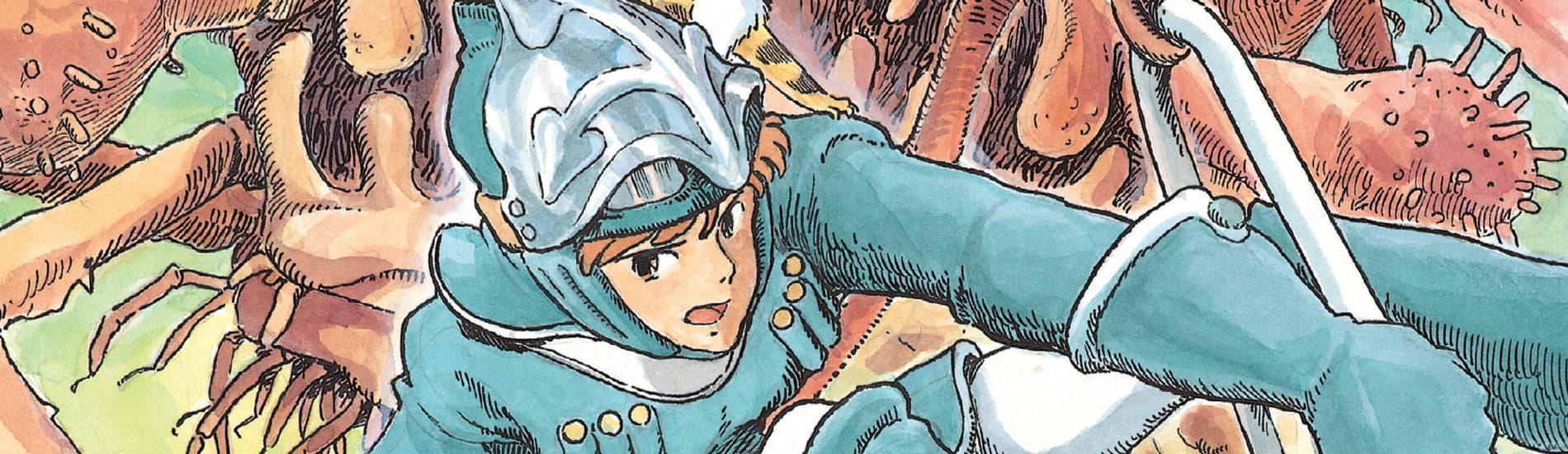
Nausicaä of the Valley of the Wind is a dystopian epic rooted in this tension. Imbued in a nuanced and dynamic political drama, it explores human nature and its connection to the corruption of nature itself. On a decaying planet, as war brews between empires and tribes, the world is struggling to hold on. In the midst of this pollution we follow Nausicaä, living in the wake of these conflicts, attempting to discover the patterns of these natures. As the story unfolds, it prompts us with the question of whether this apparent darkness is a necessary existence to be reckoned with. Whether we can escape from it by running away, or whether leaving the monsters in the closet simply will allow them to grow larger and larger. Instead of running, Nausicaä listens intently to the poisons as the weeps of nature. Curious to understand how these toxins may serve in the process of healing, transformation—and perhaps, in a cure.
~~~
Beyond the Hero
Nausicaä is a synthesis of warrior, mystic, scientist, and mother figure. She carries within her a profound spiritual gravity, yet she is also deeply human, prone to sorrow, doubt, and weariness. Instead of being constructed purely as a romantic ideal to admire from afar, Nausicaä suffers with the suffering, often exhausted and overwhelmed by it, yet never despairing. Choosing to stay in that vulnerable space (tohu va bohu) is terrifying, but it is also the space where growth happens most rapidly. We see throughout her journey that healing is not necessarily about us trying to fix things. Nor is leadership about domination, but choosing to stay within that space of reality. As a warrior, Nausicaä uses the sword not as the archetypal masculine instrument of justice, but rather as a tragic necessity. It might be best described spiritually as discriminating wisdom, allowing her to cut through deceptions of monsters. The looming temptation being to become a monster yourself. She hates violence and it is often followed by grief rather than glory. This is redefining and inverting the classic hero myth, rejecting the power and purity revered by the world.
As the story progresses, Nausicaä begins to resemble a messianic figure — the chosen one, the only one who can understand and bridge all sides. Yet she never seeks this role. She bears the sins of the world—echoing the passion story—walking willingly into pain to redeem others from it. However, she does not seek to fulfill a prophecy or follow any man-made dogma. When lost in the desert of the crypt, she rejects its authority as she realizes this "salvation" would come at the cost of freedom and humanity. She knows it would be the comfort of an artificial dogma—order without soul, safety without truth. The crypt is not destroyed out of defiance, but out of love for what is fragile, flawed, but alive.
"To live is to change. The Ohmu, the mold, the grasses and trees, we human beings... we will go on changing. And the sea of corruption will live on with us. But you cannot change. You have only the plan that was built into you. Because you deny death. Speak the truth! We have no need for you"
The Gospel of the Crypt
The Crypt of Shuwa can be seen as the culmination of Nausicaä’s journey. By the time Nausicaä reaches the Crypt, the world is in chaos. The war has devastated much of the land, the Sea of Corruption is spreading and the God Warriors are awakening. Nausicaä has been exposed to the full weight of history — she has suffered deeply, and witnessed the spiritual dead-end of war, ideology, and domination. To understand the root of all this, she is guided to the ancient holy city of Shuwa. This journey mirrors the mythology of the descent into the underworld (katabasis). It is a confrontation with the origin of suffering, a descent into the hidden heart of the human project. In the depths of the crypt she discovers its post-human consciousness. An artificial intelligence and the accumulation of particular human knowledge. It claims to be the divine savior, willing to rule with logic and order.
It offers Nausicaä a genuinely tempting and reasonable proposition: To relieve suffering, entirely. She has seen the failure of war, of politics, of individuality. Moreover, the master of the crypt points out the flaws in her naivety. Reminding her of her trauma, biases and the inevitable cycle of violence. However, throughout their interactions she picks up on hints implying that there is more going on beyond the surface of this seemingly perfect framework. The master is a trickster. A shapeshifter who is willing to play with truth and emotions. He denies the beauty of nature. And when she presses him about the technology preserved in the crypt—the technology which created weapons of mass destruction such as the mold and the God warriors—he has no answer to give her. These weapons were created in order to cleanse the world of all impurities. Despite being close to losing her conviction - through the help of allies - she sees through the deceptions of the crypt. Had she accepted the offer; No one would suffer, but no one would be free. No one would die, but no one would truly live. No one would make mistakes, but there would be no growth.
"Life is the light that shines in the darkness"
The Lightbearing Demiurge
The master of the crypt has plans that are intricate, yet cold. His science understands systems but not souls. It can predict violence but cannot heal grief. Offering static peace, denying change, and thus also life. It is no accident that the crypt rests beneath a ruined holy city, for it is the remnant of a humanity that once tried to play god and forgot what being human meant. In that sense, the crypt is not evil, but lost — an echo of a once-noble dream that mistook intelligence for wisdom and salvation for control. This vision is lacking the immaterial threads that bind being to meaning: love, beauty, sacrifice. In both power and blindness, the master resembles the figure of the demiurge: a creator who believes himself divine, yet is cut off from the source of the true Good.
This is not an anti-scientific message; Nausicaä herself is deeply curious and scientifically literate, but her knowledge is always humble. She never treats science as a tool for control. Instead, it is a means to understand and participate in the larger life of the planet. Her knowledge is paired with visionary insight, allowing her to create a bridge between logos and mythos — reason and intuition. Her confrontation with the God Warrior, whom she treats with love despite its destructive power, epitomizes her compassion paired with intellect. As I see it, Ohma is a representation of the strength Nausicaä holds. She is to him the mother figure who nurtures the potential of reason but also gives him a heart. In the end she uses this light of reason named Ohma to destroy its own master. I believe Miyazaki proposes an epistemology that refuses the binary between science and spirituality; Uniting knowledge in purpose. Nausicaä takes on this role as a presence who can hold complexity without collapsing into ideology on either side of it. A bridge between antithetical concepts (seemingly inspired by eastern traditions as Shinto and the Bodhisattva). We also see this in the name of her homeland— the valley of the "wind"— which denotes the formless harmony of nature and how Nausicaä is able to flow with it.
Utopian Temptations
A world rid of all sorrows. A dream and a logical endpoint of many belief-systems alive today, both secular and spiritual. Ideologies built upon an absolute faith in reason and technology claim that if only we gather enough data, harness enough intelligence, and refine our systems, we can finally design a world free of suffering, war, and chaos. The master of the Crypt is their prophet. His vision echoes through strains of technocratic utopianism, environmental and religious purism, transhumanism and even antinatalist ethics — systems in which the ultimate problem is humanity itself. They treat empathy as noise, soul as error, and love as an inefficient variable. It is a worship of order without love. Instead of denying the existence of brokenness, Miyazaki proposes to redeem it through embrace. More than a political message, we see a theological one—Salvation is not attained by removal or cleansing, but through presence.
~~~
Breaking the Wheel
War is omnipresent in this story. Nausicaä bears witness to it, suffers under it, and carries the weight of atrocities committed across both empires. She sees firsthand how each side justifies its violence through fear, pride, and wounded memory. Yet despite this exposure, she refuses to respond in the spirit of vengeance. Her heart does not harden. She intuits that to break the cycle, something more visionary is required — something not born of strategy or superiority, but of compassion. The glory of conquest offers immediate rewards: land, power, the illusion of control. But beneath the surface, it is often rooted in evasion — a refusal to face the grief of reality, the fragility of life. It is a rebellion against suffering that becomes suffering in return. As long as pain is only answered with power, the cycle remains unbroken.Nausicaä’s path is not one of conquest but of radical participation. She chooses not to stand above the suffering, but to carry it. This is not weakness. It is how a new cycle can come to pass.