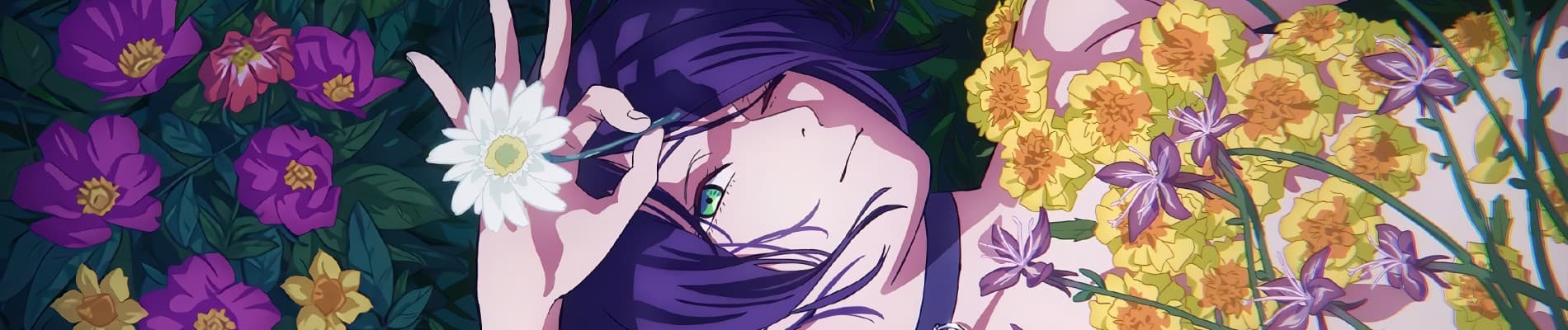

I have to start by prefacing a few things. This review contains spoilers. Skip to the third paragraph if you want to hear about the actual movie. This is my first anilist review. I have not watched the anime for CSM. I read the manga, and currently have paused reading it some 200 odd chapters in. CSM is not my favourite Fujimoto work. Far from it, I always found myself caring for it less than other people in my peers who did like it a lot more while also liking his other works. Chainsaw man was fun, and some parts were cool, but overall I care about it a lot less than works like Goodbye, Eri and Fire Punch. So why did I watch this in theatres almost as soon as it was released?
Well, for one Fujimoto really likes movies. And damn does he make that clear in his works. And so when I heard Look Back was getting a movie, I was really happy for him and went to watch it. But looking back, my experience wasn't as great. The movie was cool, no doubt, but I don't go out to watch movies that much, and going alone at an overpriced theatre was kind of a mood killer. So this time I after some back and forth on deciding if I want to watch, I hit up a friend who had not watched CSM at all to go watch a movie to, just because. And honestly a much better choice. And I think the movie worked out quite well despite that, because it introduces returning characters sufficiently (in a subtle way without wasting it's minutes on this).
Chainsaw Man: Reze Arc is a really pretty movie with a banger soundtrack that I will be listening to afterwards for sure. And it covers a pretty powerful arc of the story without dropping anything essential, while adding touches that make it much more memorable and tragic. Yes, this story is a tragic one, between two teenagers who struggle to access autonomy while serving the adult world with their lives because from the very beginning they were denied a normal life. The Reze arc is about finding human connection in a world that is full of people making transactional relationships that seek to use you in order to further oneselves. Which, is one of the core themes of CSM, at least P1. At the point of writing I do not really know what P2 is about.
The main focus of the arc is obviously Reze, but it also revolves around Makima, and the relationship between Aki and Angel, and of course, Denji himself. Reze is a girl who works at a coffee shop, meets Denji in a cute scene in a phone booth, and teaches him how to swim. And then tries to convince him to leave the city life behind for the country one, for the country mice to her is happier than the city one. This folktale is at the center of the arc, and Denji prefers being the city mice, much to Reze's dismay. The city life represents continuing to be part of the war between devils and humans, and being a pawn in the schemes between goverments trying to get on top of the war. All roads lead to Metal Gear Solid. And being part of the war effort gives Denji unprecedented benefits, the ability to approach existing in a normal life. He can have good food, he can have a roof over his head, and he can have positive interactions with other people, especially girls, even if they are transactional in nature and often lead to being tried to be killed.
A brief interlude to the first scene, where Denji goes on a date with Makima, where they watch a lot of movies, for only one to be actually good, despite there being no crowd. Would be a very funny metanarrative if my theatre was empty, but it had a decent showup, though I have a feeling the other big anime movie probably has the larger crowd (or like, any non anime movie). Makima's opinion towards movies is that she only finds one in ten movies interesting, and most of them are not. While it's easy to see it as commentary on consumerist mass production of movies, and I think if I were to watch all the movies the theatre had today, I would most likely come with a similar opinion; I feel there's another sense to read into the scene, with the desire for human connection at the core of the story. We interact with a large amount of people over the time of our lives, and most of them are one offs and some are closer yet distant. And when you are a person like Makima, most of them are distant and meaningless, with only a select few meaning something to you and giving you the hope for a real human connection.
I'll say that the movie tries to present the illusion of a happy life with Reze far less than the manga, especially given it actively promotes her as the Bomb. And so I will no longer avoid the topic. Reze is a spy, developed by the Russian govt and sent by the gun devil to defeat the chainsaw devil, whose abilities actively damage the war for the devils, and a really strong devil - the bomb devil. Which makes sense. The human fear of explosives is as strong as our desire to see them explode. Her role is to entrap Denji and kill him, and retrieve the chainsaw devil's heart from him. But in the process, she ends up enjoying her time with him, and desiring to escape from the cycle of war she has been thrust into and run away with someone whom she can relate to, a fellow victim of the war who has been ridden a chance at a normal life from the start and only been given the chance to have a farce of one when acting out her role of a spy. She even realizes this attempt was moot when she learns about Makima, labelled a witch whose reach would never let her escape and have a happy life. The poem that Reze sings is also nicely done :) (miserable (positive)).
The second half of the film is a lot more full of action and I did overall like the translation of it to the medium, since I don't remember following along fights all too well in CSM. Part product of the style, part I think I just can't follow action in manga that well. Which is why Fujimoto excels at showcasing the results of action in beautiful panels over the action itself, but that is not what this review is about. It has the cool interaction between Angel and Aki over their perspectives to death and how Aki has a cut short lifespan from his choices with devil contracts, and the scene where he reaches out to protect Angel cutting into his lifespan even more. At which point I have to ask if it was the physical contact with a devil that sucks life force or the process of forming a more genuine connection with a devil and taking mental trauma from seeing people die did that. It really does remind me of the more subtler ways of presenting the story that CSM takes, which in theory means that me reading P1 again should make me care about it more as the subtleties unfold before me.
I think one small thing is I like the presentation of Bomb Devil as a lot more adult than the teenage Reze, it feels representative of the rejection of the chance at a normal childhood, and that she is like an adult, fully slotted into her role in the war fighting for the devils. By contrast Chainsaw Man keeps a more teenage appearance even when transformed, which matches him not having left his childlike perspective yet and still trying to survive in the adaptation to the adult world as someone who isn't an adult yet.
The movie ends tragically after Reze and Denji are washed away from the fight to the shore, where Reze rejects Denji again and leaves him aside, but with an offer from Denji again to have a normal life at the cafe, which she knows she cannot have because she has sinned and shown her true face to the world. And yet as she leaves, she falls for the light at the end of the tunnel to try to meet Denji and have a normal life, leaving everything behind. Alas, control over her life she shall not have, for this country mouse will be hunted by the dogs; [chose your metaphor of preference where the light at the end of the tunnel is fatal].
A really enjoyable experience, one I am pleased to have and one I want others to dabble in too. Especially with me having lost hope towards the story as CSM P2.. faltered in pacing and other departments, I am genuinely pleased to be reminded of how good P1 was, and why I cared about this arc when I originally read it.
