
For as long as I’ve been an anime fan, The Rascal Does Not Dream series has always been at the top of my list as my personal favorite anime (plus the three films that followed it). It deeply resonated with me—not only because it was one of the first few anime I watched, giving it that “first-watch buff”—but also because of how it tackled the topic of adolescent insecurity while providing both a great drama series and an unapologetically engaging romance mangas between Sakuta Asusagawa (Kaito Ishikawa) and Mai Sakurajima (Asami Seto).
However, since the conclusion of the three films (Dreaming Girl, Sister Venturing Out, and Knapsack Kid), the series felt like it had wrapped up on its own terms. Despite that, we’ve now been blessed with a second season that seems to expand the lore of Bunny Girl Senpai. Whether that’s for better or worse remains to be seen, since the story already felt like it had a definitive ending with the films—but I remain cautiously optimistic. ***
Lost Singer
The second season started its debut episode quite respectfully: it reintroduces us to Sakuta and the world he lives in, along with the vibes and pace of the first season that are perfectly transferred into the second season—but with a couple of changes. We’re now at the stage where these characters have grown old enough to be in college—something we rarely get to see in the anime scene—along with updated statuses of our beloved characters from the first season and films, such as Mai, Futaba, and Kaede.
Although, as per usual with this series, it immediately hooks you in with its presenting drama—or should I say, a couple of them. From episode 1 alone, you’re introduced to a bunch of new characters right from the get-go, while being given multiple threads that will lead to resolutions in upcoming episodes. On top of that, there’s a bigger mystery tied to the second season, which is Touko Kirishima’s deal. It’s placed at the forefront, yet still lingers in the background more—unlike Shouko’s.
As for our first case of Puberty Syndrome for this season, we have Uzuki Hirokawa (Sora Amamiya), a character we briefly saw in the first season and films—but now she’s the core focus of the series. Uzuki, usually known as an airhead, is now clearly reading the room.
Uzuki’s “puberty syndrome” might not be as majestic as the ones we’ve seen throughout the series, but it is by far one of the most impactful in an adolescent mindset. That sudden feeling when your ears unlock and anxious thoughts vigorously flood your mind—changing your perspective and even your personality to the point where people grow deeply concerned about you—can be a scary, anxiety-driven experience for an adolescent.
An existential dread, and an anxious attempt at beating through time, are heavily focused on Uzuki in this arc. It’s something many viewers can relate to—being unsure of their direction in life, dreading dreams that, in retrospect, feel unreachable, and facing the moment of shifting course as life takes you ahead. But when that push comes to shove, it comes not as an explosive sense of spectacle, but as a wonderful realization, with a fulfilled heart that longed for an answer.
In the end, it's not really a puberty syndrome–focused arc (like Kaede’s “Sister Venturing Out” film), but a fulfilling one nonetheless—and a great opener for the second season, despite how much the first arc focused more on setup rather than Uzuki herself on its first half. ***
Nightingale
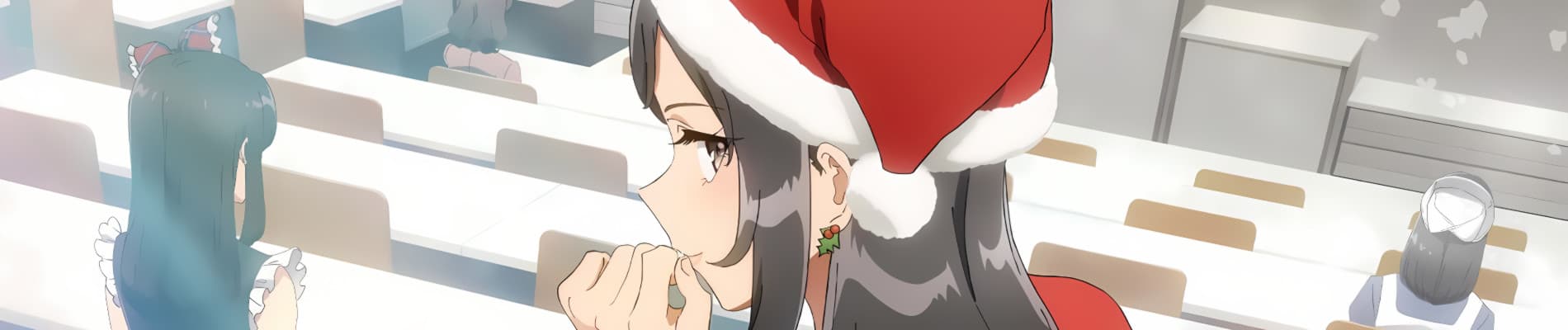
In the second arc, we immediately picked up right after the end of the first arc with the proper introduction of the Miniskirt Santa and her relevance in the series, which gave a huge lore drop that gives merit in actually watching the series with a goal in mind, and along with a lot of slice of life element but this aspect can be continued on a later arc as we'll focus on a different person entirely.
In this arc, we’re following Ikumi Akagi (Aya Yamane), one of the people who were given a form of Puberty Syndrome by Miniskirt Santa. On that note, Ikumi is out there combating the current—and recurring—phenomenon in the series known as #Dreaming, where people dream of something, and for some reason, it comes true. It’s up to Ikumi to seek out these #Dreaming posts online and track down places she deems dangerous.
Ikumi’s desire to save people stems from how Asuzagawa once did his best to defend his sister from Puberty Syndrome when no one else could, and the guilt she feels for not helping back then becomes her driving force in this series. This adds another earnest layer of lore expansion from the first season.
It also sparks an interesting dynamic between Sakuta and Ikumi. While she actively works to save people from the effects—or “victims”—of Puberty Syndrome, Sakuta has his own way of approaching it. Seeing them compare and contrast their morals in dealing with Puberty Syndrome brings a refreshing pace to the story and further expands on how different people confront it in their own ways.
Ikumi’s Puberty Syndrome is also one of the most intriguing so far, as it leans more into the supernatural aspect (excluding Miniskirt Santa’s constant appearances). This mirrors Sakuta’s own pain-driven symptoms, highlighting another angle of how the syndrome manifests. At the same time, the arc explores Ikumi’s backstory—her past traumas and guilt—and how these shaped the person she has become. Watching how she deals with her syndrome on her own terms, while still striving to help others overcome theirs, adds a captivating perspective to the narrative.
Overall, this is one of the longest character-focused arcs in the series, with a multitude of rabbit holes about Ikumi and her backstories, and multi-layered forms and effects of Puberty Syndrome that involve multiple aspects across the series. It also brings in characters from the past, a couple of visits to the past, and revelations after revelations, alongside parallel worlds—ultimately concluding in an intimately profound finale that’s absolutely satisfactory, closing the chapter on Sakuta’s past and Ikumi’s guilt. ***
His Student
While this arc focuses on a newly introduced character, we also take a step back to revisit the ones we’ve grown to love since the first season—especially Mai-san. As the face of the series from the very beginning, she’s often been sidelined throughout the arcs. But by the end of Nightingale, Mai’s importance is brought back into the light through certain revelations in the story (without spoilers, of course). Beyond that, it also reintroduces those romantic, cheeky slice-of-life moments between Mai and Sakuta that we adored in the first season—and seeing them grown up like this is utterly sweet.
Meanwhile, the mystery surrounding Touko Kirishima has only deepened. With the “gift box” of her story slowly opening, puberty syndrome feels like it’s becoming more than just a phenomenon tied to individual characters—it’s turning into a looming presence within the world itself, giving the illusion of higher stakes.
Returning to the core of the arc, we have Sara Himeji. From the start, her puberty syndrome is left unknown to the audience, though it’s clear it carries a powerful weight that could influence the future, much like Koga’s did. While this arc initially feels like a repeat of Koga’s “petite devil kouhai” story, it comes with a twist: we now follow a more mature Sakuta as he navigates the situation, all while strange #DREAMING incidents continue to surface throughout the episodes.
Despite Himeji’s emotional moments hitting hard—offering a fresh perspective on puberty syndrome both as an ability and as an emotional struggle—the arc is undeniably bloated. Not to mention that Mai’s moments had greatly overshadowed her (probably the most candid moment we've ever seen from Mai since her own arc). Still, I wouldn’t complain too much, as it is a great arc, and serves as a necessary transition into the final arc of the season. ***
Santa Claus
With the mysteries laid out around the identity of the Miniskirt Santa, this final arc immediately kicks off with tension—placing Mai in a vital role within a certain event that slowly, and carefully, builds toward the grand finale of the series. Since we’re now at the last arc, the focus naturally shifts to the main mystery: the Miniskirt Santa, otherwise known as Touko Kirishima.
While we’ve gotten a grasp of what her motivations might be, the series deliberately injects confusion. Even though we “know” her identity, there’s still a strong sense of uncertainty about who Touko truly is. Sakuta continues piecing together her truth, all while trying to prevent the significant events that Ikumi Akagi warned us about at the start of the series. This creates one of the most tightly gripping mysteries the show has ever crafted—where just as you think you’re getting closer to the answer, the more distant it feels.
Another layer to this arc is the sense of doubt it plants in both Sakuta and the viewer. As other characters find some measure of solace within their dreams, Sakuta faces the burden of protecting Mai from her predicaments while also trying to uncover Touko’s intentions. Yet, the questions remain unanswered.
Ultimately, the Santa Claus arc works more as a “part one”—a setup for something grander. It ends on a cliffhanger, leaving the final two books of the series for a potential movie adaptation. For now, all we can do is wait for its conclusion. ***
Overall
Despite how heavy of a lore dump this series is when it comes to new aspects and an expanded exploration of the concept of Puberty Syndrome, the series never really loses its footing. It remains a very witty show with sharp interactions among characters on screen, which are consistently entertaining in every scene. Its slice-of-life elements, where we follow these characters in their college lives, create a new perspective that feels closer to us while also retaining the familiar essence of the series we’ve always loved.
The role of Puberty Syndrome has expanded beyond its original formula, allowing us to see diverse characters who are either directly involved with it or unaware they even have it—showing how it affects them, and for some, how they choose to use it. This offers a unique and fresh perspective compared to what we had before. On top of that, with Puberty Syndrome’s scale being much larger this season, the story gains an added sense of intensity and scope, giving its supernatural nature more weight and respect.
As for Mai Sakurajima (and a lot of the original characters from the first season), they've largely been overshadowed by many of the bigger events happening throughout this season. Still, her interactions with Sakuta remain solid, and the more you see them interact in moments between the chaos, the more your heart remembers why you love this series in the first place: it’s about having someone by your side to help you whenever the time comes—plus, of course, the quippy romantic exchanges between Sakuta and everyone else (Especially Mai). ***
Conclusion
This new season of Bunny Girl Senpai didn’t achieve the highs of the first season—and that’s understandable. The first season alone had set such a high bar for itself that this series couldn’t simply replicate that success, especially since the story was more or less concluded by its third movie.
Instead, this new season feels more like a supplement—an additional, yet intriguing story to experience before the series officially wraps up with its final movie. But regardless, it isn’t devoid of its charms. While the story may drag at times, it still delivers with a stellar, endlessly entertaining cast you can’t get enough of, along with fresh settings and perspectives that remain intriguing. For fans, it’s another welcome dose of Bunny Girl Senpai to cheer them up.
It may be the weakest CloverWorks project this season, and certain arcs here that's the weakest all throughout the series, but it’s still one of the best shows of the season. ***
47 out of 49 users liked this review
