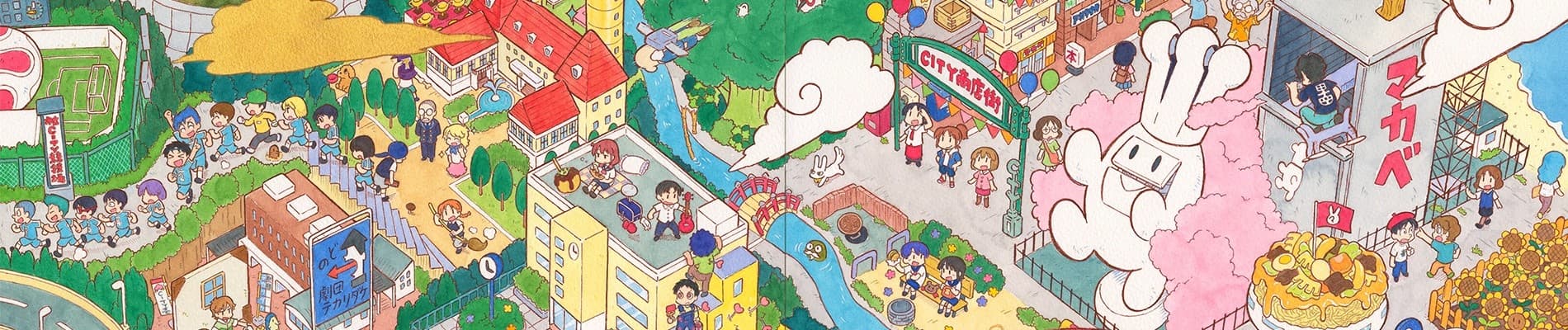
CITY is a strong absurdist comedy that paints a charming picture of its setting through its large ensemble cast. Though its sheer number of characters, which all exist in their own subgroupings that only interact with each other occasionally, can lead to lulls or even misses with some of them. To the show’s credit, it does demonstrate a wide comedic range, being able to execute everything from heavily character driven skits to those composed of absurdist non-sequiturs. But despite having a sketch comedy element to it, CITY is still structured more along the lines of a sitcom with a large recurring cast that maintains continuity across episodes. This naturally makes the few long form comedic scenarios that last whole episodes the strongest and funniest moments the show has to offer. While the impact of these set piece moments are definitely reliant on setting up the entire ensemble cast, it does leave the show feeling like it is obligated to run skits with its less well realised characters and dynamics. It is still abundantly clear despite the ensemble format that Nagumo, Niikura and Izumi are the strongest characters with how their skits almost always land. This is helped in no small part by the voice acting, but it is hard not see how a structure a little closer to Nichijou with more focus on a core set of characters would have been playing more to Arawi’s strengths as a writer. Perhaps that is why some of the tender emotional beats that serve as the comedy’s falling action feel less impactful than they could have been. CITY does still succeed in painting a rich and vibrant image of its setting while weaving its large cast of characters into a city-wide tapestry, but it also hard not to notice the few definite dull spots present.
It is still undeniable that the writing, animation and cinematography of CITY displays excellent skill when it comes to their comedic timing and the sheer variety of skits they can execute. Whether is physical comedy that is delivered through only animations and sound effects, to jokes that are composed primarily of a character monologue, the show is able to execute all of them with a high degree of polish. There is definitely a much larger subjective element to comedy that other genres, especially for the absurdist comedy that is frequently used, but it is possible to acknowledge something is funny even it is not personally amusing because of preference or a different cultural context. CITY undoubtedly meets this standard with a high degree of consistency, which is arguably the most important thing for any comedy given its core purpose.
However, a price that seems to be paid for this wide range is an equally expansive cast to create the pretext for these scenarios, which comes with its own benefits and limitations. Having a large ensemble cast was certainly planned from the outset, with the opening narration of the first episode, despite being a non-sequitur joke, clarifying the shows intention to highlight the rich interconnectedness of its setting. CITY does achieve this with how the different subgroups of its characters occasionally overlap or affect the comedic scenarios the others are put in. It does lead to the city itself, or at least its residents as a whole, feeling like a character and an integral part to the atmosphere of the show. This is crucial for its massive comedy set pieces like the city race or escape from the hospitality towers. A show more narrowly centred around just Nagumo, Niikura and Izumi might have created the impression that these long skits were an extended cameo that distracted from how the core group of characters were responding to the situation. CITY succeeds in keeping the audience interested in the antics of each group as they all interact with the same scenario, which in turn maintains a good sense of momentum in these episodes. But perhaps most importantly, it is this general connection and familiarity that the audience has built up with the setting as a whole that gives the conclusion its emotional punch, seeing them come together as a community or closing off a significant story arc for particular characters.
This does come at the price of CITY occasionally feeling it is not always focused on its most well realised elements. While the core purpose of almost every segment of the show is comedy, it does feel like certain skits with parts of the cast were done almost by the numbers out of a need to maintain their visibility in the story. Of course, it still unreasonable to expect every skit to land perfectly, and part of the point of an ensemble cast is to provide variety and opportunities to experiment. Yet it cannot help but feel like some characters receive more skits after their initial joke because there is a planned interaction between them and some other group much later down the line, rather than there still being comedy to mine. Despite there still being plenty of subjectivity to this, the mangaka of Mr Bummer and the magazine editing group in particular feel like they have little variation after their initial jokes are spent and are dragged along solely for exposure before they again feel like they have a comedic purpose once they group overlaps with Izumi. In a similar vein, the many of the skits that involve just Matsuri and Eri as a duo seem more intent on building an emotional arc than there being an inspired joke to be told which necessitated using their particular characters or dynamic. While the arcs of these characters groups still all eventually paid off to reasonable effect, it gives the distinct impression of lulls in the comedy with these skits feeling more like obligations instead of their jokes having fought for a place in the story.
Perhaps if CITY were more character agnostic, serving almost solely as the blank canvas for whatever sketch comedy the author concocted that week, the quality of its ensemble would feel more evenly spread out. Yet it is abundantly clear that Nagumo, Niikura and Izumi are much more well realised than most other members of the cast. They are written with the most distinct voices, which is then elevated again by their voice actors, and are consistently able to carry skits just playing off one another’s personalities. There are even compelling solo skits that involve only one of the trio, built entirely around their particular quirks or a running gag. Beyond just building off previous story beats or skits, using the trio without any set up to parody certain trends like attempting to get internet famous through inane videos make for hilarious segments that are almost entirely sketch comedy. As it stands, there is still a strong emotional underpinning in their relationships, particularly between Nagumo and Niikura, but it is hard to say that it has been utilized to its full potential like the connection between Hakase and Nano in Nichijou. It leaves the viewer craving more, and makes the other skits that are slightly weaker stand out more than they would in a vacuum.
While comparing CITY to Nichijou does feel like it might only be a disguise for being disappointed over preconceived expectations, it is somewhat apt since the two works are still in the same genre with a similar structure. Where they differ is in how Nichijou concentrates on skits with its six core characters , leaving those comprised of only the supporting cast or one-off sketches to form the minority of its stories. CITY leaning more towards the inverse of this ratio while still having three noticeably stronger characters ends up feeling distinctly imbalance, leaving some skits to feel like they are treading water or just there to force a certain story structure. Mostly notably, this has limited the impact of the emotional beats in CITY since comedies are often left predominantly reliant on raw screentime and familiarity to build a connection with the characters given their genre. This emotional impact of Matsuri and Eri’s story coming to a conclusion did not cut as deep as it could because of how the time spent on their scenes left them only feeling like one of many, and how much of their interaction during skits felt less like comedy and more their character beats being forced into the shape of jokes because playing it straight was not an option. Although current structure of the show is certainly still serviceable and has a clear purpose, it’s hard not to see that its strengths lie more in particular characters and a different approach might have led to a more consistently strong show.
Overall, CITY is still undoubtedly strong in almost every respect from its comedic timing, direction, animation, to voice acting. But there are distinct hit and miss elements that form a pattern around some of its supporting cast which detracts from its overall composition as a series. This will vary quite a bit given how comedy is more subjective than almost any other genre, but a good litmus test might be how its emotional moments also more limited in impact than they could have been due to the show’s spread out character focus. While something structured more closely to Nichijou might have made for a better overall story, it is also unfair to criticise a writer for not just repeating their last work when they also likely wanted to try something new with CITY. And to their credit the new elements of having the setting be an integral part of the atmosphere and story was successful. With all that said, it seems like an 8 out of 10 is an apt score since CITY as a comedy has polish fundamentals and some fantastic high points, yet still could have made for a better experience if its character focus were just a bit more concentrated.
32 out of 35 users liked this review