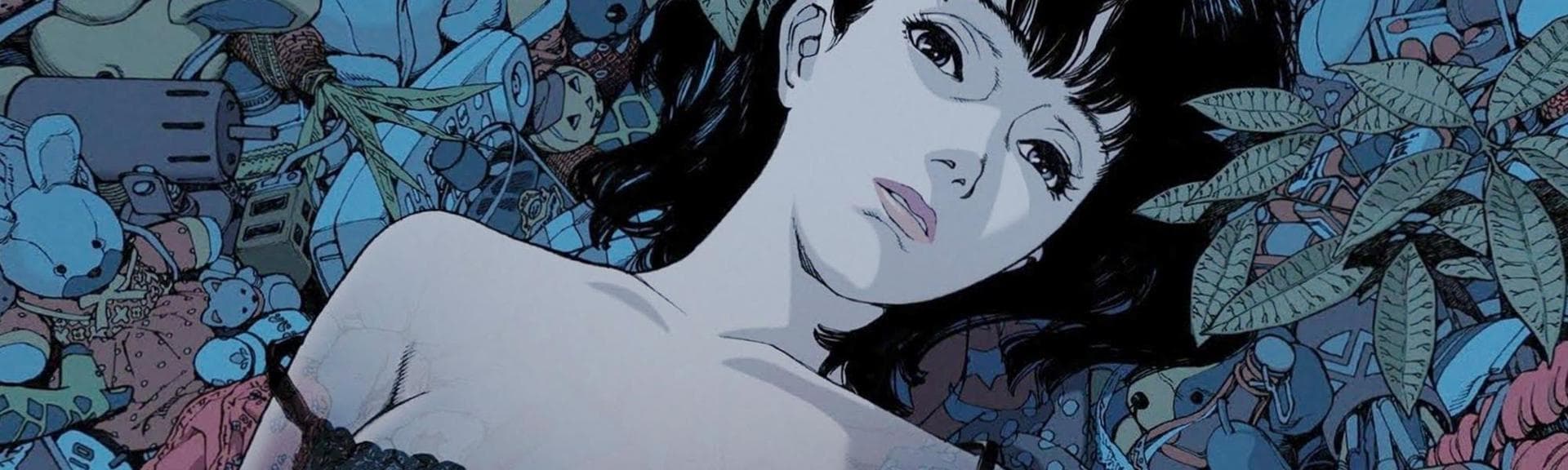
Perfect Blue
a review by Pemulis
a review by Pemulis
"Who are you?"
Perfect Blue is the first feature film directed by Satoshi Kon. A protégé of Akira creator Katsuhiro Otomo, Kon cut his teeth as a manga artist, screenwriter, and animator (his early credits including layout work on Patlabor 2: The Movie and episode directing and writing on the 1990's OVA of JoJo's Bizarre Adventure) in the years before taking the job to adapt the novel by Yoshikazu Takeuchi. In just his first film, Kon's style is seemingly fully formed out the gate. Aside from having a much more cynical tone than most of his later works (the outlier being his lone TV series directing work Paranoia Agent, which is even darker than Perfect Blue), Perfect Blue is remarkably similar to his later works, and showcases what made Kon such a generational talent.
Let's start where most critics neglect to mention: the original novel. The novel is overshadowed by the film, with its first English translation coming decades later to coincide with the film's 2018 rerelease in the US (after spending years out of print, which was the timeframe in when I first watched the film). Having read the novel recently, there's a reason it gets overshadowed: it's not very good. While it has interesting and ahead of its time themes in regards to celebrity culture, show business, and fan entitlement, it is weighed down by overly simplistic prose and narrative, an overreliance on gore and sexual content, and an ending that discards all semblance of realism for a hokey slasher film-esque climax. Reportedly, Takeuchi gave Kon and screenwriter Sadayuki Murai free reign to make any changes he wanted as long as he kept the premise, character names, and horror genre, which suggests that even the author was aware his original story would not make a satisfactory film.
The script by Murai is infinitely more thoughtful and complex than the source material. While the driving force of conflict is an entitled stalker angry at a pop idol's change in direction, just as much weight is placed on internal conflict. The protagonist Mima Kirigoe is torn between the pressure of her fans and manager to stay a pure and virginal pop singer, the industry's desire for her to become an actress with a mature image, and her own uncertainty on what she should be. Mima's lingering self-doubt and second guessing is only worsened as the difficult material of her TV role and the escalating behavior of her stalker create further stress, driving her to experience hallucinations and question her own reality and identity.
Film, especially animation, is a visual medium. It is Kon's directing and animation style that truly elevates this film. Kon has a distinct visual style that contrasts him from typical directors and animators in anime. His characters lack most of the stylization that pervades the medium. Rather, his characters tend to have facial expressions, bodily proportions, and movement closer to real life than average. However, this does not mean his style is wholly grounded. In fact, his style is closer to magical realism than realism. Kon utilizes the animated medium to blur fantasy and reality, a theme that is executed in this film to convey psychological horror. In particular, the heavy usage of reflections that appear to talk and move on their own or seamlessly change appearance aids the psychological themes in a manner that simply can't be done as effectively in live-action.
One aspect I only noticed on this rewatch was Kon's secret weapon in this film: the match cut. Within the first few minutes, match cuts are heavily used to jump between Mima's final concert and her buying groceries, Mima's performance and her sitting at a meeting between her manager and a TV writer deciding the future of her career, and Mima leaving her final idol performance and Mima arriving home. Another stand-out example of the match cut is when the film jumps between Mima's nude photoshoot and a simultaneous performance by her former bandmates, two events linked by the flash of cameras and their shared nature as entertainment for the (predominantly masculine) masses. These two events converge into a fantasy sequence of Mima's old self appearing at the concert, representing the selfish desires of fans who only want a pure and idealized Mima and Mima's fracturing psyche trying to convince her that this is something she secretly wants to do instead of the photoshoot.
Perfect Blue is a masterwork that has grown in stature since it released. When it was first released, it received plaudits and attention among critics not just within anime, but among overseas critics as well. Over time, attention would subside as the film fell out of print in most territories and most western critics largely shifted their focus to other anime films, if they bothered giving the medium attention At the time I first watched the film, it was long out of print (not divulging how I watched it, wink wink), most discussion of it outside of devoted cinephiles was centered around the debate of how much Darren Aronofsky ripped it off in Black Swan (a can of worms I won't be delving into), and even anime fans largely saw it as a pretty good film as opposed to a masterpiece. In the years since the 2018 rerelease, however, Perfect Blue has seen something of a resurgence. In an era of rabid stan culture enabled by social media, parasocial relationships, and violence driven by incel ideology, time has been extremely kind to the film's themes. To illustrate the film's rise in stature: in 2017, the film had a 4.1/5 average and 11,000 viewers on Letterboxd, as well as an 8.26/10 average and 73,000 users on MyAnimeList. Now, the film has a 4.4 average and over a million viewers on Letterboxd, far above anything else by Kon, as well as an 8.55 average with over 420,000 users on MyAnimeList. Fan art, video essays, and fanvids* of the film can be easily found on social media platforms. Hell, at the most recent anime convention I attended, I saw more Mima cosplayers than all prior conventions I've been to combined. At this stage, Perfect Blue is far and away the most popular and acclaimed film of Satoshi Kon. While I personally wouldn't call it my favorite of his, since I gravitate more towards Millennium Actress and Tokyo Godfathers, Perfect Blue is undeniably one of the strongest opening salvos of any director.
*In the process of writing this review, I discovered one such fanvideo editing clips of the movie into an AMV for "Volcano" by Swans, a combination I always imagined in my head as a huge fan of both but never thought actually existed.
39.5 out of 40 users liked this review
