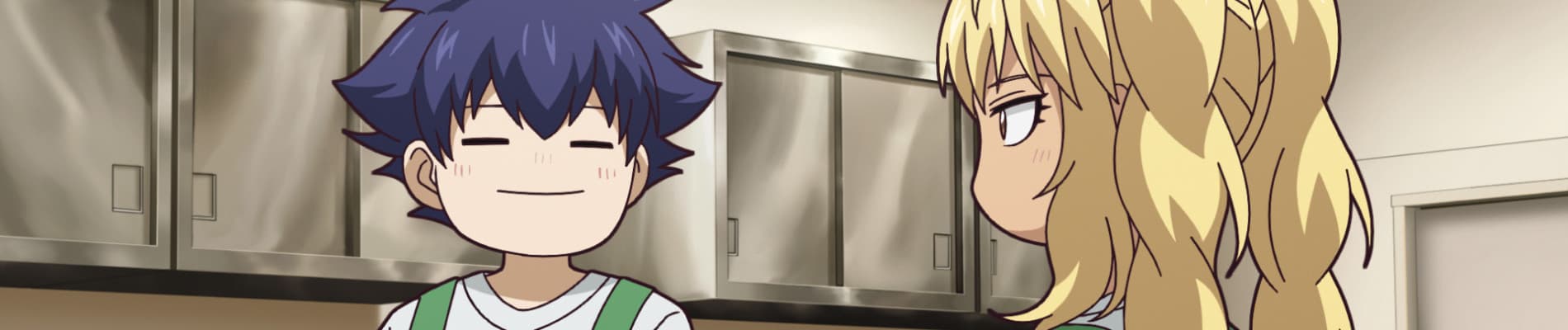

Fermat Kitchen is my second favourite anime this season, after Secrets of the Silent Witch, partly because this anime and Silent Witch include mathematics in characterising their main characters.
Overview
Kitada Gaku once had a dream of becoming a great mathematician. But ever since getting intimidated by the prowess of a friend and fellow Maths Olympian, he lost his mojo as far as mathematics is concerned, so he became directionless in his schooling.
Fortunately, a genius chef, Asakura Kai, recognises his potential for cooking. He believes that Gaku has the potential to unlock delicious dishes, thanks to his background in mathematics. Can Gaku succeed?
Notes
The main character here is Gaku, not Fermat. The Fermat in the title refers to the French lawyer, Pierre de Fermat; he was also a part-time mathematician and more known for theorems in number theory.
There are numerous mentions of famous mathematicians here, and some concepts cited are more advanced than in Silent Witch.
Screenshot from the anime: Gaku creates a functional diagram of the recipe of the food he tasted.

Spoiler, click to viewclick to hide

Spoiler, click to viewclick to hide

In other words, the use of mathematics in this anime is tenuous at best and confusing at worst.
To be fair, advanced mathematicks is really out of reach of too many people. Even if you can explain an advanced concept in layman's terms, there is this added challenge of harmonising that concept with cooking. That's why I'm inclined to cut this anime some slack in terms of mathematickal content.
As a side note, we should understand that real mathematicks does not involve merely solving equations and memorising some numbers and formulas, as many of us suffered from our high school years. In general, mathematicks is the science of patterns. With this broad definition, one can argue that this anime somewhat engages in mathematicks.
Consider this quote on frustration:
"You enjoy solving a problem if you have difficulty solving it. The fun is in the struggle with a problem that resists. It’s the same kind of pleasure as with hiking: You hike uphill and it’s tough and you sweat, and at the end of the day, the reward is the beautiful view. Solving a math problem is a bit like that, but you don’t always know where the path is and how far you are from the top. You have to be able to accept frustration, failure, your own limitations."
— Sylvia Serfaty, French mathematician
Even though the maths content and its application to cooking is tenuous at best, I find Gaku's agony and not being able to find the right answer immediately more in line with how mathematicians (and maths students for that matter) think.
I was too cynickal and expected Gaku to be this overpowered genius who readily finds the solution. Not so in this anime. He often fumbles, even if his output is great. Kai demands that he conform to a higher standard.
Put in another way, it's not pleasant to watch his struggles, and they are as realistic as it gets. But once Gaku finds the right solution, we are shown great moments in this anime.
Consider this quote on the joy of mathematicks:
"The real joy in mathematics comes from the process of discovery, not just the final result."
— Maryam Mirzakhani, Iranian mathematician
Many professors don't give full marks in exams if you only come up with the final correct answer. You must also show the process. The same could be said in doing mathematicks. It is, more often, the process that counts.

I like the 'door of truth' motif we see in the nondiegetick scenes. It's about that sudden flash of insight where a proof or solution, or in this anime's case, Gaku's sudden revelation on how to cook a delicious meal. Again, the mathematickal content here is poor, but the realism of how it is done is still reflected indirectly by how Gaku agonises and is frustrated at his cooking.
I mentioned the nondiegetick scenes. Even though the production value in this anime is mid, I like that there are nondiegetick scenes reminiscent of Flower and Asura.
Let's look at some of the staff.
⚫ Ichikawa Kazuya is the director, and I barely saw anything he directed. One work I've seen was the chibi version of Flying Witch, which I don't remember that much.
He is also the director of the Fall 2025 seasonal, Gnosia, which boasts the who's who of seiyuu.
⚫ There are numerous people involved with storyboarding, as well as different animation directors. I'll focus on the chief animation director, Okamoto Takeshi. Unfortunately, I haven't seen his previous works, which are a few.
⚫ The studio is domerica, and it's pretty much unknown. Despite existing for 15 years, it has only 10 titles listed on MyAnimeList. I suspect this studio works more as support for other studios than producing their own works.
The character designs by Kashiwagi Satsuki and Okamoto Takeshi are ugly. I wouldn't be surprised if some people won't give this a time of their day just because there are no waifus here.
Despite that, Kai, as a quasi-villain, and the other bloke, Milo, who looks like Hisoka, are quite effective in pushing Gaku to his limits in order to face the real villain, kind of, in Hirose Ichitarou.
Conclusion
Despite its rough edges, I enjoyed this anime. It's a favourite of the Summer 2025 Season.
NOTA BENE: A grade of 7 out of 10 [70 out of 100 in anilist] means that I find this anime is very good and two notches above average. I enjoyed watching it.
It is a high score. It's not mid or average, unlike the misconception of some people on this site.
My enjoyment spectrum lies from 4 to 10. If I have scored an anime below 4, I actively dislike it.
~~~~~~