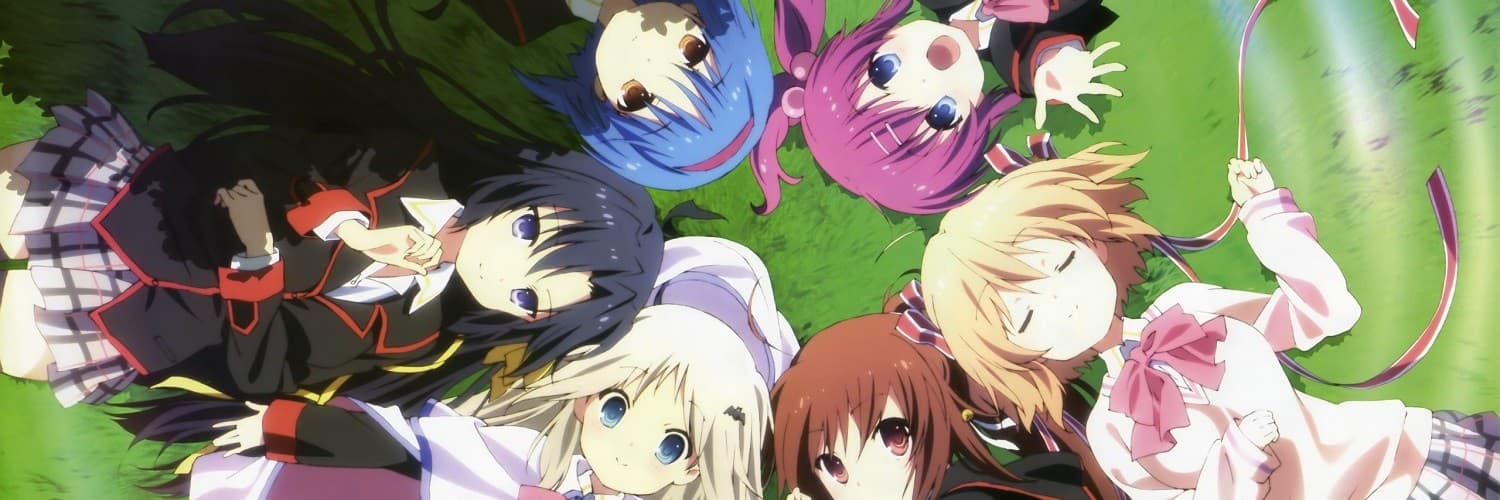
It is a bit hard to not completely associate how I view the anime in comparison to its original material, the visual novel. Although one could argue that you should not take it into consideration, it is certainly a much different experience if you had read or not, mainly when you love the original content so much. This is relevant because part of your experience gets thrown down due to you knowing, mostly, what the show will present to you while watching it.
I think what most people have missed out on is one of the most important messages Little Busters is trying to make here, that is while the characters are in the way they are. Sure, I will not get down on how I view them on a psychological level; as in, for example, Komari's possible autism, basically all main female characters having depression and Mio DID. You can simply say that it is not that deep and it's just stereotypes. The thing is that the anime, due to its direction choices, failed to show that the characters are much more than simple stereotypes to fill Key's way to make every single work, but rather show us a "cast of girls who have strange and superficial problems and the Little Busters saves them". In fact, differently from the visual novel, Riki's role as the character's "saviour" is downplayed by making the Little Busters relevant as a whole, except for Mio's route. This happened due to J.C Staff choice of writing to not make Riki "romantically involved" with any of the cast, but then, most of the scenes going on in the visual novel wouldn't make sense, so they had to cut a lot of what made the characters deep for the sake of consistency.
You could say the same happens in Clannad and other visual novel adaptations, and you can argue that the fact that there is no romance is not much of the issue as to why the show lacked the deepness of the characters. From a studio perspective, it is a bit understandable, as then you can make a simple show about a group of friends helping each other with no complex problems going on. So you can say the lack of romance would not be a problem per se, but as in JC philosophy, it is. Little Busters anime is a bit like how you would explain to that anime watcher friend who doesn't care about depth, only the important parts that make those stories minimal sense.
Another message the anime kind of failed to deliver is how important was the characters childhood, their traumas and experiences. Komari with her brother, Mio with her alter, Haruka AND Kanata with their families and Kud with her mother plus homeland. The adaptation felt more like the characters were suddenly having drama out of absolute nowhere, than these problems being what actually make them, them. Again, you can call me an overthinker, but there is a reason to why Komari is so lightheaded on only like sweet and light things; as to why Mio is the introvert bookworm nerd; as to why Haruka is such a troublemaker and why Kud is so "forgiven" to the ones who mistreat her — and this being reflected in people's view on the characters. Of course, you can always doubt people's capacity to understand more than the obvious, but I also think that one of the most important messages LB was trying to show and think of, was sidelined, as it would take complex screenwriting to make it good, something the adaptation was obviously not that interested.
Now, let's briefly talk about the anime as it is.
If you only want a show about a good cast of friends messing with each other in one episode, and then dealing with their problems with another, then Little Busters can match your expectations. But like I said, in this first season, do not expect anything deep, as the factors that make all of these characters deep were cut off by direction's choice.
The scene sequence also lacked artistic view, as the majority of the show, they only showed their moving mouths talking and their heads moving, without much intelligent sequences to make your head think and be amazed by the drama. Unfortunately, most because the anime do not care about being unique, as people describe it as "melodramatic. Pacing wise, it seems like a formula: two to three episodes of drama, than one of comedy — this can be of your taste, but that's one of the reasons why the visual novel is so much successful: is a nakige, so comedy and simple interactions first, then you get used to the character, than the drama. I can see a lot of people not giving a damn about Komari as her arc came so early in the show, but this is perhaps more of how studios prefer to adapt visual novels than actually an individual problem.
As for the music, it is literally the same as the visual novel, so it's something special for those who read it, but for the ones who don't, they can be quite bland, as visual novel BGMs do not really match with animations, except of course for the insert songs. I can give JC credit here, though.
And the most important of all, the characters, in which I've already talked much, but I do really need to talk about one particular case: Kyousuke. If there is a reason to actually bear Little Busters common route, it is him — in which, here, unfortunately, he doesn't seem more than a side character that helps Riki sometimes. Fact is that Kyousuke is an amazing and very special character, but due to the anime's limitations, he seemed a bit unimportant; and that's one of J.C Staff's writing's more impactful flaw. You do not see Kyousuke as someone who knows more than the others, or someone who conducts the flow of the group in a way so perfectly that feels strange — he's just one more of the Little Busters, and he's role will only return in next season, mostly because it's almost impossible to fail with Kyousuke's importance there.
All in all, J.C Staff or any other animation studio could make a lot worse of a show. It is not rare we see really good visual novels being complete ass in the anime adaptation, so if we consider Little Busters as being only "mediocre", it's still better than just plain "bad" or even worse. You see, the animation is not something out of the average mark, the route's adaptations are flawed but not completely destroyed and, at the very least, you can feel comfortable as watching this group being happy with their companion. At the very least, one of Little Busters' main massage, as to value your friendships in the way they are and in the way YOU are as yourself, is easily visualized. You will feel happy for them, just perhaps not sad.
In general, it is a watchable show if you don't expect anything deep, and the problem, contrary to the common sense, it's not the writing itself (although, like already explained, pacing is an issue), but rather direction view, as you could work something out with the adaptation’s screen composition, but the direction ultimately did not make much with it.
8.5 out of 9 users liked this review