(Note: Utena refers to the character, Utena refers to the series)
A retelling is a storytelling practice deeply ingrained in tradition, and there is hardly a more traditional style of storytelling than the fairy tale. It is only natural then, that the storybook of Utena sees its own retelling in the form of Adolescence, though describing the film in that way might hardly do it justice in the end. Rather than just examine the TV series at a different angle, Adolescence completely strips it bare and lets it wail, cry and shout its way to a more than fitting ending.
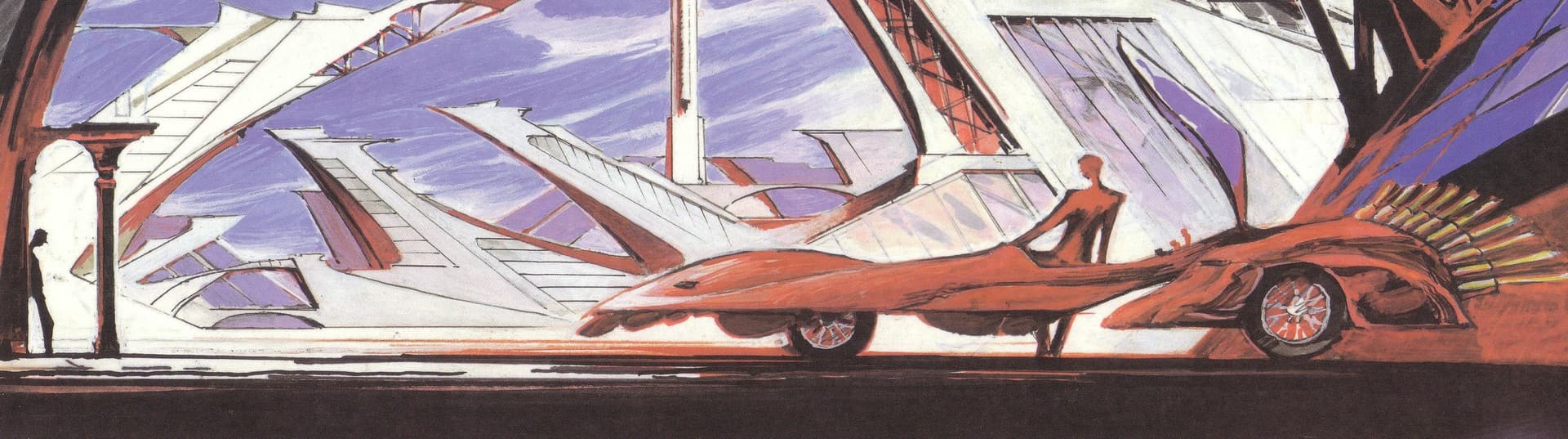
A core part of ridding this fairy tale of its façade comes by way of reinterpreting the actual physical environment it takes place in. The original Ohtori academy was ripe for the more calm, slice of life moments (and saving money probably lol) by creating a consistent physical space for day-to-day school life. Adolescence tears this to shreds and turns the familiar academy into an incomprehensible futurist labyrinth, befitting a society that is both beyond the understanding and escape of the people living in it. We also get to see much more surreal but direct representations of the tightly-locked cages that the students minds rest in- a particularly great scene is one in which hundreds of swimsuit-clad girls are sweeping an endless floor for seemingly no reason. Of course this scene is not without the Rose Bride herself, who sees the most creatively reimagined space with her small rose garden being expanded into an almost nightmarishly large field of the flowers.
Anthy is the shining main star of the film naturally, which is only fitting after they played it so coy with her in the TV series. At first pass she might seem to have broken out of the shell that confined her before, but it only serves to highlight the crushing unfairness of the role she is expected to play. She is both meant to be the obedient Bride, to be passed along from Prince to Prince, and the whore whose autonomy is stripped from her again and again to satisfy those around her. It does a really fantastic job of painting the previous terms of her life in even more bleak terms, especially with regards to Akio. It may seem incompatible with the show, but really its just framing their relationship in a much more visceral and disgusting but ultimately fitting way. It's doubtless that the film going this route was always planned, but I almost wonder if Ikuhara and co. felt especially determined to show Anthy not just as dependent on Akio but an outright victim of his violence, the violence of the world as a whole.
Adolescence puts Utena and Anthy's relationship as a whole in a different light, but also continues excellently from the conclusion of the show. Here they are finally able to recognize the mutual hurt that each other carry, with the drawing scene being a very direct but powerful way to show the long-needed demolishing of the barriers between the two. Not only does it allow the film to be efficient in picking up right where they left off, but it naturally evolves this dynamic in a really great way. The mythos of the Prince, a figure that can deliver these girls from their pain, has been long vanquished, and rather than just try to save Anthy on the terms that Akio has imposed, Utena manages to strike a balance between her and Anthy's desires. Of course out of returning characters it's a must to mention Touga, who I think more than any other side character sees a pretty great payoff here.
It is fitting that Touga reclaims his status as a Prince, but is already dead this time around, a mere ghost of the past and an ideal that nobody can really live up to (and not to mention the weight he still carries on him, as both a victim and as one of the main villains for a lot of the show). The even more fitting ghost of the past here is Akio, who is another instance of Adolescence stripping things down to their raw form. He came off as delusional in the show, but is perhaps even more so here, a pathetic loser who loudly blames Anthy for his own malaise while meeting an ironic end long before the events of the film. Yet what is so great about Adolescence is that Akio and Ohtori at large can't help but loom over the characters lives still, fulfilling the role that society does in forcing people into roles. "Adolescence" as a term may seem to indicate a coming-of-age story exclusively, but I also felt like it was a fitting title choice to punctuate how important the psychosexual elements of the film are. It's a time of heightened emotions, vulnerability, and rawness that is exploited not just by bad actors, but by society to mold people into a certain standard of existing.
You might've heard that Utena is a work about feminism or being gay, and those are fair readings, but I found it to be refreshingly anti-gender and Adolescence really cements this. There's so much to be said about the fantastic final sequence and its great use of music, the incredibly inspired and frankly quite beautiful and masterful repurposing of the car imagery (notice how it comes to represent adulthood in two different ways), and just the all out fun completely balls-to-the-walls style of Ikuhara and crew (complete with a real budget). But what really stuck with me is how it throws away the notion of the previous world away completely, rejecting its notions of what prince and princess should be. When Utena and Anthy say they were born in the outside world, it really just applies to all of us. And hardly anything can be more revolutionary than rejecting the state of things as they are and shaking off our past in favor of creating our own roads forward.
19 out of 20 users liked this review
