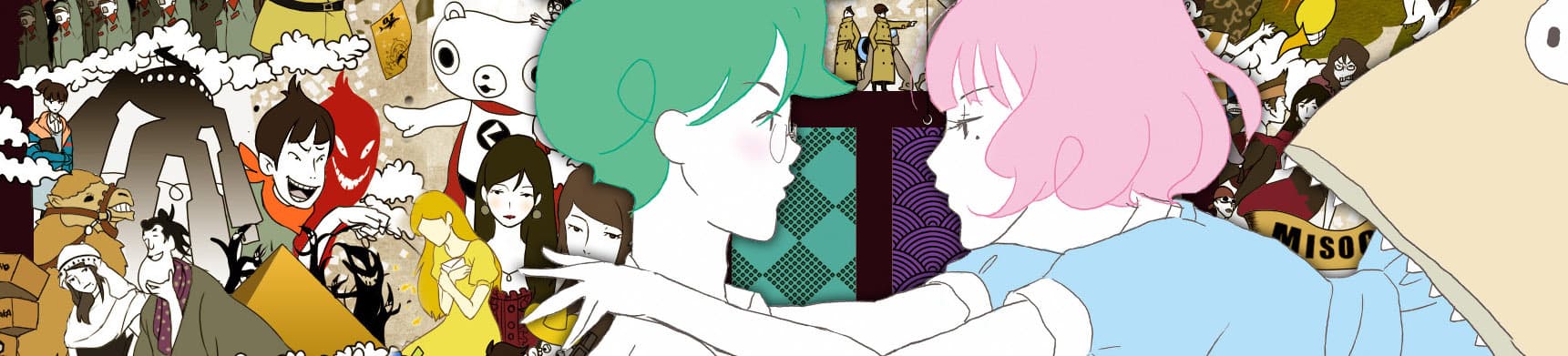
Tatami Galaxy is an interesting anime to watch and ideally rewatch a time or two. I've tried to think of another anime that matches it or something to compare it to that's equivalent and it's a bit tough to pin it down. In the modern age of anime with very established tropes and expectations, this alone makes Tatami Galaxy something that should at least be watched for the experience.
It's going to be really hard to offer a review of this show without going into spoiler territory, so if that bothers you, stop reading immediately and watch the anime instead of looking at my semi-drunken ramblings.
Some technical and story background for Tatami Galaxy:
First off, this is a very visually interesting anime. The blend of styles is pretty "artsy" and quite a bit surreal at times. It is also mixed in with live action scenes and sometimes monstrous imagery. It doesn't stray too far from reality, but there's enough weirdness that it gives things a dream like quality at times. Those looking for something super realistic are going to be disappointed, but the style works for the narrative and is impressive to look at. The sound and voice acting is done very well. The protagonist spins narrative at a pretty incredible rate, and it always sounds really good even though it has to be difficult to sustain the pacing. If you can't understand spoken Japanese and rely on reading the subtitles, you will probably have to pause a few times to catch what is said and what is going on visually. The OST is great. The opening and closing songs fit the moods very well. The prepare you for what you are watching and wrap up the plot quite nicely each episode. What is also pretty unique, or at least experimental is the plot and narrative itself, which complement the style pretty well.
At a broad stroke, this is an anime about a young man (never named) and his strange quest for a grand experience in university that has seemed to be a failure based on the opening scene's narrative at a Ramen Restaurant. The venue alone is interesting in itself. Most school anime focus on high school shenanigans, with university life ignored for the most part. This provides us an opportunity to avoid many tiring cliches of high school based anime and explore the harsher realities of life outside of the comfort of the parent's place, with a more mature look at relationships. Our intrepid protagonist believes that this is his time to shine and he is seeking to create for himself "the rose colored life surrounded by raven haired maidens". The kind he has no doubt enjoyed in popular light novel adaptations and harem anime. Somehow, he seems able to try again after his interesting failures (some spectacular in their disappointment or comedy) and take a new look at what might have been in another trial run of his first two years of university. He also runs into the same cast of characters repeatedly, although with slightly different perspectives. He always has that goal of the perfect life in mind, and all those raven haired beauties no matter what he's doing.
The following thoughts are my own and just one of a great many ways to interpret the relationships in Tatami Galaxy.
I'm not going to repeat those lines from the show, but suffice it to say, this show initially seems to subscribe quite a bit to the very Japanese concept expressed in translation as "it cannot be helped". There is an almost oppressive level of doom in the protagonist's story and cycle of do overs. How one feels about the concept of fate vs. free will likely color quite a bit of your response to the protagonist and the overall message that the show seems to try to convey to us.
This is especially conveyed through the recurring "best friend" character of Ozu who's goal (at first) seems to be breaking up people's attempts at happiness. So much so that the main character sees Ozu as a type of demon in the early episodes. Although from an outside view, Ozu is working towards getting our thick-headed hero to do what will ultimately make him happy and break out of his bizarre quest for the perfect everything in life, which is a questionable goal. (I suspect this is why Ozu slowly becomes less demonic looking as the show goes along and the protagonist is slowly starting to understand what will make him happy).
I'm torn between two divergent ideas on the protagonists quest for that "rose colored university life". The message that the show seems to give us is that accepting your lot in life and being happy with what is in front of you does have merit. Many people have very unrealistic ideas about the way that life works, and life can kick your butt pretty hard if you let it.
However, I did have a lot of admiration for the protagonist trying out all the different possible "lives" for himself and seeing where he fit in. There is a lot to be said about not accepting your fate and struggling to see where life takes you with hard work. In fact, the protagonist tries many strategies in his do overs, none of which ultimately work for him and it seems like he cannot escape what's "in front of him all along". Hard work doesn't solve his problems, nor does hedonism, breaking the rules, revenge, trying multiple relationships, trying solitude, dropping out of society, fitting in to society, etc. Nothing seems to solve our protagonist's problems at all.
This is where it's easy to take the route of "it cannot be helped" and say that the protagonist's problems can all be solved if he goes with the flow and just bebops along like he is expected to and takes the obvious way forward, that is the only choice that will work. If the show focused more on what career or what club or major that the protagonist settled on, it'd be a cleaner message. There's something else at work though, as that really isn't the ultimate focus in this series.
The anime begs several questions. What exactly is the protagonist's problem that he finds himself stuck in this loop no matter what action he seems to try? What is the common issue across all his attempts at life across all the episodes? Why does he continue to be miserable?
Much like the movie Fight Club told us that most of this is really about a girl named Marla Singer, most of Tatami Galaxy really is about a girl named Akashi. Akashi is a conventionally pretty, yet very understated cool collected type. Our hero doesn't find satisfaction until ending up with Akashi, which sort of makes you wonder if he is kind of an asshole for spending almost two years doing all kinds of different things trying to find some perfect girl when he was already in love with Akashi. While this becomes clear later on, it comes to light that early in his interactions with Akashi, the protagonist became infatuated with her. So why was he continually trying to join new clubs and meet these raven haired beauties? Was he hoping for some kind of upgrade over the somewhat plain Akashi? Did he look at her and think, "man, she's so dull or average". What exactly was the issue if he realized it so early in the series of events that made him keep trying to find some other solution? Was Ozu really the demon, or was the protagonist?
Our "hero's" problem seems to be that he has a vastly distorted and idealized view on life and that he cannot seem to see the people around him as complex individuals that have flaws of their own. Life isn't a fairy tail as much as we wish that it were, and it seems that the protagonist believed that somehow, if he can only do things in certain ways, he'll find that idealized version of life that he fantasizes about. People around us don't work like the tropes that we see in media. People are a great mix of good and bad, beauty and ugliness, cleanliness and untidiness. Yes, even your horrible (or wonderful) boss or girlfriend, or that politician you're obsessed with who will either fix or destroy everything, and everyone in between. Expecting people to be perfect, or worthy of pedestals just isn't realistic.
Our hero interacts with a great many individuals and seems greatly disappointed in all of them in some way or other as they don't live up to these types of expectations. While seeking that "rose colored life" he seems dismayed and can't accept that there are shades of grey, blue, red, and all the other colors of the rainbow. Whether these are good or bad doesn't really matter, they are just a part of the world around him and the hero can't quite come to terms with this. Ultimately, this leads to his continuing lack of satisfaction with things and a wish for a do over in life that will surely get him to utopia. Eventually, he withdraws altogether for a couple episodes and finally has some introspection on things leading to the resolution.
Most frustrating for me, the protagonist seems to be staging all of his hopes on his idealized goal of feminine perfection to make himself happy as we very rarely see him working academically or towards a career. I wonder what in universe media he has consumed to think this perfect world exists. It's blatantly obvious that the protagonist should end up with Akashi and everything foreshadows it so hard as to basically bludgeon the viewer with it. Why is the protagonist dodging the issue for two year stretches? One can't help but feel that even though he says he is head over heels for her, Akashi just doesn't measure up to his ideal in some way.
Most of the message I got out of the story came out of the middle of the series. A major crux of the series are the three episodes where he is caught in a bizarre love situation with three different "women", or more importantly, his conceptualizations of these women in his life. One of them is actually inanimate, and oddly causes him issues because he can project his fantasy of this perfect girl onto her. Hilarity ensues as he pursues this girl in one time line. This is his constant pursuit of the love of perfection that just cannot be. One would think he would learn, but that's not the end of it.
A second girl, named Hanuki (far less inanimate), that he is interacting with is in his English speaking club (joined of course to become popular with all kinds of people and women even though he has no great skill with English) is actually a mutual friend of his who is interesting in her own way and actually providing him with female friendship and to some extent companionship. He repeatedly says that there is nothing about her to complain about, in mind and body, and it seems as though he's pursuing a romantic relationship with her in his own bizarre way. Yet, she still does not meet his standard of perfect femininity and is ultimately rejected (although not before some rather interesting comedic symbolism after a drinking date). Whereas the inanimate doll was perhaps too perfect, it seemed as though Hanuki was almost "too real", and too passionate for our protagonist. Hanuki, while perhaps not at that specific moment, seemed a good match for our hero in some ways to counteract his personality, yet our hero retreats.
A third candidate in a pen pal that the protagonist believes is the perfect beauty, set up as a prank by Ozu, rounds out a third possibility for our hero. The protagonist tries to woo her through increased exaggeration of his qualities in some sort of dream world fantasy version of himself to match his view of his pen pal's perfection. This is especially ironic when we figure out that it is Akashi who is writing to him, (whom the protagonist is supposedly head over heels for), first as going along with Ozu's prank, but implied that it is out of genuine interest. The right time for introspection could have been immediately when the protagonist figured out that he was trying to make himself "perfect" for Akashi, even though he was already in love with her, despite her falling short of his ideals of long raven haired sparkly beauty. The time to go to Neko Ramen with her was right then, and the story could have concluded, yet he wasn't quite ready for some reason. Poor Ozu was obviously shaking his head, and poor Akashi sits out for a few more episodes.
Anyhow, long story short, I think that there's more to this than a simple, be happy with your lot in life mantra. I'd argue that a more nuanced message exists here of stop chasing perfection and don't make perfect the enemy of the good is a better take away from this story. As our protagonist discovered when he withdrew to the Tatami Galaxy, he missed living and interacting with people regardless of whether or not things went well for him. Chasing perfection is unwise, as it doesn't exist. Hanuki has her flaws, but she would have made a good companion and grounding influence. Ditto Akashi for other reasons, and that's ultimately where it went after a lot of adventure and (admittedly enjoyable to watch) silliness. It's a good idea to realize that what's right in front of you can be pretty darn good if you're willing to give it a chance.
Time to wrap these thoughts up.
I recommend that you watch Tatami Galaxy and see if it opens your mind up to a new way of looking at things. This is one of those shows that can make you take a time out and ponder your approach to things.
24.5 out of 25 users liked this review