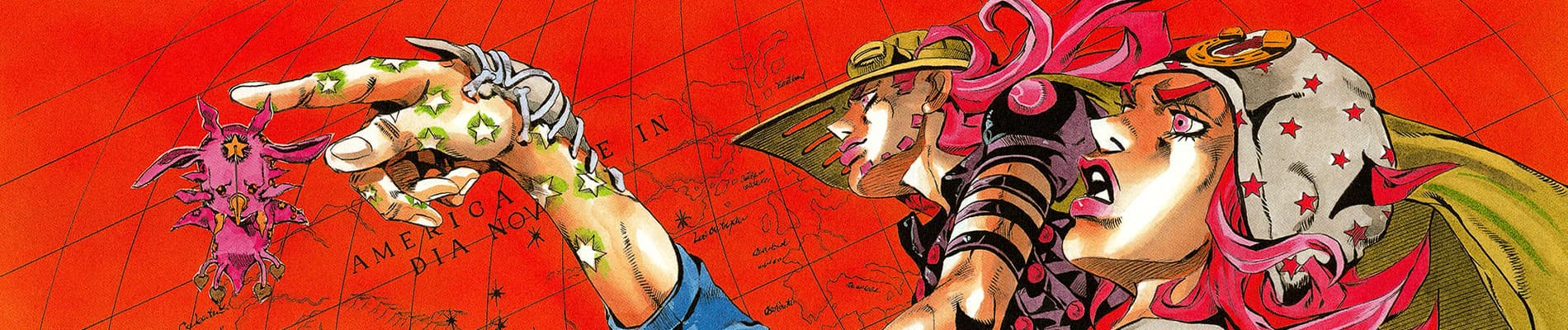
Rereading Steel Ball Run is like realising that the mayhem you had been so fond of, was actually accuracy disguised as a madman. It is not just the finest work of JoJo, but the one in which Araki stopped being a stylist of excess and had become the architect of the storytelling. Evolution does not happen this way, but it is created by human design. Each page is as though an artist had at last come under full control of his own maniacal genius.
On the surface, Steel Ball Run is a race in America, on reread, it is nearly an allegory. It is not about who makes it to the finish line and more about spiritual movement which moves each of the characters. Even the steel balls themselves, the golden rectangles, the never-ending rotation, they are not merely power systems, they are metaphors of persistence, of the endless whirling of the human will. Araki is the philosopher who puts philosophy in motion, violence in revelation. Each and every spin, each and every stand, each and every shot in the desert sounds like an echo of something bigger.
Formerly bitter, Johnny Joestar has since changed to read as a man seeking meaning in a cold world. His change is not a shock, but a revolution - minute, gradual alterations, which culminate in transcendence. His friendship with Gyro Zeppeli is one of the best, in manga: a men-to-men mentorship, competition, and friendship in which both gentles reinvent the souls of the other. Gyro is the desire to act, the beauty of doing things without stopping, and the tragedy of being aware of the inevitability too much. The two characters create a duality that captures the spirit of the whole story, belief and doubt, movement and stasis, purpose and emptiness.
Funny Valentine is another of the few antagonists who are not villainous in any way. He is no wicked fellow; he is a man who is as patriotic as he is frightening. His principles distort morality into mathematics, horrifyingly rational, beautiful logically. It is what Araki said about the nationalism and sacrifice the fact that righteousness can be monstrous when observed through the wrong perspective. And yet, there is honor in the madness of Valentine like Araki wants us to know that even the most ugly ideologies are created through sincerity.
When reread, the absurdities with which JoJo used to be characterized the grandiose poses, the strange stands, the religious imagery no longer appear accidental. They are symbols of a surreal gospel. The proximity of the Corpse of the Saint, the mythical Americana, the intrigues with divinity and rotation all these are used to blend the sacred and the grotesque. Steel Ball Run turns into a spiritual parable which is a Western concealed in the language of movement, pain and impossible grace.
The art of Araki in this case is flawless. The hyperbole in the earlier sections are now perfected in statuesque realism. All the page writing is deliberate, almost structural. The sceneries breathe - the expansive, interminable plains, in which the light cuts like scripture. His treatment of speed, movement and stillness in one photograph is unparalleled. You are able to experience the sand, tension, seriousness of each impact. It has become art that no longer entertains, but uplifts.
Once you reread it with the passage of years, you start to think that Steel Ball Run is not JoJo at their most mature, it is manga itself that is leaving its genre. It is a reflection of motion as life, how even damaged individuals can grace in motion. Johnny does not win in the traditional meaning of the word. He understands. This realization, that the spin is interminable, that everything is united by movement is the thesis of Araki, not only of the story but also of life.
What appeared to be lunacy a few days ago reads like deliberate divinity. Steel Ball Run is not a crazy rebranding of a franchise anymore; it is the completion of all the things which Araki ever tried to express. It is a tale of men running after God through a desert, only to realise that God upon them is their spinning, eternal, beautiful, and wicked.
41.5 out of 42 users liked this review
