This review contains spoilers. It's impossible to discuss it without veering into dangerous spoiler territory. Please watch the film if you have not, it's fantastic.
It is difficult to imagine a more harrowing film than Takahato Isao’s Grave of the Fireflies (1988). Ghibli’s utterly breathtaking hand-drawn art and animations serves as the only respite from the unrelenting, gradually intensifying misery of the two protagonists—a young brother and sister, Seita and Setsuko—who survive in the midst of a rapidly deteriorating Imperial Japanese wartime situation. American B-29 bombers, allowed to roam uncontested by the ravaged Japanese defenders, bellow an irreverent hum as they engulf the sky like locusts. They drop canisters, silently, of slowly trickling fire that rapidly engulfs the dense wooden cities of Japan into vast fields of flame. This is the catalyst (occupying the first ten or twenty minutes of Grave of the Fireflies’ runtime) for Seita and Setsuko’s gradual withering away. Indeed, fire gives way to loneliness, then to scarcity, then to thievery. The procedural emaciation of the children’s bodies, minds, and morals as they are thrust into an impossible independence is unrelenting, inescapable, and, ultimately, destructive. Grave of the Fireflies serves as an immensely impactful illustration of the Japanese civilian experience during the Second World War and also, perhaps, interrogates the viewer as a passive observer, temporarily rendering us as a kind of historian only to force us, when the film is over, to simply return to our lives as normal. After all, as the ghostly figures of Seita and Setsuko demonstrate in the final scene of the film, the societies of today are built atop the graves of many fireflies.
There is an unabashed neutrality to everything in Grave of the Fireflies. There is no huge moral statement made by any of its characters and no definitive evil. The film and its inhabitants treat the Americans and their weapons of vast decimation almost as if they were a phenomenon of the weather, not totally unlike the typhoon which people remark upon near the end of the film. Bombs level cities to nothingness, men shovel corpses into massive piles, yet life seems to simply carry on. Even after his home is destroyed and his mother is killed in an American firebombing, Seita is criticized by his aunt for his incapability to revitalize himself enough to serve his country. A farmer beats and detains Seita for stealing his crops. The adults, who act as a kind of passersby from the perspective of our young protagonists, almost seem to be an indirect evil. They ignore and berate the suffering of our two protagonists, indeed, but are their feelings really all that unreasonable? The American firebombing is indiscriminate in its fury, its reach vast and impossible to fully capture. Instead, we are a spectator for Seita and Setsuko’s moments only.
There is a scene, roughly two-thirds into Grave of the Fireflies, which stands askew from the rest. Young boys stumble across the cave and former home of Seita and Setsuko well after their departure. They toss around various items strewn across the ground, sneering in disgust at the primitivity of the space before them. “Rest in peace!” one boy jokes over a memorial mound, later revealed to be the grave of Setsuko. “Yuck! Ground soybeans!” another boy exclaims with disgust, lifting a cooking pot. The boys treat the cave as if it were a local curiosity, unaware of the tragedy contained within its chambers. These boys, immature as they are, are observers, stumbling across a piece of history, and yet their first instinct is not trepidation or reverence; instead, they judge, pick apart, and laugh at a scene they do not fully understand. This is the epitome of the modern, passive observer when it comes to many such histories. How barbaric and careless people were! In doing so, the scene interrogates our role in the film. Are we, as the spectator, guilty of something similar, only forced to care when presented with the context of Seita and Setsuko upfront?
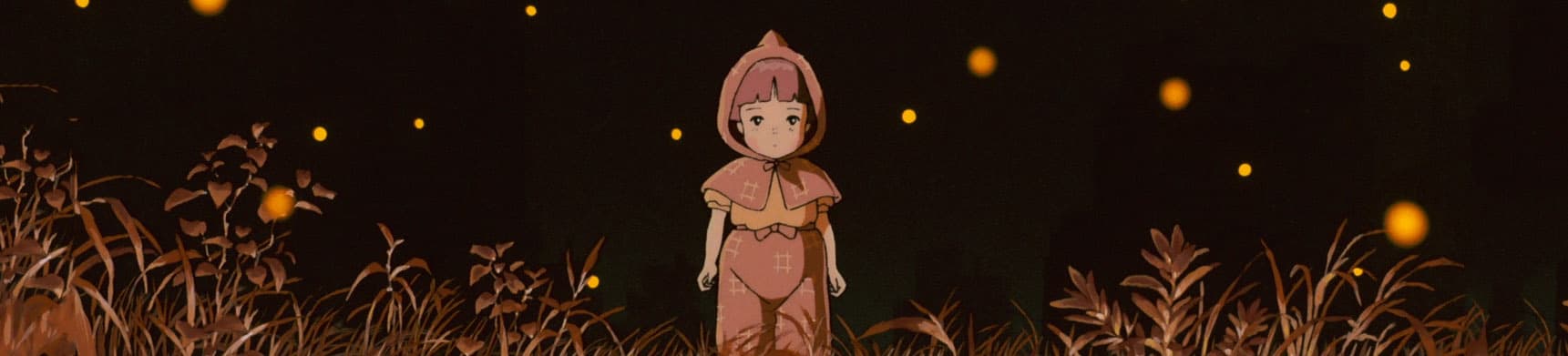
This scene undercuts the scene before it, wherein Seita, fireflies glowing around him, reminisces on an earlier time—a grand Imperial fleet, his father in tow, leaving a harbor bathed in brilliant ceremonial light. Seita’s wistful conceptualizations are for an era now forever elapsed. The fleet and his father, Seita later finds out, are gone. The Japan he knows will, too, soon cease to exist. In such a short life, Seita has seen everything he knows and loves end. All that remains is a hazy image of the past, glimpsed through the ephemeral body of the firefly, its glow set against the abyssal walls engulfing it. “There’s a ghost!” ones of the boys in the following scene yells, fleeing from the cavern’s nostalgic innards.
Indeed, the symbol of the ghost provides the narrative and emotional framework for much of the film. Basked in a soft orange radiance, a spectral Seita observes much of he and Setsuko’s gradual deterioration. An immense sorrow permanently molds his face, becoming even more pronounced as the real Seita resorts to increasingly desperate measures for survival. As the film unfolds and the innocence of the children is progressively stripped away, Seita’s phantasmal presence comes to embody the childlike innocence lost to time. The ghostly Seita is clad in an untattered uniform, untouched by the flames of the American firebombing, almost as if it were his past self, facing the future.
Seita and his ghost are, perhaps more powerfully, a representation of the death of the Empire of Japan. It would be a mistake to directly equate the innocence of Seita, a victim of circumstance, to Japanese military aims and stately conducts, but Seita’s bodily and spiritual demise do have much to say about the general, collective demise of Imperial society. An idealist and son of a military man, Seita remains optimistic in the beginning of the film. More broadly, Japan was the same way, their early sweeps across the South Pacific full of the vigor of a newly powerful state. Then, something occurs to catastrophically alter their being, chipping away at the very essence of their sanguinity. For Seita it is the firebombing, the death of his mother, the probable death of his father, the emaciation of he and his sister; for Imperial Japan it is the reckoning—a rapid series of catastrophic blows in places like Midway, the islands of the Pacific, and the bombings of the home islands—faced when put up against the vengeful spirit of the United States. What remains is the tragic cadaver of a life that could have gone very differently: Seita—a young boy with a full life ahead of him—caught up in the whirlwinds of war, and Japan—a nation that had begun to embrace democracy and personal freedoms in the interwar Taishō—ensnared by its unchecked and unrealistic radical militarism. Indeed, as Seita and Setsuko waste away, ultimately so too does the nation that failed them. In the beginning of the film, as Seita is slumped over in a train station, succumbing to starvation, passersby regard him with disgust. “The Americans will be here soon,” one says. “Can’t have them seeing this filth.” The legacy of Imperial Japan, and everything attached to it, must, like Seita, be swept aside to make way for its rebirth.
In essence, Grave of the Fireflies is a masterful, heart-wrenching tale of bodily and spiritual deterioration. It is, also, a film of infinitesimal depth. The story of Seita and Setsuko serves as a powerful symbol for the immense decimation brought upon Imperial Japan by both the United States and itself. The profound neutrality, the aversion to finger-pointing, that the film provides allows us to just simply wallow in all its tragedy. Grave of the Fireflies is, ultimately, a poignant reminder that we tread on hallowed ground.
34.5 out of 35 users liked this review