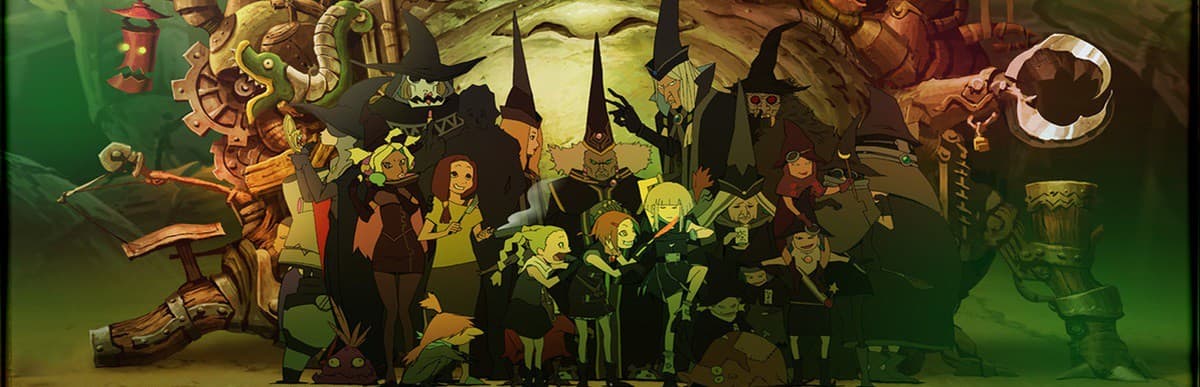
Arusu was an ordinary Japanese preteen who had enjoyed an average, ordinary upbringing. The only particularly strange detail about her life was that her father raised her to believe in magic and witches, which would become her obsession... And he also gave her a large, elaborate book of magical spells that would become her most prized possession. One day, while attempting to retrieve her book from the hands of two of her classmates that she had been messing around with, she starts to receive strange visions, and is instantly transported to a real, genuine magical world! However, society in this world isn’t anything like her fantasies. Witches, warlocks and wizards live in strict opposition to each other, poorly performing witches get banished to the human world, fairies are captured and exploited for their magic power, and it turns out her book is some crazy magical artifact that holds the key to world domination! With two new friends at her side, Arusu sets out to not only survive this world, but to change it.
Tweeny Witches was produced by Studio 4°C, and if I’m being perfectly honest, I’m not a big fan of theirs. They’re probably one of my least favorite Japanese animation studios. You know that effect some anime sometimes use called the runny eggs technique, where the animators temporarily give up on consistent character model framing and turn a character into some kind of broken, twisted monstrosity to heighten their articulation and/or emotional resonance without spending any extra money? Sword Art Online and Toradora are good examples of this, in fact it was my one complaint about Toradora particularly. Yeah, Studio 4°C basically built their resume on this style, and I want to be clear about this, it IS a style. It’s a very deliberate artistic choice to utilize this aesthetic, it’s not necessarily an issue of budget or quality. Some anime will dip into this technique in short bursts for various reasons, but other anime... Particularly anime produced by Studio 4°C... Will use it as their main auteurist aesthetic, once again, for various reasons.
Because it is its own distinct style, your take on it will be entirely personal. You can’t really assign a specific level of objective quality to it, you can only go off of your own personal tastes, and I’ll stop burying the lede, I hate it. I’m not saying you’re wrong for liking it, or that my sense of taste is better than yours, but I really do not like this style. I think it looks ugly as fucking get out. I don’t like the angles it uses, I don’t like how it makes characters look, and on an even more personal note, I don’t like that it’s always being done on purpose by people who could very well draw and animate far more visually pleasing characters if they wanted to. Granted it’s not always bad... Certain anime like Mind Games have deliberately leaned into how uncanny it looks to hit a certain bizarre mood with their stories, which I do support... And I haven’t seen Memories, which I think also uses it, but I’ve heard good things, so maybe that’s an exception as well. Either way, any anime using this style is fighting an uphill battle with me.
Tweeny Witches uses this style, and yeah, no surprise, it looks ugly as fuck. It’s also really poorly directed during these sequences, with some truly laughable close-ups, and genuinely questionable cinematography choices. Thankfully, it doesn’t always do this. It can slow down and look like a normal anime sometimes, especially during more tense or dramatic moments, which is a blessing, because at least they knew better than to undermine the material that they wanted us to actually take seriously. The runny eggs technique mostly pops up during action scenes, and in comedic scenes where Arusu is interacting with her friends and certain other people. A lot of these shots happen during lengthy conversations, which is kind of similar to the way Akiyuki Shinbo’s style is sometimes used. There’s also CG animation peppered throughout, but it is not integrated very well, and it looks jarring as fuck more often than not, especially when it’s used to animate actual characters flying.
I should add, when the story actually WANTS to look cool, it usually does succeed. With more dynamic visuals like Arusu’s visions and the unspoken episode previews at the end of the credits(which I do not recommend skipping) the visuals are far more striking and dynamic, especially in the ways they’re lit and shaded. Part of this is due to the fact that behind all the messy animation, the actual design work in this show is pretty badass. Every single environment, from the more traditional fantasy aesthetic of the witch kingdom, to the more futuristic look of the warlock realm, to the suffocating expanse of the wasteland inbetween them, and especially the occasional ruins, look amazing. Even the forests, deep and dark and bordering on unnatural, never feel even slightly generic. Granted, only a handful of characters really stand out visually, and a few of those stand out for the wrong reasons(I enthusiastically dislike the design of Lennon), and I didn’t care for how the interior of each character’s hair is shaded green. Still, the fairies look cool and diverse.
I don’t usually talk about music anymore, but I did have a few comments to share about the opening and ending themes of this show. The opening is, well, not great. The song is okay, it sounds like a perfectly pleasant minor instrumental tune that you might find on one of those celtic CDs they used to sell in the candle aisle at Walmart, but the accompanying visuals are just randomly chopped up and sewn together clips from the show, and this is by no means the only anime I’ve ever seen do that, but I don’t remember ever seeing it done this badly. The clips aren’t even mostly good looking clips, and they don’t flow together at all, especially not in time with the music. The ending theme is a little better, it’s just shots of the girls flying, accompanying a pretty little Japanese cover of a fairly common ballet ballad. Still, I found myself skipping both of these while watching most of the episodes.
The English dub was produced by Animax for a south-eastern Asian release prior to its stateside distribution, and I’m kind of torn, because sometimes, it damn well feels like an anime that wasn’t specifically dubbed for native English speakers. There are names in this cast that I’ve never heard of before or since, and a few of them don’t make a great case for themselves in general. On the other hand, the main three protagonists are played by some genuinely talented voice actors who were veterans at the time, and are still working today. I mainly know Julie Maddalena from Battle Athletes Victory and Monster High, and she imbues Arusu with enough strength and passion to sell her as an earnest beacon of hope, rather than letting her idealistic platitudes make her sound annoying. Cindy Robinson has to go to some dark places as Sheila, the loyal follower who has to face tough realities about the people and system she believed in, and Mela Lee... I mean, she’s a good actor in general, but sometimes she does this high pitched young girl voice that hits my ears like artificial sweetener... Think Rena Ryuuguu, but without the psychotic duality to make it interesting... I don’t like it, but it could be worse.
One final note about the dub is that anime really seems to like naming characters after the titular protagonist of Alice in Wonderland, which is unfortunate because they always fuck up the pronunciation, and more often than not, the resulting English dub winds up carrying that burden. Thus, Alice becomes Arusu in both languages, and I really wish this particular anime had taken the initiative to fix this problem and just called her Alice. In any case, it’s a mixed bag of a dub, but it’s serviceable enough.
If you couldn’t tell from my comments on the opening, this show does not make a very good first impression. Before we even get to the story itself, we have to look at the amount of shit you have to swim through to even watch an episode proper. You start by panning over this weird mural that I’m sure had some deeper meaning to the story, but I never got it, and I enjoyed the story just fine. After that, you get a previous episode recap, and the opening. That doesn’t sound too bad, right? Well, it’s not, except for in the most important area possible: The first episode. The first episode, you have to go through all this, and if you’re wondering how they give a previous episode recap before you’ve even seen the first episode, don’t worry, they found a way. Before you’ve even met Arusu as a character or seen her journey, you have a narrator telling you about her and how she got isekaid.
Then, after the opening credits, we catch up with her in the other world, SHE tells you who she is and how she got there. And then, halfway through the episode, you finally get to see how she got there. That is the exact order all of that happens in. Instead of just starting the damn episode by showing us Arusu’s origin, you have it explained to you twice before it’s shown to you. This isn’t just getting off on the wrong foot, this is hopping up and down on the wrong foot while chanting “Drop me, drop me, drop me!” Which is a real damn shame, because once you get over this little speed bump that’s parked right outside of the gate, Tweeny Witches is actually really good. I’m sorry to drop that assessment on you so early in the review, but this is a show with a very complex and intricate plot that I can’t say too much about without getting into some pretty heavy spoilers.
What I can say is that the actual plot set-up is a fairly familiar one. It’s your basic fish out of water story where a newcomer in a strange land has to both adapt to their surroundings, and bring about some necessary changes to their world in the process. Granted, this sort of story doesn’t always work... There’s a line of cultural disrespect that is far too easy to cross, and it can sometimes come off like the world was made unbelievably stupid or dysfunctional so the main character can come in and fix it, which can wind up feeling idiotically naive at best, and condescending at worst. This happens in basically any story where a normal person suddenly becomes royalty, it’s the basic plot of Idiocracy, I’ve seen more than one isekai anime where the protagonist uses knowledge from the internet to teach people how to do basic things they should have figured out generations ago like sustainable farming techniques.
There is a way to make this work, though, and I wish I could be more straightforward and specific with this, but you have to find some way to make the world the protagonist is entering make sense, at least to the people who live there. People who have to be told they don’t have to eat rocks might as well just keep on eating rocks. Thankfully, Tweeny Witches does find a way to pull this off. There are a lot of problems with the magical world, but every single detail of it is intricately woven together into a technically functional, but by no means ideal, society. The first issue that Arusu notices is the subjugation of fairies, which she strongly opposes, because she believes they should be free. According to this society, fairies are the source of magic that witches draw upon, so letting them go free would cause their society to gradually collapse, so you understand WHY their society is like this, but Arusu’s point is still valid, as not only is slavery wrong, but their usage is a disturbing taint on what her father taught her about magic making people happy.
This creates a highly nuanced situation where you, as the viewer, have no idea what the right answer is, but you’re encouraged to have faith that somehow, some way, Arusu will be the force of hope who finds it. And of course, the plot thickens from there, as Arusu’s actions, however noble, set off a chain reaction that threatens a possible armageddon of the magical world, as secrets about the true nature of the world come to light, and multiple different factions with drastically different outlooks and goals engage in a conflict against one another that keeps getting worse and worse, the stakes keep getting higher and higher, and Arusu and her friends are constantly involved in all of it, and never in ways that feel forced or unnatural. They grow and change as the plot challenges them and their beliefs. They make mistakes, and sometimes they make the wrong choices, and the situation keeps unraveling in the most chaotic, but more or less logical, ways possible.
I guess you could say that the plot can get a little convoluted and overly complicated at times, and if you’re not paying attention, it’s easy to get lost in multiple spots. This is not the kind of anime you want to watch while browsing on your phone. The pace moves very quickly, the narrative does not hold your hand and make sure you’re paying attention, and admittedly, this can make it a little hard to follow at times, which is especially unfortunate, because aside from that one detail, Tweeny Witches would probably work best as a children’s show. Personally, I could see myself liking the animation and art style a lot more if I were watching it as a kid, I also just generally paid a lot more attention to what I was watching back then. Actually, I’ve noticed that Little Witch Academia seems to have taken some influence from this series, and it wouldn’t be unfair to call that show the fully realized version of Tweeny Witches. Still, I do recommend this series, if you’re looking for a hidden gem to add to your spooky october watchlist.
Tweeny Witches is out of print from Media Blasters, but it’s very easy to find a cheap copy on Ebay. Honestly, the old box set is designed to look like Arusu’s book, and it looks pretty cool. A six episode OVA is also included in most releases.
Tweeny Witches is not a terribly deep or meaningful anime. What it is, though, is thoroughly well written and executed. The plot is engaging and constantly developing, and the story never gets boring or stale. The characters who matter are likeable, the ones who don’t are largely forgettable, and while there are a few specifically intended antagonists, it’s hard to say any character is entirely in the wrong, as their motivations make sense, and everyone is reacting to the threat to their world in their own believable ways. That threat, by the way, is taken exactly as seriously as it deserves, in a story that thoroughly understands its own stakes, and it gives you plenty of reasons to care about it as well. The visual style isn’t really my thing, so I do have to knock off a point for that, but your experience may vary, so I do think it’s worth checking this show out and seeing if it casts a spell on you.
I give Tweeny Witches a 7/10
9.5 out of 11 users liked this review