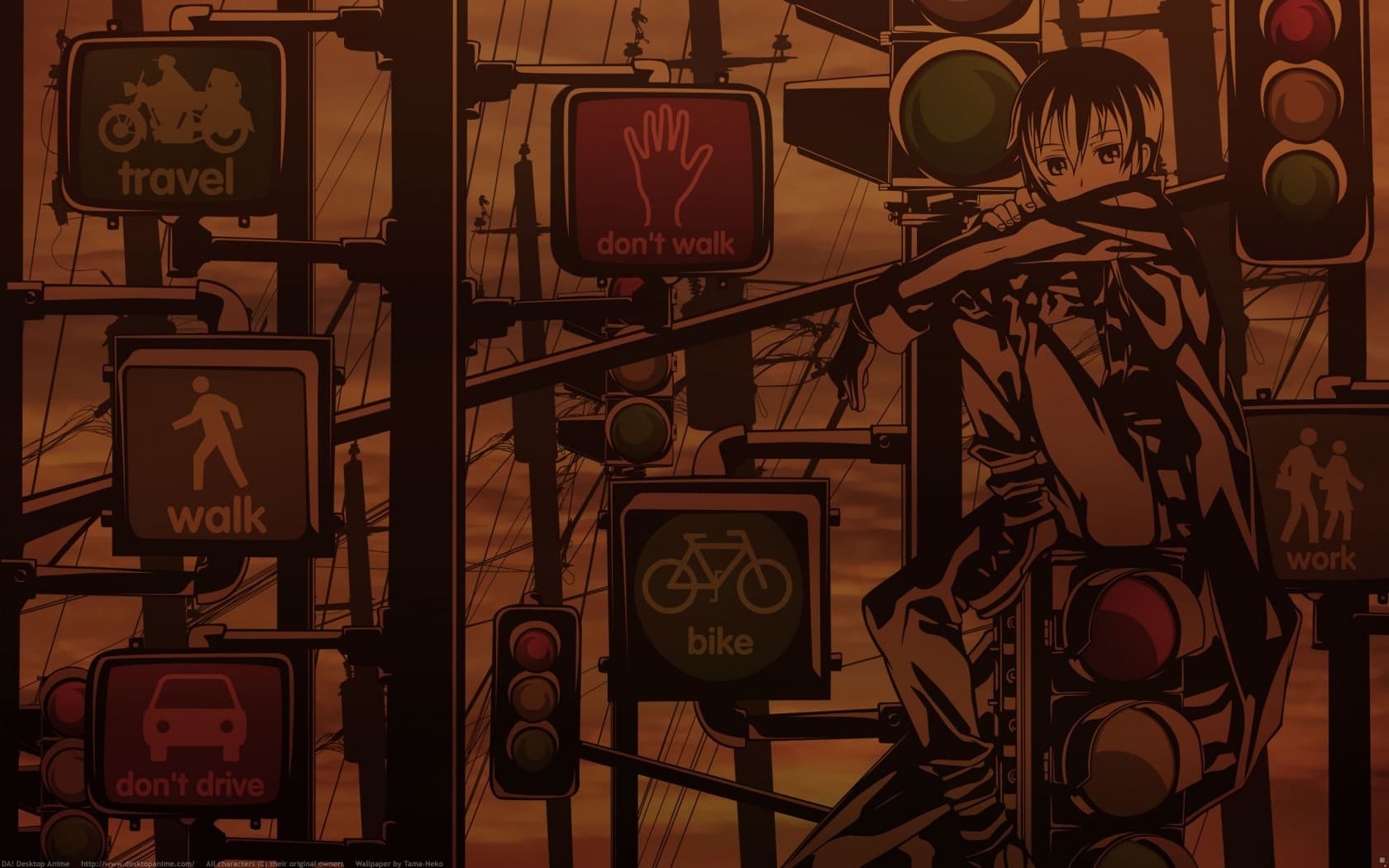
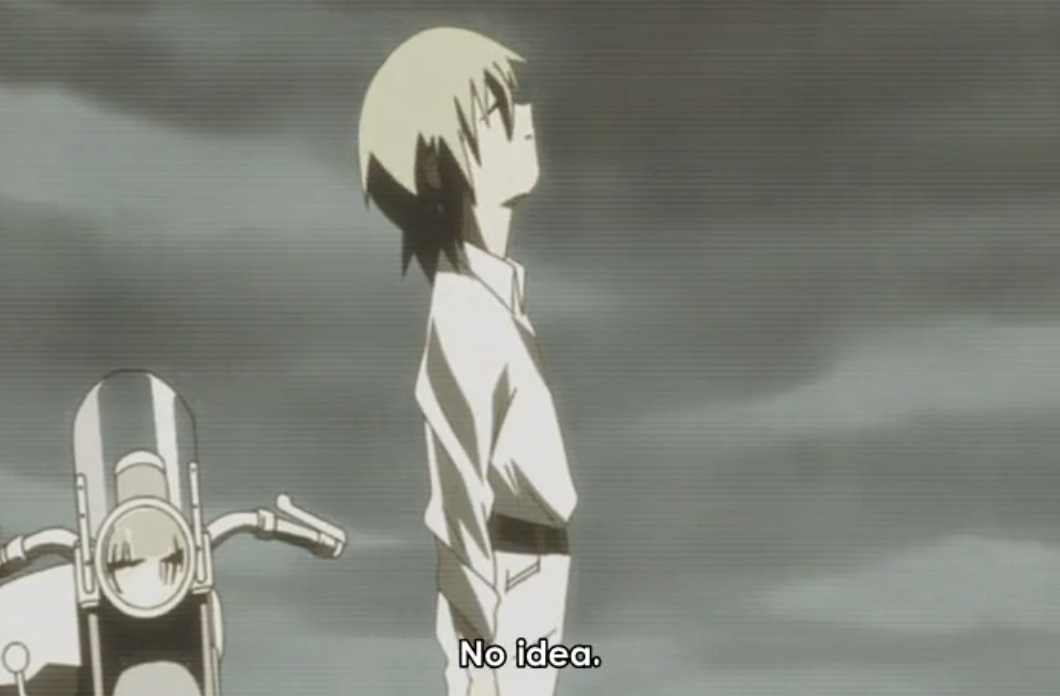
Kino's Journey(2005) was truly one of a kind for me. While it was the only part of the series I've seen before making this review, I still felt it warranted a materialization of my feelings.
[Disclaimer: I've only seen Kino's Journey (2005). This review WILL have spoilers so please don't read if you don't want to be spoiled for the first season. When referring to Kino, I will most of the time just use Kino. But when needed, I will refer to Kino as "she" AND "he" and I will refer to the original Kino as "he" or "Kino the Traveler"]
Going into this, I expected it to be another non-mainstream-12/13-episode anime that wouldn't have any effect on me but this really did grow on me. It was extremely hard to get into this from the first episode but after pushing through that, the show really grew on me.
Throughout this, I didn't exactly get to see Kino grow as a character; Aside from seeing Kino become Kino, it was more like seeing parts of his character open up for the viewer to see. It was always there, just not at first glance. And on this, I found Kino's character really interesting. After the original Kino died in her place, she ceased to be—both spiritually and physically—as she consumed Kino's identity as The Traveler Kino. With this, he lives on while the nameless girl died there in her hometown street.
Honestly, sometimes I wanted him to step in in some societies where things were obviously not right, but he always seemed rather impartial in his actions and cared about learning the culture/history and helping people who wanted it but attacking if he needed to. For example, he very much could have attempted to prevent the military crusade on the country stricken by the sad poet's woes but he drove on. And he could have told the railroad workers they'd be working for the rest of their lives potentially but he drove on. At first, I started to think he had a "leave no trace" type of mindset, but over time I grew to understand him seeing the beauty of each society and the world as a whole. From the travel there, to the people and the culture, it was the experience that he lives the way he lives for. Seeing some of the countries Kino visited caught my attention in the way they mirror some of today's or yesterday's countries. From countries who are so developed, they've got machines to do everything for them (such as the country whose people worked behind desks on solely computer calculations or the country whose people used machines so they wouldn't be around anyone else) to countries that are less developed (such as the country who discouraged their citizen, Nimya, from building a plane). Or countries who hold values that many countries hold today: Countries who value religion and crusades (the country who attacked another because a poet's book was interpreted so) and countries who have traditional values (Nimya's country, where she was discouraged by her husband and the town to build a plane and achieve her dreams other than being a proper wife). It was interesting to not tie any of these to any specific country, but recognizing them only being slightly extreme representations of different societies to be dystopian.
One of the details I appreciated throughout the show was how some people recognized Kino as a "Mr." or a "Sir" whereas some of them knew he was a girl. I found the country who murdered any discord in the name of democracy to be just as ironic as the country of people who so desperately wanted their own culture, they unintentionally created their own culture.
My favorite part of the series was seeing Kino fight in the Coliseum arc. Listening in on the conversations he had during the tournament matches, he displayed his reluctance to taking life. The fatal shot of the king was epic! i loved it so much. It was also interesting to see Kino interact with the queen's son, Shizu, and Hermes with the talking dog during and after the tournament. I think the fleeting-ness of these short lived conversations with people whose paths he'll (most likely) never cross with again gives a sort of estrangement or emotionally distant feeling. Kino's ability to be able to let go of people that he meets almost immediately is quite interesting and I hope they go into it in the parts of the series that follow after.
The ending song, "The Beautiful World" by Ai Maeda, was like a kiss after each episode. Maeda's vocals are divine and the instruments in the back set a bit of a different tone from the show but it compliments the theme of the world being clashing and beautiful. Hearing it after each episode could almost serve as a reminder that not every place, not every country, not every society is beautiful—and therefore, it is. Published: November 1st, 2025